Successful sales teams identify the right accounts faster instead of prospecting more accounts. They can identify which accounts are in an active buying cycle before competitors contact them, and this precision often arises from B2B sales intelligence platforms.
B2B enterprises often build their pipeline from a static list, gut instincts, and firmographic filters, which incurs an invisible cost, where sales reps push for accounts that never were going to buy. Databar.ai’s analysis finds that reps waste 27% of their selling time due to inaccurate data.
Beyond a sales activity issue, prospecting inefficiency is a problem tied to information. Sales teams that accelerate their growth often spend more time engaging qualified buyers than identifying them.
How Do Sales Intelligence Tools Improve B2B Prospecting?
Poor prospecting performance is often attributed to list quality, but in reality, the real constraint is timing rather than targeting. Prospects will never respond, despite perfect targeting, if they are not in the active buying cycle, and at this stage, sales intelligence tools for B2B improve contact timing.
The buying window in B2B is very short, and therefore, timing becomes a distinguishing factor. By the time reps contact buyers and the formal evaluation process becomes visible, a shortlist is already formed, typically within 2 to 4 weeks.
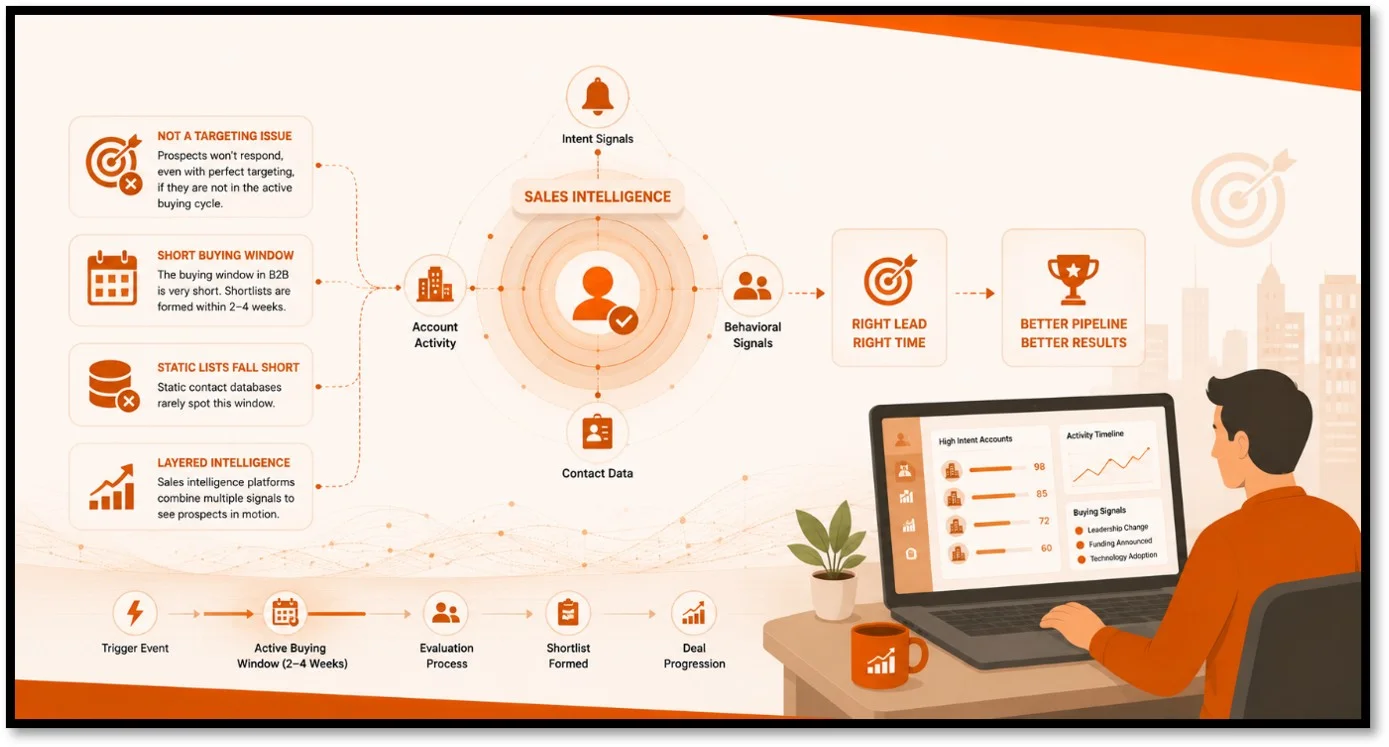
B2B sales prospecting tools that operate on a static contact database hardly spot this window, but sales intelligence platforms layer account activity, intent data, and behavioral signals on top of contact data to help reps observe prospects in motion.
Sales intelligence finds the correct leads at the right moment, and it eliminates prospecting activity that might not build a pipeline.
How Does Intent Data Help Sales Teams Find Prospects?
As most B2B teams invest heavily in intent data to employ it as a sophisticated filter, many implementations often underperform. More than a prospecting filter, intent data for sales teams acts as a prioritization and timing engine.
Intent signals answer three categorical questions that a contact database cannot:
- Which accounts research a solution actively in the category?
- Which contacts among those accounts lead the research?
- Which comparison criteria and key concerns drive their evaluation?
According to SalesGTM.ai’s research, intent-driven targeting boosts reply rates by 30-60% and a 2-3x boost in meetings booked compared to sequence-based outreach against static lists.
Sales reps have more context when they are aware of a buyer comparing competitors’ pages, engaging review platforms, and consuming category-level content than reps operating on static lists.
At this level, instead of automating the outreach volume, AI powered sales prospecting routes the right reps to the right accounts at the right time, and with the right context.
Beyond improving conversion rates, sales intelligence reduces the pipeline generation cost by making sales reps focus on accounts that are more likely to close in the current quarter.
How Sales Intelligence Improves Pipeline Generation?
B2B teams often celebrate pipeline volume as it means more prospects, more deals, and more meetings, but it is the metric that never fails to mislead them. A pipeline full of poorly timed, low-intent leads not only makes forecasts inaccurate but also consumes rep time that could have been concentrated on moving deals.
Sales intelligence for lead generation contributes by refining the pipeline. It improves the prospects entering the pipeline in the first place, and predictive lead scoring follows.
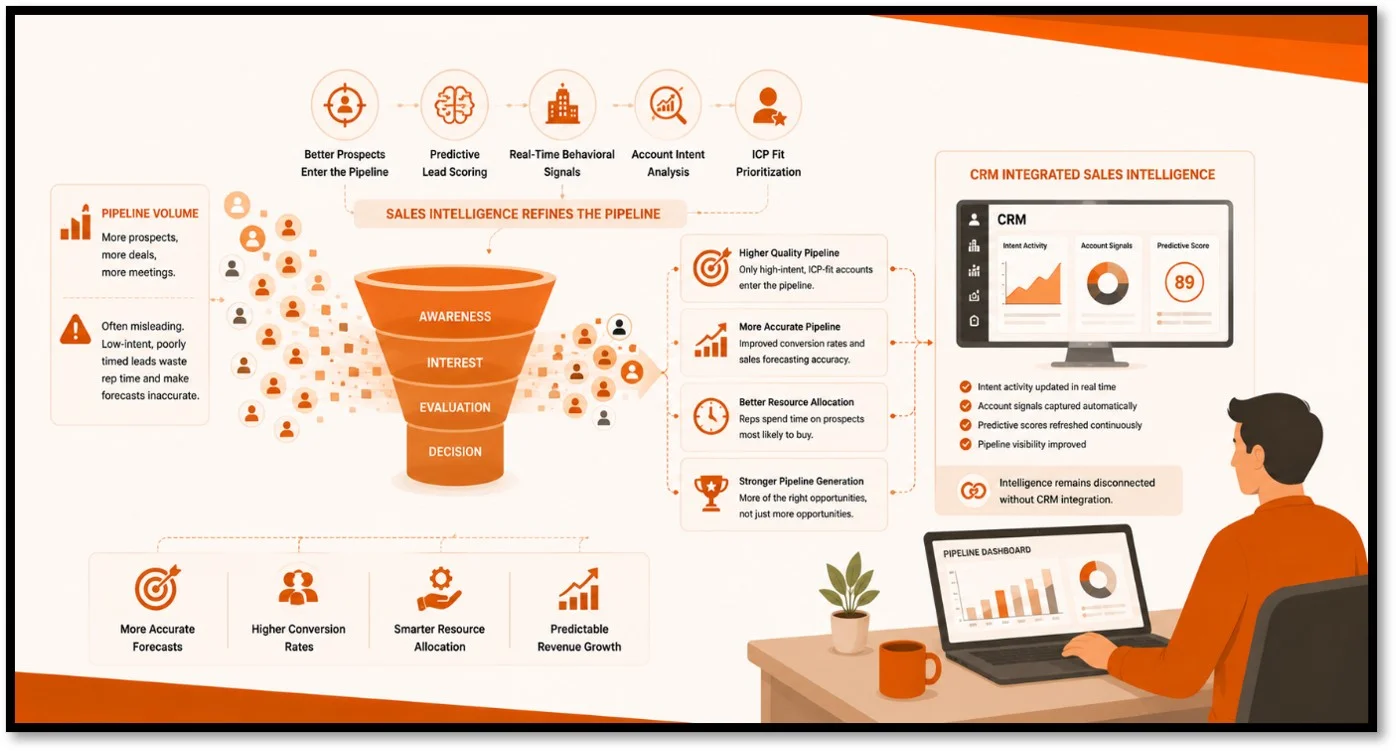
While conventional lead scoring frameworks relied on firmographic fit, modern predictive sales analytics platforms combine firmographic attributes such as company size, revenue range, job title, and industry with real-time behavioral signals.
ICP-fit accounts demonstrating correlated intent signals are ranked higher than leads showing no buying behavior, despite being ICP-fit. The pipeline becomes more accurate, increasing sales forecasting accuracy. More than prospect discovery, resource allocation offers the biggest advantage.
CRM integrated sales intelligence bolsters this advantage, where intent activity, account signals, and predictive scores are updated inside CRM automatically to improve pipeline visibility. Intelligence remains disconnected without this integration.
What Are the Benefits of Sales Intelligence for SDR Teams?
Although sales intelligence software for SDR teams emphasizes real benefits like faster list building, reduced manual research, and automated enrichment, they are often the strategically least important outcomes of a well-deployed platform. Optimizing for these benefits only amplifies the broken prospecting motion.
SDR teams must treat context as the transformational benefit over speed. An SDR reaching a prospect on a specific trigger can hook the lead even before completing the first sentence.
AI lead scoring tools further improve prospecting efficiency, changing the SDR role’s nature. AI SDR Shop’s 2025 analysis finds that AI-driven systems, using intent signals, can boost meeting conversion rates by 50% with a 15-20% increase in reply rates.
The SDR’s role shifts to interpreting and acting on signals, which matters for SDR retention and SDR performance. Most B2B teams deploy sales intelligence data platforms for list building and enrichment, extracting only a fraction of their value.
Enterprises that extract the strongest outcomes ask, “Why should this account hear from me today?” instead of checking on whom to contact.
Final Thoughts: How Sales Intelligence Platforms Improve B2B Prospecting?
Sales intelligence for B2B prospecting is an entirely different model, beyond incremental upgrades, transforming the way of deciding which accounts to pursue, when, and what to communicate to them. Using the model as an accelerated list-building tool will offer marginal improvements.
Whereas B2B teams that devise a prospecting workflow around surfacing signals can control how the pipeline is built, how sales allocate resources, and how SDRs operate.
As real-time account signals enrich and AI-driven intent frameworks mature, the gap between teams using account intelligence platforms and those using traditional prospecting will widen. This gap will never be filled by adding headcount.
Want to identify where your high-intent buyers reside? Contact the Knowledgeboats team to find sales intelligence solutions for B2B to predict which accounts are currently active in the buying cycle.
FAQs
1. What are the benefits of sales intelligence tools for sales teams?
Along with helping the sales team in identifying high-intent prospects, sales intelligence tools prioritize outreach, reduce wasted prospecting effort, increase conversion efficiency, and improve pipeline quality.
2. How do sales intelligence tools integrate with CRM systems?
Sales intelligence platforms integrate with CRM systems as they sync account signals, predictive scores, intent data, engagement activity, and contact updates automatically into prospect records.
3. What is the sales intelligence strategy for B2B companies?
Sales intelligence strategy integrates behavioral signals, intent data, and predictive scoring with CRM systems to emphasize accounts showing buying readiness instead of reflecting static demographic fit.
4. What features do sales intelligence platforms offer?
Common features of sales intelligence platforms include CRM integration, predictive lead scoring, contact enrichment, technographic insights, account intelligence, buyer intent tracking, AI-driven prospect prioritization, and sales alerts.
5. How does predictive lead scoring for B2B sales teams improve prospect prioritization?
Predictive lead scoring simultaneously evaluates buying behavior and account fit, which allows sales teams to focus on prospects reflecting the highest probability of converting rather than depending on demographic criteria.