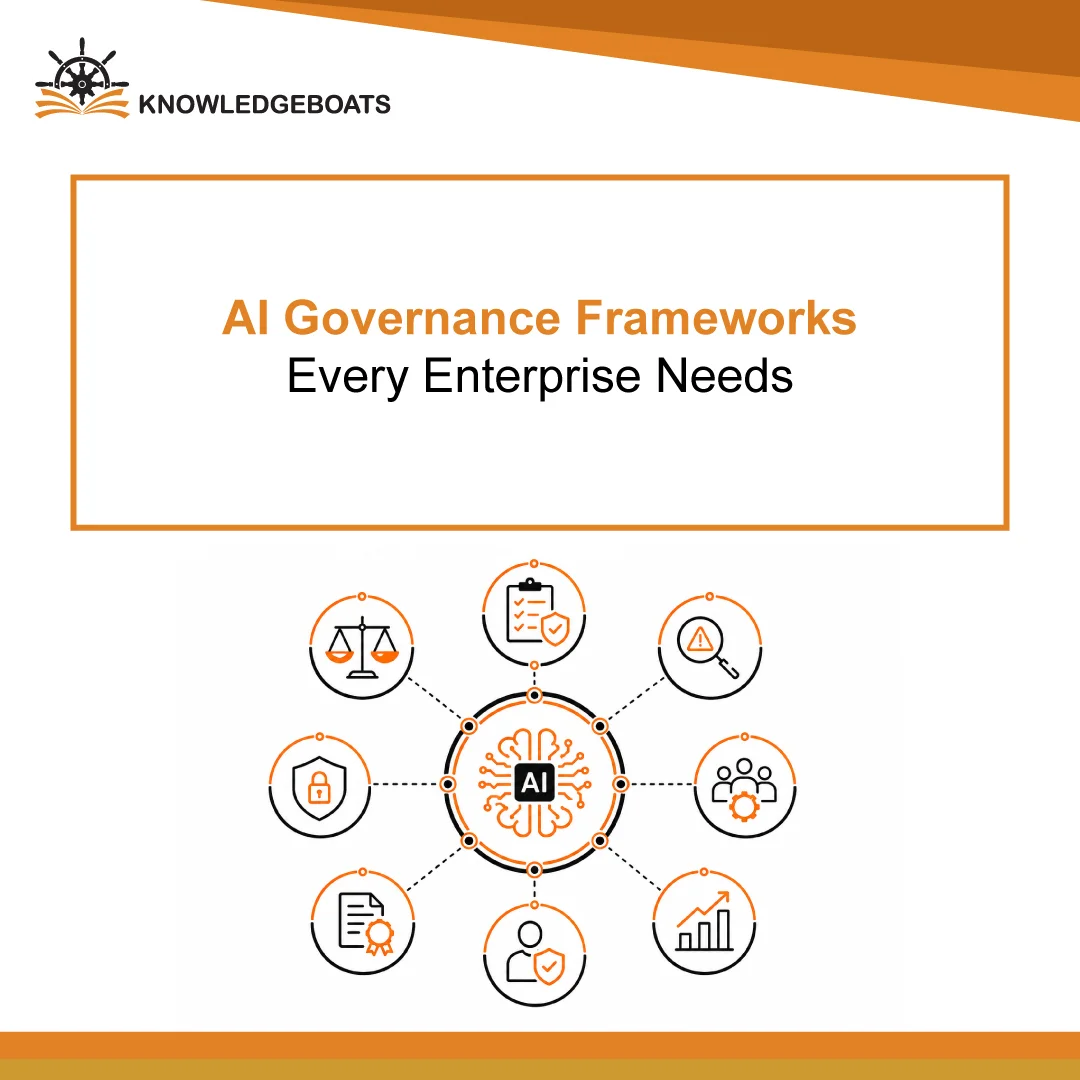
B2B enterprises that lack AI governance frameworks end up accumulating risks, as they do not have a system to forecast, contain, and correct them. The framework allows teams to deploy AI at scale. It ensures that B2B enterprises maintain accountability across all models that support business decisions.
However, many B2B teams treat these frameworks as compliance requirements. AI often fails due to poor governance rather than bad models. According to The Daily Brief’s 2026 report, 70-85% of enterprise AI compliance efforts fail to deliver their expected value.
The governance gap erodes models by producing biased outputs even before the external compliance pressure surfaces. Rather than a legal function, AI governance is an operational infrastructure decision.
What Is an AI Governance Framework
The enterprise AI governance framework is conventionally defined as a set of processes and policies guiding responsible AI deployment and development. Though the definition is accurate, it is operationally incomplete, as it merely explains elements of governance rather than describing what it does under pressure.
Most B2B teams develop their governance models as documentation libraries, and they hardly control production drift, unreviewed AI deployment, and evidence-demanding regulatory audits.
A responsible AI framework differs from the governance framework in many aspects. While the former describes intent, the latter emphasizes enforcement, and B2B teams integrating these two often develop ethical AI principles.
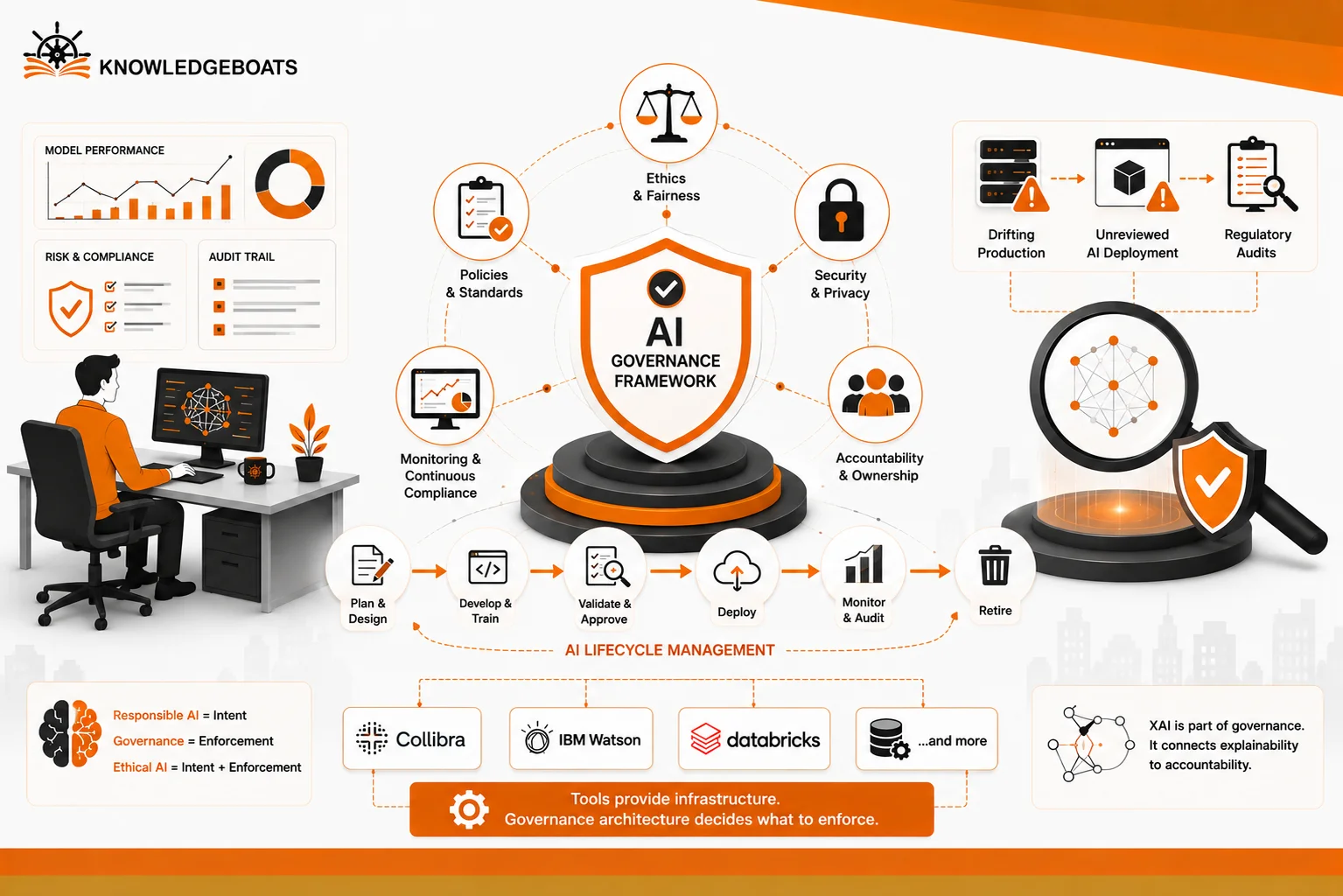
Explainable AI (XAI), on the other hand, is a component of governance, and the complete framework connects explainability to accountability. AI lifecycle management stands at the core of the governance framework, and the framework that merely covers model approval or deployment without monitoring or retirement often dresses as governance.
Although Collibra, IBM Watson, or Databricks develop lifecycle-tracking infrastructure, only the governance architecture can determine what these tools enforce.
How to Build an AI Governance Framework
Developing AI governance regulations often begins at policy design, but it is the wrong beginning. The governance framework developed around mere policies instead of operational controls produces documentation that satisfies an auditor but fails at a production event.
Gartner finds that inconsistent global AI standards and cross-border misuse will give rise to 40% of AI data breaches. Beyond oversight authority, ideal governance also needs enforcement capability.
Instead of adding controls before audits, governance must be embedded into AI delivery. The following steps build the AI governance strategy:
- Define an AI governance committee. Define clear ownership across data science, legal, compliance, security, and business teams.
- Segment AI use cases by risk. While operational automation needs lighter oversight, consequential decisions demand the most rigorous review cycles and highest governance controls.
- Establish AI governance policies and controls. Each policy must reinforce a specific control, making non-compliance detectable and compliance observable.
- Implement explainable AI governance. High-impact AI systems must be transparent for customer explanations, regulatory investigations, and internal reviews.
- Deploy continuous AI lifecycle management. Beyond deployment, governance is ensured by monitoring drifts, biases, performance degradation, and results.
- Conduct AI governance documentation and audits. From approval to retirement decisions, every model must maintain detailed documentation.
What Are the Key Components of an Enterprise AI Governance Framework
Despite using the same number of foundational components in the AI governance model, the implementation depth of each component distinguishes the framework working under pressure from those operating only in documentation.
AI governance checklists often assume components to be sequential deliverables, but practically, siloed component delivery causes the governance to fail. The maturity of AI model governance is measured by the orchestrated functioning of components upon an incident.
The following comparison table analyzes governance maturity across different components and different levels:
| Component | Initial Level | Defined Level | Operational Level |
|---|---|---|---|
| Inventory | Add-on list of AI tools with significant gaps. | Embedded model metadata in centralized registry. | Auto-updated registry integrated into deployment pipeline. |
| Risk Classification | All models are treated equally. | Defined risk tiers, while high-risk models are specifically labelled. | Tiers track review depth, monitoring frequency, and escalation protocols. |
| Accountability Structure | Generic AI policy. | Every role is documented. | Model owners are completely accountable. |
| Monitoring and Alerting | No production monitoring. | Dashboard monitoring. | Trigger-defined response alerts. |
| Audit and Explainability | Undocumented model decisions | Explainability reports are produced for high-risk models on demand | Automated audit trails for all consequential decisions. |
What Is the Best AI Governance Strategy for Businesses in 2026
The enterprise AI strategy in 2026 is built around the following three decisions:
1. Centralized vs Federated Governance Architecture
While centralized governance poorly scales with growing AI deployment volume, federated governance scales with the company. However, the latter asks organizations to have domain competency, which they hardly possess at deployment.
Neither is completely sufficient, and that is why a hybrid approach works best. Enterprise governance controls standards, whereas domain teams share responsibility to monitor AI systems.
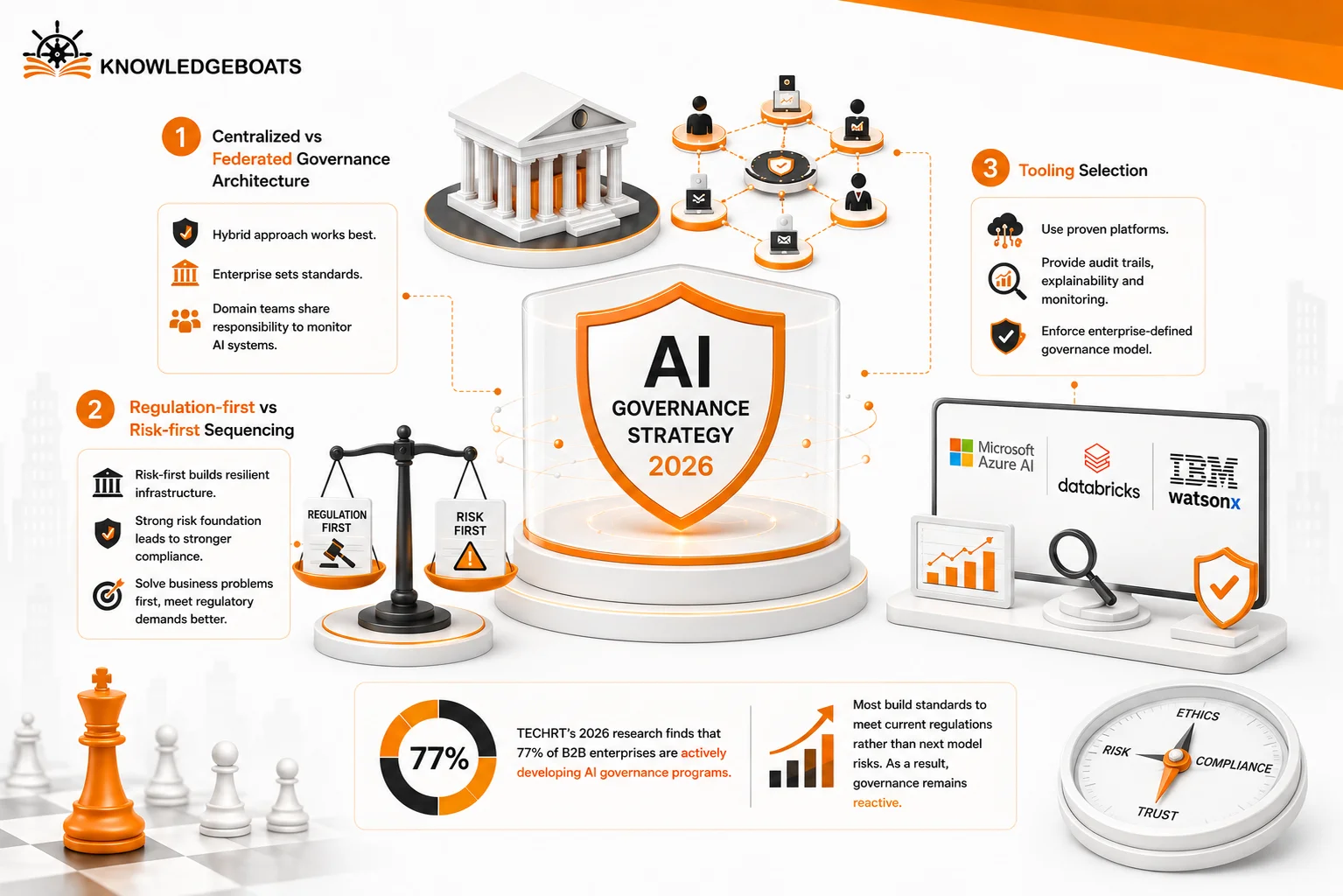
2. Regulation-first vs Risk-first Sequencing
B2B enterprises that prioritize satisfying SEC model risk guidance or the EU AI Act end up building an AI governance and compliance framework, while teams focusing on managing operational model risks often develop resilient infrastructure.
Both are equally important; however, teams adopting a risk-first framework develop stronger compliance programs because it addresses business risks before regulatory demands.
3. Tooling Selection
Instead of developing their own framework, platforms like Microsoft Azure AI, Databricks, or IBM Watson enforce an enterprise-defined governance model by providing audit trail infrastructure, explainability, and monitoring.
TECHRT’s 2026 research finds that 77% of B2B enterprises are actively developing AI governance programs. However, most of them build their AI governance standards to meet current regulatory requirements rather than matching the next model risks. As a result, governance remains reactive.
Final Thoughts: Why Is an AI Governance Framework for Enterprises Important
AI governance for enterprises is an operational infrastructure that must evolve with a changing regulatory environment, the company’s model portfolio, and the AI landscape. When the governance is enforced in production and performs under real failure conditions, it is the best governance framework an enterprise has built.
Autonomous AI systems will have a greater decision impact, and this will benefit B2B teams that have real operational AI governance implementation, while those prioritizing only documentation will be at regulatory risk.
If you want to find out if you are at that risk, contact Knowledgeboats and identify existing gaps in your framework that will cost you the most in the upcoming regulatory review.
FAQs
1. How do enterprises implement AI governance?
B2B teams employ governance by defining ownership, classifying AI risks, enforcing governance controls, continuously monitoring models, maintaining documentation, and integrating governance throughout the AI lifecycle.
2. What are the best AI governance frameworks?
ISO/IEC 42001, enterprise-specific governance models, NIST AI RMF, and OECD AI Principles are a few frameworks that offer a strong operational foundation and depend on business requirements.
3. How does AI governance reduce risk?
AI governance monitors AI systems continuously, detects biases and drifting models early, enables rapid incident response, and enforces accountability to reduce risks.
4. What are the key components of AI governance?
Continuous monitoring, governance ownership, incident response, lifecycle management, AI policies, risk assessment, explainability, and audit documentation are some key components of AI governance.
5. How does AI governance support compliance?
AI governance develops transparent documentation, produces evidence for regulatory reviews, maintains auditing trails, and enforces governance policies while supporting compliance.