More than with a better rep or a promising product, vendors win deals in 2026 by mapping and engaging the entire B2B buying committee before evaluation, where every stakeholder influences the buying decision.
Most B2B teams believe that an individual champion makes enterprise purchasing. They stop after sending a sequence to one prospect, routing a single lead, and developing the pipeline around one contact.
However, the future of B2B purchasing will shift from being account-centric to buying committee-oriented buying. Geisheker’s 2026 research finds that B2B enterprises often involve 6-10 stakeholders across different departments.
The increasing number of stakeholders in a buying committee hardly raises the buying complexity. The intricacy often increases because every stakeholder consumes different content at different stages via multiple channels.
What Are B2B Buying Groups
Conventional definitions of B2B buying groups describe them as groups of stakeholders that collectively govern a buying motion, but this definition is operationally incomplete. Most B2B teams add a list of contacts to a sequence, claiming this as a buying group, but in reality, this is only a naming convention.
A B2B buying committee should be treated as a dynamic network of concerns, interests, and internal politics, which changes during the entire buying cycle. The lead initiating the contact might not influence the deal over time.
Many enterprises assume that organizational charts translate into buying behavior, but this is commercially the biggest mistake. Bypassing organizational hierarchy, B2B buying committees often assemble around decisions. Every stakeholder from the group has a different question or concern while entering the buying process.
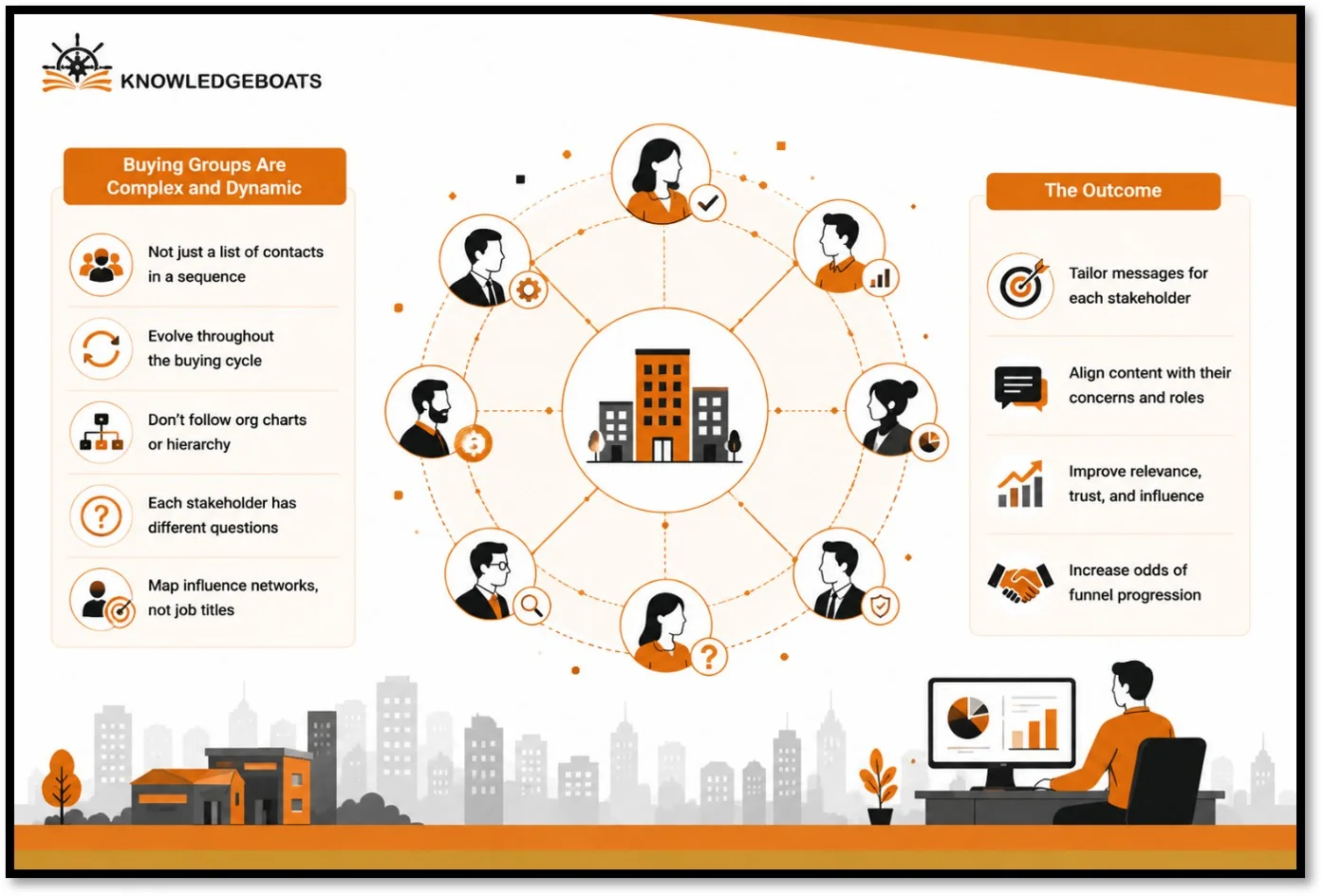
Only those enterprises advance through the funnel that differentiate their content by tailoring messages for each committee member, aligned to their concerns and functions. Instead of mapping job titles, organizations must map influence networks.
How Enterprise Buyers Make Decisions
B2B buyers hardly ever move linearly through the buying funnel, and this is where most B2B GTM strategies collapse because organizations build their strategies around the wrong customer buying journey funnel.
Buyers often reach different dimensions of the same problem simultaneously, and move in non-linear loops, without contacting reps most of their journey. Demand Gen Report finds that 80% of buyers initiate first contact after completing 70% of their buying journey.
However, most vendors believe that when a prospect interacts with their content, they get involved in the B2B buying process. Vendors waiting for inbound contacts to initiate the engagement often miss the most consequential decision-making phase.
The digital buying experience has shifted the decision-making to channels that B2B teams often fail to influence. Buyers’ behavior beyond owned channels becomes visible to GTM teams with the help of tools like intent monitoring and revenue intelligence.
What Are the Emerging B2B Buying Trends for 2026
More than inflated digital touchpoints and increasing content volume, the future of B2B buying groups will depend on fewer, yet high-quality engagement signals arriving at the right time for every stakeholder. Companies building volume-centric demand generation frameworks will only optimize for buying behavior that has become obsolete.
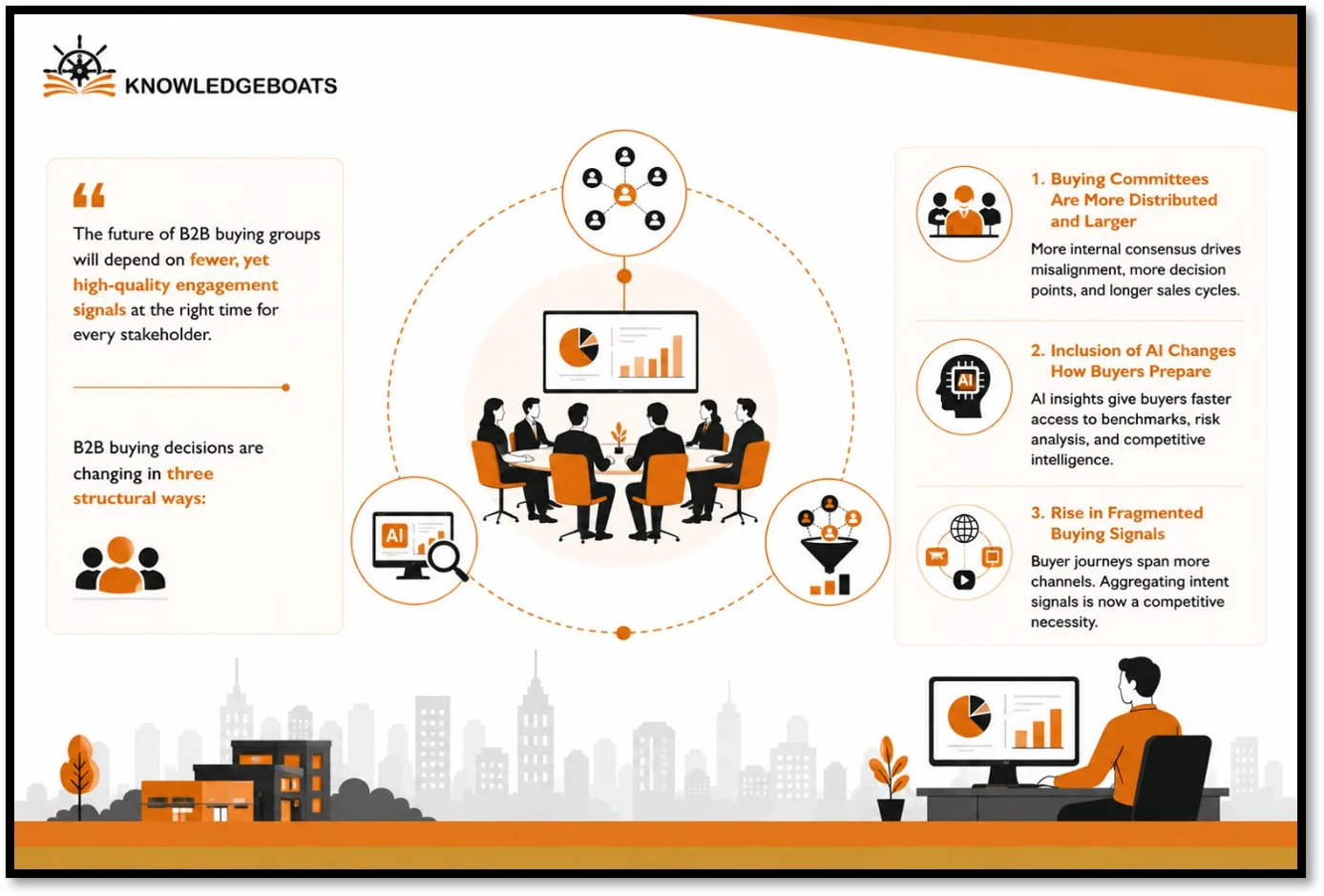
Changing buyers’ behavior is changing how enterprise buying decisions are made in three structural ways:
- Buying Committees are More Distributed and Larger: B2B teams are relying on a broader internal consensus, thanks to rising economic uncertainty. The single champion approving the decision is replaced by a committee, increasing the scope for misalignment, more decision points, and longer sales cycles.
- Inclusion of AI Changes How Buyers Prepare: AI-driven buying insights produce faster access to peer benchmarks, risk analysis, and competitive intelligence. B2B buyers become more skeptical, yet more prepared, during discussions with vendors.
- Rise in Fragmented Buying Signals: Modern B2B buyer journey spans across more channels, scattering intent signals, which most vendors do not monitor. Tools that can aggregate these signals have become a competitive necessity.
How Enterprise Buying Trends Determine the B2B Buying Group Strategy
Here are the three architectural decisions that most enterprise buying groups overlook:
1. Replace Contact-level Lead Scoring with Account-level Signal Aggregation
While traditional lead scoring emphasized a single engaged lead, modern enterprise procurement is built around a decision-making committee. A scoring strategy developed around an individual champion often misses committee-level signals.
According to Demandbase, B2B teams that engage 2 members of a buying committee observe a win rate of 29%.
2. Build Stakeholder-centric Buyer Enablement
Every stakeholder measures success differently. B2B teams often believe that delivering the same content to all stakeholders is personalization, but it is indifference disguised as efficiency.
The consensus develops only by delivering the stakeholder-specific content that helps them build an internal business case within their domain.
3. Invest More in Decision Intelligence
While pipeline dashboards can only describe what has already happened, decision intelligence elaborates on the current scenario of the buying group before the deal stalls. Customer intent and buyer behavior will continuously make modern B2B buying groups more observable rather than discovering them manually.
Beyond producing individual leads, orchestrating buying consensus will be the decisive advantage for GTM strategies in 2026.
Final Thoughts: What Is the Future of B2B Procurement
The future of the B2B purchasing process will be governed more by intelligence, and vendors that understand how B2B buying groups work internally will outperform those who only emphasize aggressive outreach cadences and the largest sales teams.
Beyond a stand-alone champion, the buying committee will make the deal. Only those B2B teams will compound the pipeline advantage each quarter that develop their revenue architecture around buying committees.
For RevOps, AI-powered buyer journey, predictive decision mapping, and buying group intelligence will become foundational capabilities, replacing conventional beliefs of the buying journey.
Want to find why your current GTM framework fails to capture buying group signals? The Knowledgeboats team will help you identify active pipeline accounts that reflect high-intent signals.
FAQs
1. Why are B2B buying groups important?
Stakeholders from different domains and functions come together to influence buying decisions. This is due to B2B buying groups, and the engagement of these buying groups can increase the probability of buying consensus, improve stakeholder engagement, and reduce deal risk.
2. How do B2B buying groups work?
Instead of forming around a fixed hierarchy, B2B buying groups form around a business problem. Every stakeholder has a different perspective on the problem, and the final decision is taken after collective research, discussion, and internal consensus.
3. How is AI changing B2B buying groups?
The involvement of AI catalyzes deeper research, enables effective vendor comparison, forecasts risks, and develops a strong business case before a rep is contacted. Vendors can also predict buying signals using AI.
4. What are the biggest B2B buying trends in 2026?
Emergence of AI-supported buyer research, reliance on intent data, increasing buying committee sizes, stakeholder alignment requirements, distributed buying signals, and using GTM strategies to engage the buying group are some key trends in 2026.
5. How can businesses engage buying groups?
Identifying key stakeholders, delivering role-centric content, understanding every stakeholder’s preferences, orchestrating engagement around collective decision-making, and monitoring buying signals are some steps to engage buying groups.