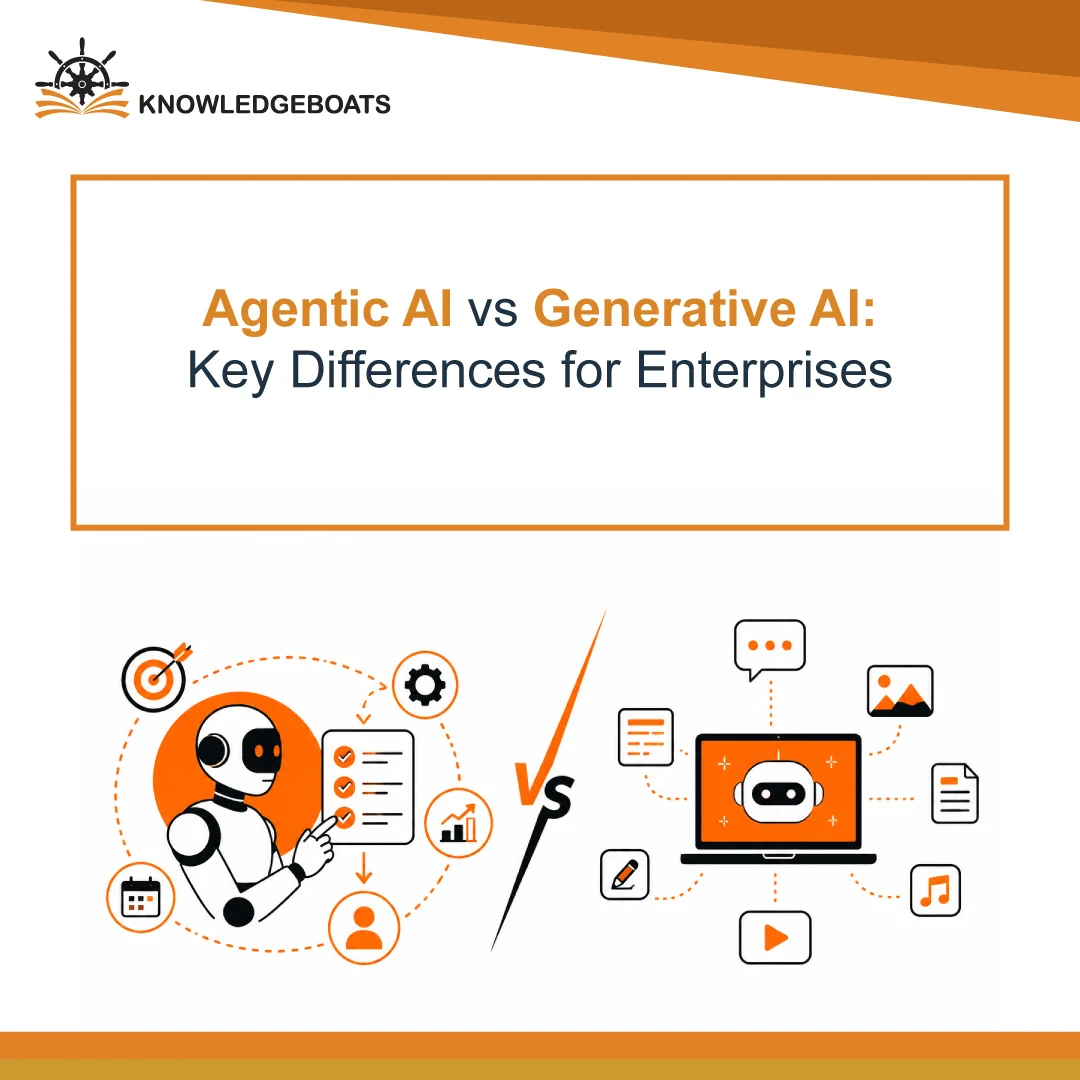
Enterprises that decode Agentic AI vs Generative AI early can move faster, making precise AI investment decisions. Rather than sounding impressive in board meetings, B2B teams can deploy each AI capability where it actually enhances operational outcomes.
Companies often treat the Agentic AI vs Gen AI discussion as a technology taxonomy task, but in reality, it is about deployment architecture. Boston Consulting Group’s 2024 report finds that 74% of companies fail to adopt AI and scale value.
This is because many of them try to apply Generative AI to problems that require autonomous decision-making. Beyond generating output, companies’ ability to automate decisions determines their AI adoption maturity.
What Is Agentic AI vs Generative AI
As both Generative AI and Agentic AI can be built on an LLM foundation, the difference that matters most shifts from underlying models to theories of what AI needs to perform in an enterprise. The clarity in that framing makes definitions of AI models useful, and the real difference lies in the control architecture layer.
| Factors of Comparison | Generative AI | Agentic AI |
|---|---|---|
| Key Role | It generates language and content based on prompts. | Goal-driven execution is expected from the model across different autonomous steps. |
| Model of Interaction | Starting from input in, the interaction ends at input out, and there is a single inference loop. | The interaction starts from goal setting, which then includes step execution and result evaluation. |
| Human Contribution | Humans are executors and decision-makers at every step, and AI only assists them. | Humans only define the goal and review output, while AI executes all steps in between. |
| Type of Output | Content, code, summary, or recommendations. | Executed actions, resolved tasks, and completed workflow. |
| Context and Memory | Context resets after every interaction, and the memory is session-scoped. | AI maintains context throughout the interaction, and the model has persistent goal memory. |
| Tools Used | Limited use; primarily used for language-based output. | Tools are used as a part of execution, including API databases. |
| Company Fit | Q&A, code assistance, drafting, and content creation. | Multi-system coordination, workflow automation, and exception handling. |
| Mode of Failure | AI model hallucinates. | It drifts from the goal. |
More than capability depth, the structural difference between the two lies in operational autonomy. Instead of comparing these models based on their intelligence, B2B teams should weigh them on the responsibility they own. In reality, deployment failure is a category mismatch problem, but often treated as a technological issue.
When to Use Agentic AI
Checking on business processes that require autonomy or augmentation is a far better approach for B2B enterprises than debating which enterprise AI platforms are better. Generative and Agentic AI are complementary layers of the enterprise AI solutions.
Agentic AI becomes valuable when enterprises emphasize entire workflow execution over siloed task assistance. NICE’s report finds that B2B teams employing AI-powered business processes accelerate cycle times by 30-50%, while reducing operational costs by 20-40%.
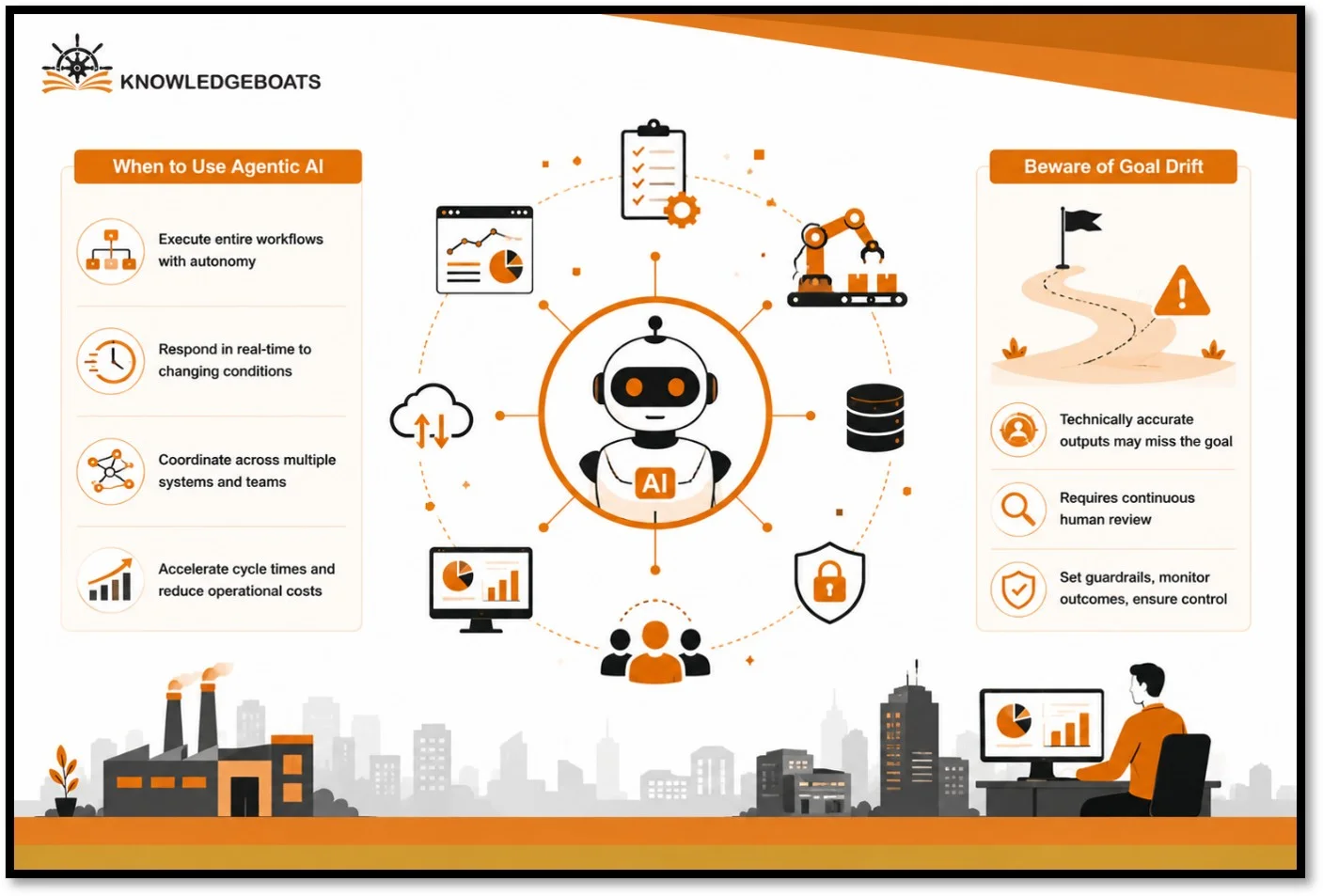
It gains importance in situations where predictable action sequences form multi-step workflows that currently need manual governance and are time-consuming.
Changing conditions that require real-time response and operations demanding simultaneous coordination across multiple layers are the other two operational contexts where the AI framework generates commercially valuable output.
However, goal drift is the most common failure mode that is hardly discussed. Although it produces technically accurate output, it creates downstream operational problems. AI platforms designed for faster ticket resolution might achieve speed, while sacrificing accuracy.
The set-and-forget approach is not suitable for this model. Instead, it requires continuous human review checkpoints, outcome monitoring, and defined guardrails to ensure smooth operation.
How Do Enterprises Use Agentic AI
Technological underperformance is hardly the reason behind the enterprise AI copilots’ failure. They often fail because of their deployment in the wrong problem category, and moreover, a lack of redesign while deployment digitizes human bottlenecks.
Replacing human coordination with enterprise agentic AI is the most effective way in which B2B teams can use it. This is because coordination overhead causes enterprises to lose their productivity, and agentic systems become most effective here, as operations are rule-governed, human-executed, and high-frequency.
According to Arcade’s findings, AI workflow automation delivers 240% average ROI within 12 months. Enterprise marketing automation that deploys AI agents as an architectural decision often produces compounding value. Rather than owning individual tasks, agentic AI controls workflows, and this changes how organizations operate.
Final Thoughts: How the Difference Between Agentic AI and Generative AI Will Determine the Future of Enterprise AI
The AI agents vs Generative AI debate mainly revolves around capability that fulfils the operational requirement rather than concentrating on the technology. While enterprise generative AI empowers humans, the other automates operations. Neither can replace the other, and this is why both are equally important in the AI architecture.
Rather than chasing the most powerful AI model, B2B enterprises make accurate deployment decisions to build durable competitive advantage using AI. This includes building governance around autonomous execution, problem-capability matching, and tracking the output against operational benchmarks.
As enterprise digital transformation continues to mature, multi-agent AI systems will become the foundation of the entire process, and B2B teams that have already developed the governance framework to support autonomous execution will scale faster.
If you are wondering which AI framework you will need to automate execution to scale, contact Knowledgeboats to find which architecture aligns with your long-term business strategy and operational goals.
FAQs
1. How does Generative AI work?
Although generative AI cannot execute business workflows, it assists human decision-making by analyzing prompts and identifying patterns from training data to produce new content, including code, summaries, or images.
2. Is Agentic AI better than Generative AI?
No AI is inherently superior to the other. While generative AI works best for content creation and knowledge assistance, agentic AI suits autonomous workflow execution, and the correct choice depends on the business problem under consideration.
3. What are the benefits of Agentic AI?
Along with improving operational efficiency and reducing manual coordination, agentic AI accelerates business decisions, automates multi-step workflows, allows teams to emphasize strategic work, boosts scalability, and enables real-time responses.
4. What are the limitations of Generative AI?
Generative AI often fails to coordinate across enterprise systems. It also fails to execute complex workflows independently, and it is incapable of making autonomous operational decisions.
5. What is the future of enterprise AI?
Combining generative AI and agentic AI to integrate knowledge creation into autonomous execution will be the future of enterprise AI. As multi-agent AI systems streamline enterprise operations, they will make B2B teams more adaptive, operationally resilient, and intelligent.