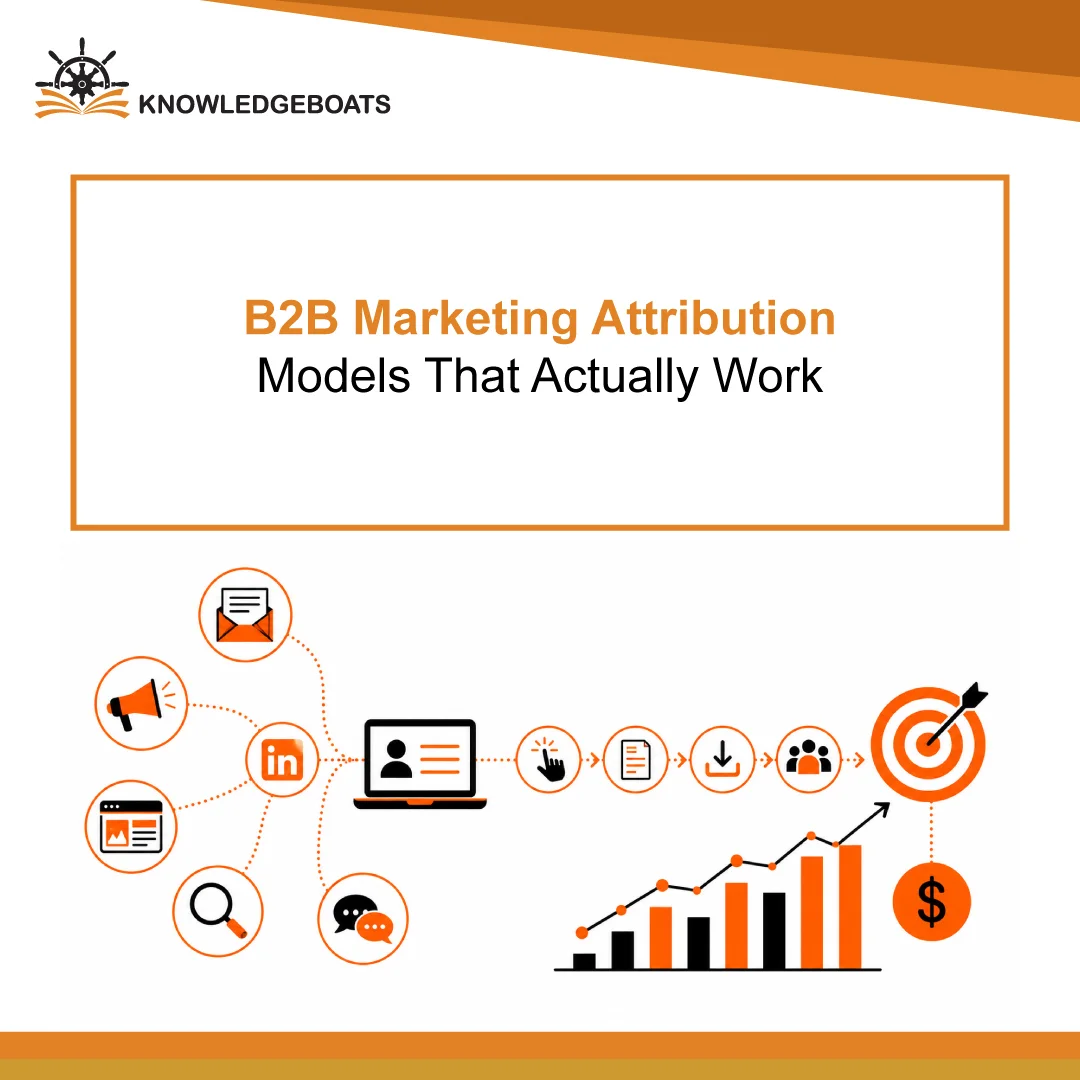
B2B marketing attribution models help enterprises make better GTM decisions by emphasizing influence over siloed conversions. However, most B2B enterprises treat last-touch reporting as attribution, where they call the analysis complete by crediting only the last touchpoint.
The channels starting the deal are often undervalued, while the channels supporting the deal closure are overvalued, and this is the core problem. B2B teams optimize their dashboards for attribution reporting rather than improving revenue initiatives.
The evolving B2B Buyer journey is making the single-touch attribution even more unreliable. Visionary Marketing’s 2026 report finds that poor attribution wastes 23% of the marketing budgets of B2B enterprises. Beyond serving only as a measurement tool, marketing attribution models for B2B act as a budget allocation instrument.
What Is B2B Marketing Attribution
Although the most technically sound definition of attribution is “giving credit to marketing touchpoints,” it is also the strategically misleading one, as it describes B2B marketing attribution as a reporting issue rather than framing it as a decision problem.
Rather than answering which touchpoints existed, attribution checks for touchpoints that changed buyer behavior. Choosing the right attribution model can help B2B teams connect buying behavior to revenue outcomes.
As B2B buying journeys are longer, darker, and involve multiple stakeholders compared to B2C journeys, B2B attribution modelling becomes harder than B2C attribution. A typical B2B deal often involves multiple trackable touchpoints and even more unknown dark touchpoints that any tool can hardly capture.
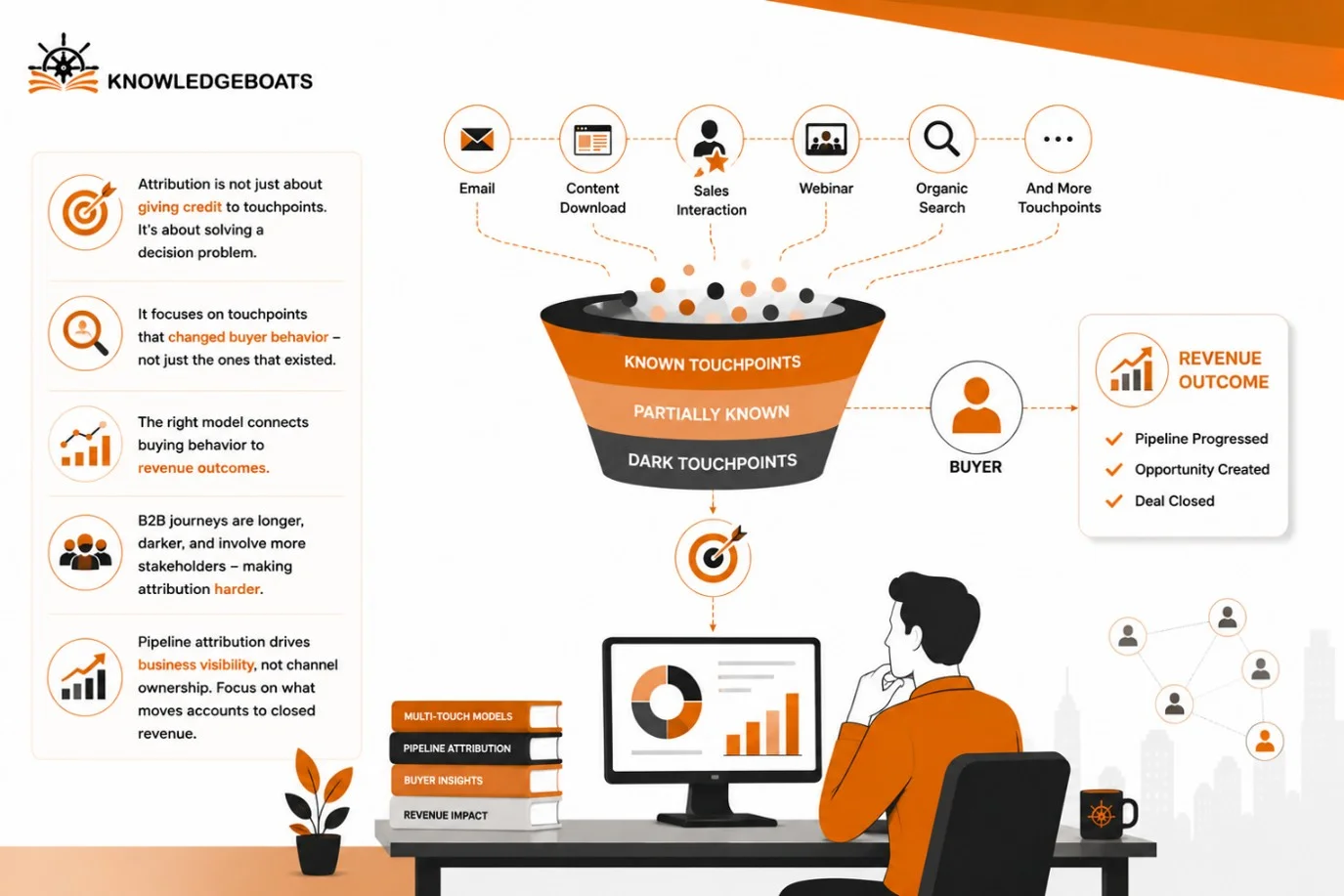
More than lead attribution and conversion attribution, pipeline attribution is a more useful frame. The core objective is business visibility instead of channel ownership. The core focus remains on which touchpoints pushed an account through the pipeline, and which contributed to closed revenue.
How the Multi-Touch Attribution vs Last-Touch Attribution Debate Unveils Marketing Attribution Dynamics
Based on the buyer journey phase the organization emphasizes, the marketing attribution models are selected, which is why they become a strategic choice. Every framework explains revenue generation differently, producing different budget allocation decisions.
| Framework | Credit Logic | B2B Fit | Primary Blind Spot |
|---|---|---|---|
| First-touch Attribution Model | Complete credit to the initial interaction. | Suitable for monitoring channel discovery. | Ignores all the factors downstream. |
| Last-touch Attribution Model | Complete credit to the last touchpoint before conversion. | Easy to defend and simple to implement. | Ignores the channels that matter the most. |
| Linear Attribution Model | Equal credit distribution across every touchpoint. | Captures the entire buying journey. | Weighs all interactions equally, irrespective of the duration of the interaction. |
| W-shaped Attribution Model | Credits more to the initial touch, opportunity creation, and lead generation. | Aligns B2B stages and different pipeline milestones. | Overlooks vendor shortlisting that happens during the mid-journey. |
| Full-path Attribution Model | Credits the initial touch, opportunity and lead creation, and closed-won. | Fits well with longer B2B enterprise cycles. | Needs complete and clean CRM data, and it is rare in practice. |
| AI-powered Attribution Model | Credits based on estimated influence per touchpoint per deal. | Provides the highest accuracy and offers deal-specific variation. | Most mid-market enterprises don’t have data and infrastructure that the model needs. |
Which Is the Best Attribution Model for B2B Marketing
Although there is no best attribution framework that fits universally for all situations, the correct B2B attribution model is selected based on enterprise sales cycle length, data infrastructure maturity, or deal complexity.
Here are three key criteria governing the choice of the attribution framework to be made:
- Sales Cycle Length: While deals under 30 days can be handled with first-touch or last-touch models, deals beyond 90 days need multi-touch frameworks.
- Data Completeness: Incomplete CRM data with the full-path framework often produces incorrect output confidently. According to Knecht Strategies, most B2B teams report 30-50% CRM data accuracy, which is not even near benchmarks that build reliable attribution. On the other hand, simple models applied to cleaner data often produce reliable outcomes.
- Decision to be Made: Instead of choosing the attribution framework based on the most advanced algorithm, select the model that answers revenue questions.
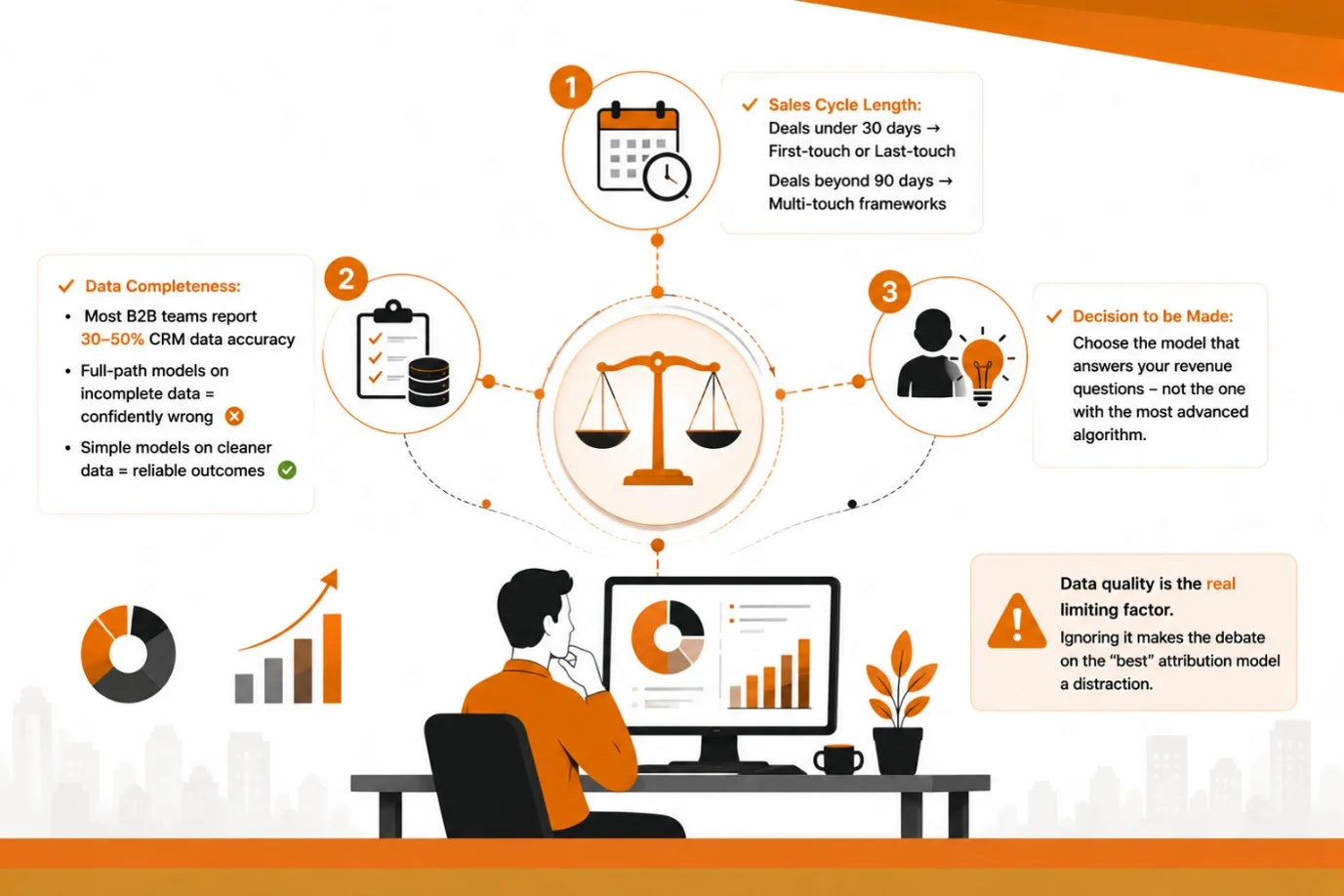
Data quality is the real limiting factor in choosing the model. B2B enterprises often ignore this problem, making the debate on the best B2B marketing attribution models only a distraction.
How AI-Powered Marketing Attribution Improves B2B Decision-making
Rule-based attribution models for revenue teams assign fixed credits to touchpoints, ignoring what influence they actually have on a specific deal. Although they measure presence, they fail to capture likely causal contribution.
AI-driven campaign attribution shifts the credit scoring system from fixed weighting to a dynamic influence-based model by analyzing campaign performance based on what changed buyer behavior in every deal.
It also identifies specific patterns across the customer journey and improves attribution. Omnibound AI’s 2025 research finds that the integration of the AI-powered model into the multi-touch framework will elevate B2B marketing efficiency by 40%.
Most vendors use complex algorithms and produce the same output as that of rule-based models, which is only a precision improvement. More than credit allocation, the ability to forecast touchpoint combinations yielding the maximum results is the real advantage of predictive attribution modeling.
Instead of replacing strategic judgment, AI should only consolidate attribution confidence. Intent data embedded into AI-driven attribution surfaces dark funnel touchpoints for the first time that most B2B teams often ignore, and bridges the attribution gap.
Key Takeaway: How B2B Marketing Attribution Works
More than just being a reporting function, B2B marketing attribution is a revenue allocation function, where the model examines channels worth receiving investments, campaigns eligible for scaling, and activities to be cut down. The chosen model decides how the marketing team will generate revenue.
Instead of initiating with the most sophisticated attribution frameworks, B2B enterprises that start with clean CRM data, define qualification systems clearly, and choose a model that matches their data maturity and sales cycle length build reliable revenue attribution strategies.
Revenue attribution will shift from reporting historical revenue to forecasting budget allocation, thanks to maturing AI attribution tools and dark funnel signals that are structurally integrated.
Still confused about which attribution framework will suit you? Knowledgeboats can help you find the best model that fits your data maturity, budget allocation decisions, and sales cycles.
FAQs
1. Which attribution model is best for B2B?
Although there is not a single best attribution model that fits all requirements, the correct choice depends on data quality, sales cycles, business decisions, and buyer journey complexity.
2. How does multi-touch attribution work?
Multi-touch attribution circulates credits along different marketing interactions during the entire buyer journey. It offers a thorough understanding of how channels can contribute to revenue and pipeline.
3. Why is attribution important in B2B marketing?
Attribution allows RevOps teams to know channels and campaigns that affect pipeline generation. As a result, B2B teams can allocate budgets based on measurable business impact rather than assumptions.
4. How does AI improve attribution modeling?
AI-powered attribution evaluates intent signals, customer interactions, and historical buying patterns, based on which marketing models can identify which touchpoint combinations will generate qualified revenue and pipeline.
5. How can marketers choose the right attribution model?
By evaluating CRM data quality, reporting objectives, and sales cycle length, marketers can choose the correct attribution model that can support informed revenue decisions.