B2B marketing incrementality helps you measure the additional revenue your marketing function generated that would not have been earned without it. The incrementality vs attribution difference is worth knowing. Attribution shows which activities influenced a deal, while incrementality shows whether those activities contributed to the pipeline.
An attributed deal may have converted even without the credited marketing touchpoint. Attribution alone, therefore, cannot establish incremental revenue. Gartner’s 2024 survey finds that only 52% of CMOs can prove marketing’s value and receive credit for its contribution to business outcomes.
Instead of only documenting marketing touchpoints, your marketing function should prove the difference it makes. A channel may look impressive in numbers but still contribute little. When your team can prove causal impact, it can earn more budget, and incrementality can help prove it.
How Is Incrementality Different from Marketing Attribution
While incrementality helps you measure marketing’s contribution to total revenue, attribution allocates credit to touchpoints that precede a conversion. Here is how you can explain revenue attribution vs incrementality:
| Parameter | Attribution | Incrementality |
|---|---|---|
| What It Checks | Who receives credit. | What happens without marketing. |
| Which Method It Uses | Tracked touchpoints. | Test versus control. |
| What Is the Blind Spot | Prospects who are going to convert anyway. | Small-sample tests and slower execution. |
Multi-touch attribution may not be more accurate than last-touch attribution, but it can distribute credit across multiple interactions without proving their commercial contribution to outcomes.
Attribution can help you explain the buyer journey, and you should use it to monitor marketing activities. Incremental pipeline measurement can show whether marketing changed the outcome, which is why you should treat it as proof of causality.
Use attribution and incrementality together, but for different purposes. While attribution can explain which touchpoints received credit, incrementality can test whether marketing activities produce additional outcomes. 6sense’s 2025 research found that 57% of B2B teams apply both sourced and influenced attribution measures.
The finance team needs credit and cause to make budget decisions because they answer fundamentally different questions, so it is not a choice between two competing dashboards.
How to Measure B2B Marketing Incrementality
Compare eligible accounts randomly assigned to receive your marketing campaign with similar accounts assigned to a control group. This is how to measure incremental revenue from marketing campaigns. The following is a practical measurement sequence for tracking incremental revenue in marketing:
- Define the Outcome: Select closed-won revenue, qualified opportunities, and incremental pipeline.
- Determine the Threshold: Use historical performance to estimate the baseline, then define the minimum lift required for the campaign to be considered successful.
- Prepare Comparable Groups: Randomly divide eligible accounts into control and treatment groups.
- Run the Test: Run the campaign for the treatment group while keeping the control group unexposed to the tested campaign.
- Track the Difference: Compare outcomes during a predefined buying window.

A rise in campaign conversion rates does not necessarily mean the campaign generated additional conversions. Existing demand, seasonality, or other influences may explain the increase.
Choose the experimental design based on the outcome you want to measure. Geo tests can help for regions, while holdouts work for tactics. Beyond a dashboard, B2B marketing measurement requires a counterfactual. The comparison’s quality determines lift’s credibility.
How to Run Incrementality Tests for B2B Campaigns
Randomize accounts into control and test groups first. Then monitor revenue and pipeline over the entire buying window. This approach enables you to run incrementality tests for campaigns. You can use the following checklist while running incrementality tests:
- Define a clear hypothesis and a north star metric.
- Use CRM data from HubSpot or Salesforce to identify eligible accounts and randomly assign them to control and treatment groups.
- Set the test duration based on the typical buying cycle, expected conversion lag, and the sample size needed to detect a meaningful lift.
- Before launching the test, define the success threshold.
Even an impressive increase in leads or clicks may not justify the marketing function’s contribution to the additional revenue generated. Rather than testing results at the individual-lead level, test them at the account level.
B2B enterprises often stop early when marketing lift looks positive, turning noise into a false win. According to a 2026 industry analysis report, 78% of B2B CMOs find proving ROI has become more important.
When you determine the marketing lift measurement method before collecting data, the test becomes more trustworthy. Defining pre-set thresholds can prevent enterprises from making the story fit the results. Incrementality experiments should reflect how buying groups operate in reality.
How to Use Holdout Groups for Marketing Measurement
Select eligible accounts at random and exclude them from the campaign. Compare these results against accounts that received campaigns. This is how you can use holdout groups for marketing ROI measurement.
| Choice of Design | Guidance | Probable Risk |
|---|---|---|
| Selection | Randomize within the same segment and tier. | Biased comparison. |
| Duration | Allow at least one sales cycle plus lag. | Missed delayed effects. |
| Holdout size | Large enough to detect lift. | Underpowered test. |
Withholding campaign spend may sound risky, but spending on accounts that would have converted anyway can be equally wasteful. Simply excluding some accounts does not guarantee a reliable holdout group. Groups may create misleading comparisons if they differ in size, sales readiness, and intent.
The treatment group should show a measurable lift over the control group, with statistical uncertainty considered before attributing the difference to marketing. A credible control group may add more commercial value than a poorly matched dataset.
How to Calculate Incremental Revenue from Marketing Spend
Subtract the control group’s revenue per account from the treatment group’s, then multiply the difference by the total number of accounts assigned to the treatment group.
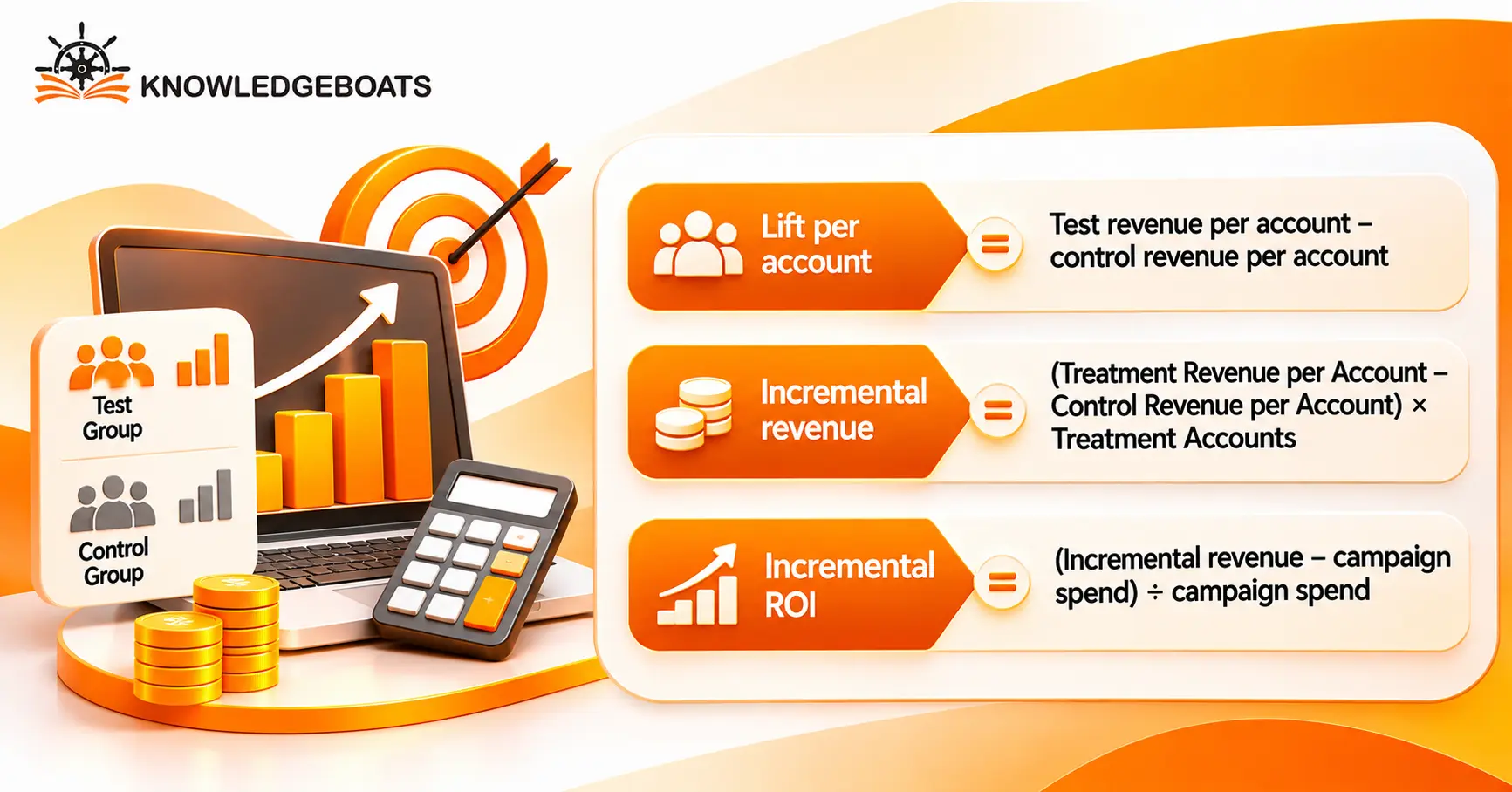
Use the next table to calculate different values:
| Step | Formula |
|---|---|
| Lift per account | Treatment revenue per account – control revenue per account |
| Incremental revenue | (Treatment revenue per account – control revenue per account) × treatment accounts |
| Incremental ROI | (Incremental gross profit – campaign spend) ÷ campaign spend |
Even though your campaign produces incremental pipeline, it may not produce incremental closed-won revenue during the same reporting period. You should not treat pipeline lift as realized revenue.
You should distinguish experimentally estimated incremental revenue from influenced pipeline and sourced revenue. Before reporting final B2B campaign ROI, count lagged revenue, but your calculation will only be as credible as its revenue window and counterfactual.
Bottom Line: How to Prove Marketing Campaigns Generate Additional Revenue
To prove marketing campaign effectiveness, run controlled tests, calculate incremental revenue, and report it alongside attributed pipeline. To achieve this, start with one holdout and one channel.
Attribution explains where conversions receive credit, while incrementality shows where additional investment creates value. When your marketing team can prove what would have been lost without its investment, the function can earn budget credibility.
You should connect campaign decisions to commercial outcomes, incremental pipeline, and causal evidence. To understand how to measure the true impact of B2B advertising, book a free 30-minute measurement review with Knowledgeboats.
FAQs
1. Why is incrementality important for B2B marketers?
Within long buying cycles, credit is shared across committees. As a result, attribution may overstate some channels, but incrementality shows where spend can change outcomes. It can support budget requests that your finance department will accept.
2. What is the difference between incrementality and attribution?
Incrementality compares control and test groups to show what changed, but attribution distributes credit across tracked touchpoints to surface who contributed. You can use attribution to diagnose buyer journeys, while incrementality helps validate budget decisions.
3. How do you calculate incremental revenue?
Subtract control revenue per account from treatment revenue per account. Multiply the difference by the number of accounts assigned to the treatment group. Include lagged closed-won revenue within the predefined measurement window. For incremental ROI, use incremental gross profit rather than revenue.
4. What is a control group in marketing experiments?
Eligible accounts that do not receive the tested campaigns are called control groups, and their performance provides a benchmark for measuring incremental impact.
5. How can B2B companies prove marketing ROI?
Use controlled experiments, incremental calculations, and comparable account groups to prove marketing ROI. However, separately report causal lift from attributed pipeline.