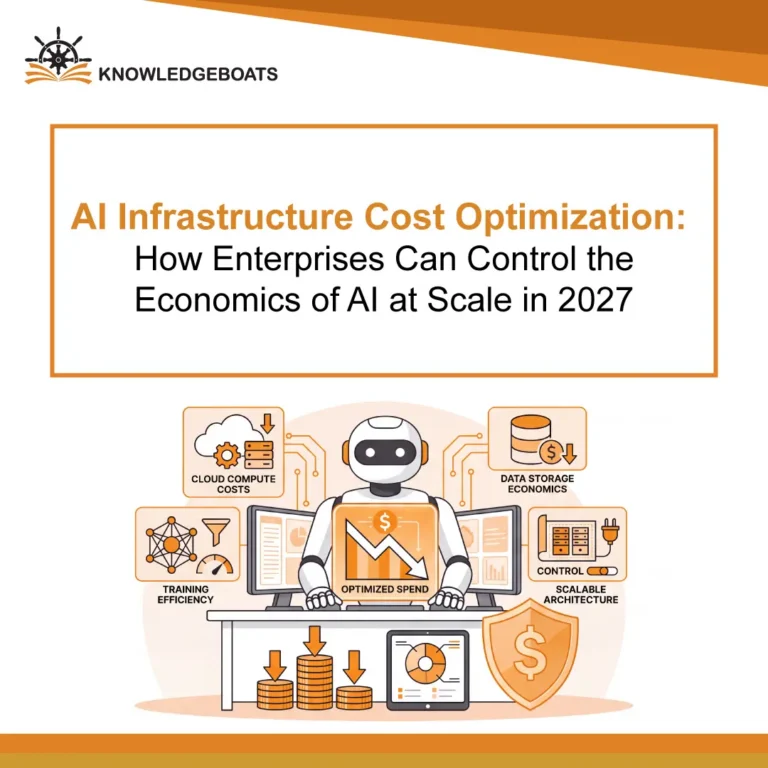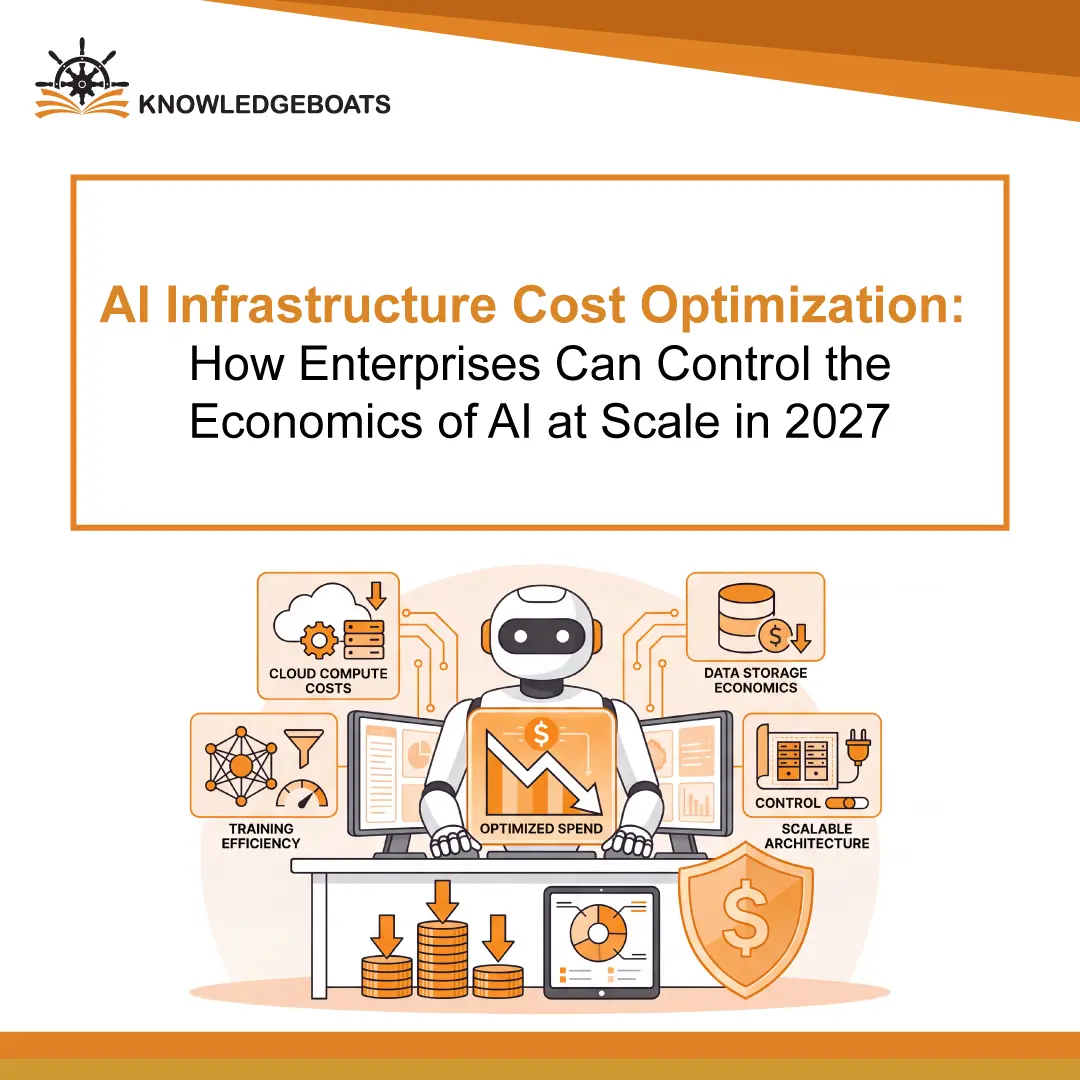
Enterprise AI infrastructure cost optimization aligns model, storage, and compute spending with the business value each workflow delivers. B2B teams are bringing AI into mainstream daily operations, and as a result, AI cloud infrastructure costs are becoming harder to predict and justify.
Beyond rising GPU prices, the real problem is the gap between organizational investment in AI and the returns it generates. Although many enterprises prioritize cheaper hardware, idle capacity and unmonitored workloads can still create waste. Less expensive infrastructure might not mean cheaper AI operations.
Gartner’s 2026 research finds that at least 50% of GenAI projects will be abandoned by the end of 2026 due to inadequate risk controls, unclear business value, poor data quality, or escalating AI infrastructure costs.
AI cost optimization in 2027 will require operating discipline and workload-level cost tracking. Instead of spending less on AI, your core objective must be to earn more value for every dollar spent.
What Drives Enterprise AI Infrastructure Costs
Data movement, idle capacity left between workloads, GPU compute, and inference volume drive AI infrastructure costs. You can use the following practical table to find cost-increasing drivers and why they grow:
| Cost Drivers | Why Costs Increase | Which Metric Should Be Tracked |
|---|---|---|
| Inference volume | Each request adds to metered usage costs. | Cost per request |
| Idle capacity | Reserved resources remain unused between jobs. | Idle hours |
| GPU compute | Training and inference workloads compete for GPU capacity. | Utilization rate |
| Data movement | Cross-region and cross-cloud transfers are billed. | Egress per workload |
As people use AI models more often, they become more expensive. GPU infrastructure costs matter, but rising inference demand and inefficient workloads can drive them even higher.
Allocated GPUs, even when unused, continue to generate costs. Flexera’s 2026 research finds that cloud spending wastage is increasing by 29% as cloud-based AI workloads grow.
Track every AI workload’s costs before making infrastructure decisions. Costs can also increase with higher model usage, operational inefficiencies, and workload complexity. Visible cost-increasing drivers are comparatively easier to manage.
How to Optimize AI Infrastructure Costs for Enterprises
Run a FinOps loop, including tagging each workload, measuring unit cost, setting budgets, and weekly review, for efficient enterprise AI cost management. Your dashboard alone may not cut costs; your internal teams should act on what it reveals. Use the following table to optimize AI costs for your company:
| Which Step Should You Take | Which Action Should Follow | Who Owns the Results |
|---|---|---|
| Tag | Tag workloads based on use cases and teams. | The platform team |
| Measure | Monitor training runs and cost per request. | The FinOps lead |
| Budget | Set thresholds and anomaly alerts. | The finance partner |
| Review | Review and optimize the highest-cost workloads weekly. | The engineering manager |
Simply owning AI cost optimization tools does not mean that an organization has adopted FinOps practices. A dashboard can save money if you act based on its insights. Make your engineering and finance teams work with a shared cost framework.
This way, the AI FinOps framework can perform better. Switch off the resources that nobody uses in your organization.
How Enterprises Can Reduce Large Language Model Costs
Route simpler requests to smaller capable models, trim prompts, and cache repeated responses to reduce large language model (LLM) costs.
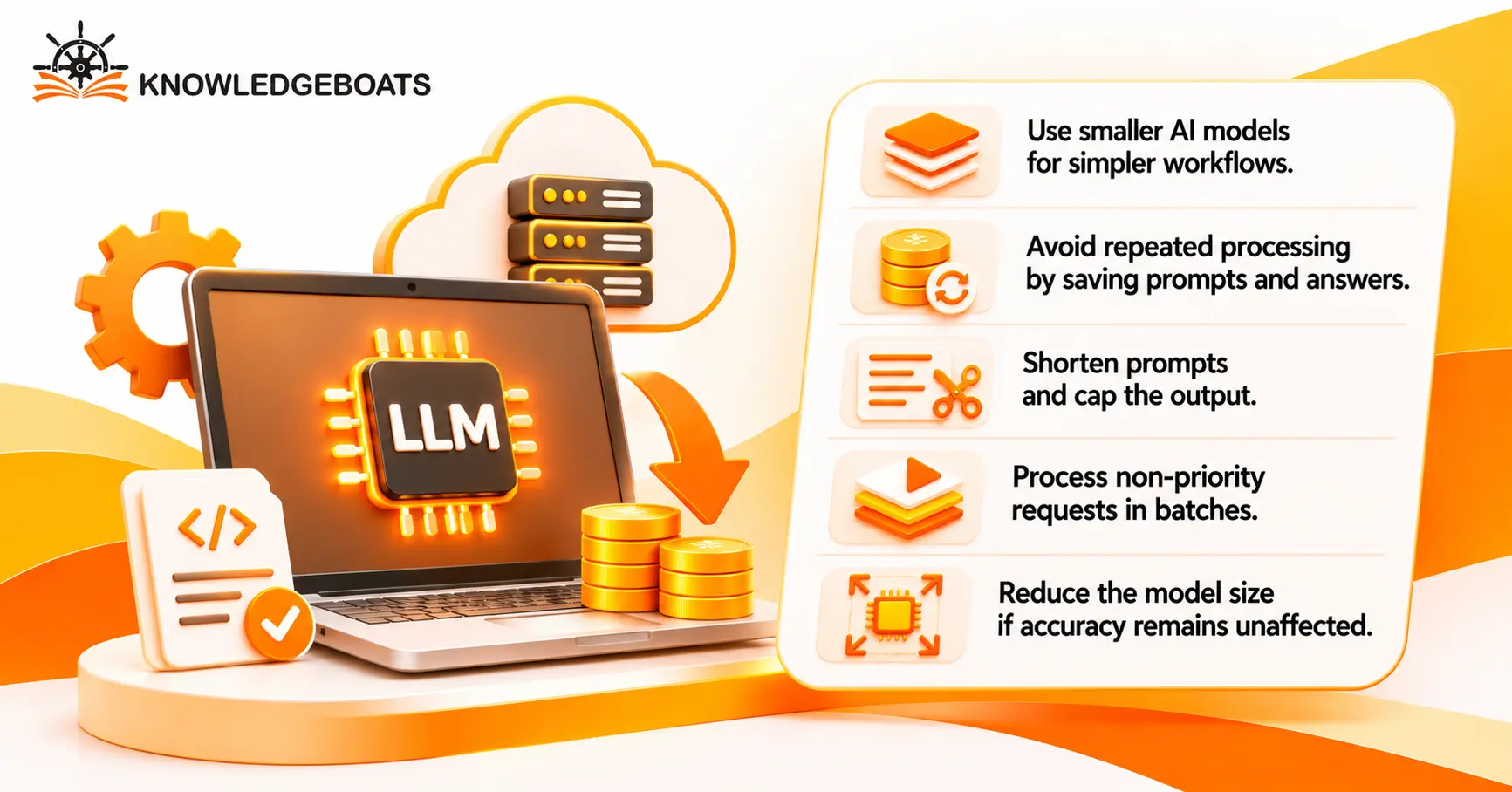
Here is a practical LLM cost checklist:
- Use smaller AI models for simpler workflows.
- Avoid repeated processing by saving prompts and answers.
- Shorten prompts and cap the output.
- Process non-priority requests in batches.
- If accuracy remains unaffected, reduce the model size wherever possible.
Cheapest models can also lead to poor output quality, more human intervention, and retries, increasing total costs. Stanford University’s 2025 Human-centered AI report found that the cost of querying GPT-3.5 fell by more than 280-fold from November 2022 to October 2024. But even cheaper AI can be useless if your spending keeps growing.
If you are looking for the best ways to optimize GPU resources for AI inference, start by batching, sharing GPU capacity across compatible models, and right-sizing. Beyond optimizing for price per million tokens, measure LLM cost optimization by the cost per successful task.
Keep tracking usage because growing volume can outrun your savings. Your selected model should reflect accuracy requirements, usage frequency, and task complexity.
How to Build a Cost-Efficient AI Infrastructure
Match every workload to the cheapest environment that meets its security, scale, and latency requirements to build a cost-efficient AI infrastructure. You can use the following practical enterprise cloud cost management framework:
| Workload | Best Fit For | Why It Fits |
|---|---|---|
| Steady Inference | On-premise or reserved cloud | It can support predictable workloads and lower unit costs. |
| Bursty Training | Cloud with spot capacity | It can offer discounted and elastic capacity |
| Experiments | On-demand cloud | You can pay while testing |
| Sensitive Data | Private or on-premise infrastructure | It can provide greater control over sensitive data. |
The AI infrastructure’s utility value is often buried under the cloud vs. on-premise debate. When utilization remains inconsistent, or hardware becomes outdated, even on-premise infrastructure may not stay cheaper than the cloud.
AI infrastructure management decisions should follow workload economics rather than deployment preferences. Invest in foundational infrastructure first. Build where proprietary capabilities and your data provide a competitive advantage. Your architecture decisions today can influence future costs.
How to Improve ROI on Enterprise AI Infrastructure Investments
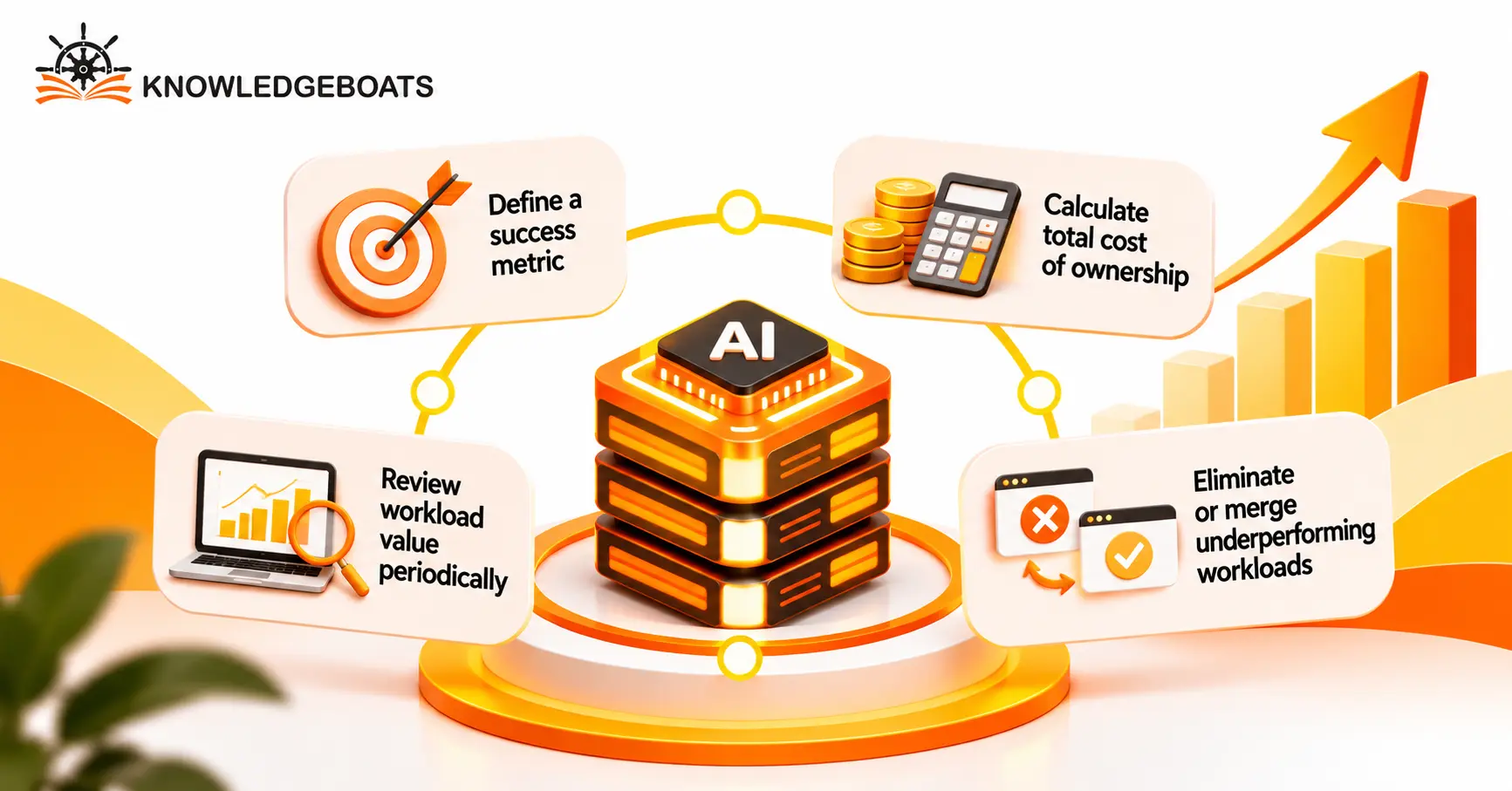
Tie every workload to a business output, and replace or eliminate those that consistently miss targets to improve ROI on AI infrastructure investments. The following is a practical cloud AI cost optimization checklist that can help you improve your ROI:
- Define a clear success metric before launching the project.
- Calculate the total cost of ownership, including data and staff expenses.
- Periodically review the value every AI workload delivers.
- Eliminate or merge underperforming workloads.
Finance needs a cost-per-outcome metric, even when model accuracy is already reported to the board. If cheaper infrastructure limits adoption or reduces AI output quality, that is inefficient AI cost governance. A stronger optimization strategy can improve the AI infrastructure economics of delivering intelligence.
AI projects should compete for compute resources to improve ROI. Instead of treating AI inference cost optimization as a technology expense alone, evaluate it as a business investment. If you do not tie an outcome metric to a workload, it is more likely to become a cost center.
Bottom Line: How Enterprises Can Reduce AI Infrastructure Costs
You should cut idle capacity, judge spend by outcomes, price each workload, and right-size models to reduce AI infrastructure costs. In 2027, enterprises that treat strategies for controlling AI operational expenses the same as any other operating cost might have a decisive advantage.
Instead of restricting AI adoption, cost discipline should enable sustainable enterprise AI scalability. If you are aiming to achieve this, contact Knowledgeboats to design AI cost management strategies.
FAQs
1. How can businesses optimize GPU utilization and reduce costs?
First, monitor GPU utilization by workload. Then schedule jobs efficiently. Also, batch inference requests and share capacity across compatible models. Respond by scaling down resources when demand falls.
2. How can organizations reduce LLM inference costs?
Route simpler tasks to smaller models. Save repeated prompts and responses. Cut down prompts and limit output tokens. Lastly, batch non-priority requests to reduce LLM inference costs.
3. What are the best strategies for optimizing AI cloud costs?
Ideally, you should apply workload-level tagging, use reserved capacity for predictable demand, review spending periodically, and remove idle resources. These can be some of the best strategies to optimize AI cloud costs.
4. How do enterprises calculate the total cost of ownership of AI infrastructure?
Include storage, model usage, networking, engineering, maintenance, data preparation, operational support, and compute when calculating the total cost of ownership of AI infrastructure, and compare it against measurable business outcomes.
5. How can businesses monitor and manage AI infrastructure spending?
To monitor and manage AI infrastructure spending, use cost dashboards with workload-level allocation, named owners, and anomaly alerts. Then, regularly review high-spending workloads and act on usage patterns.