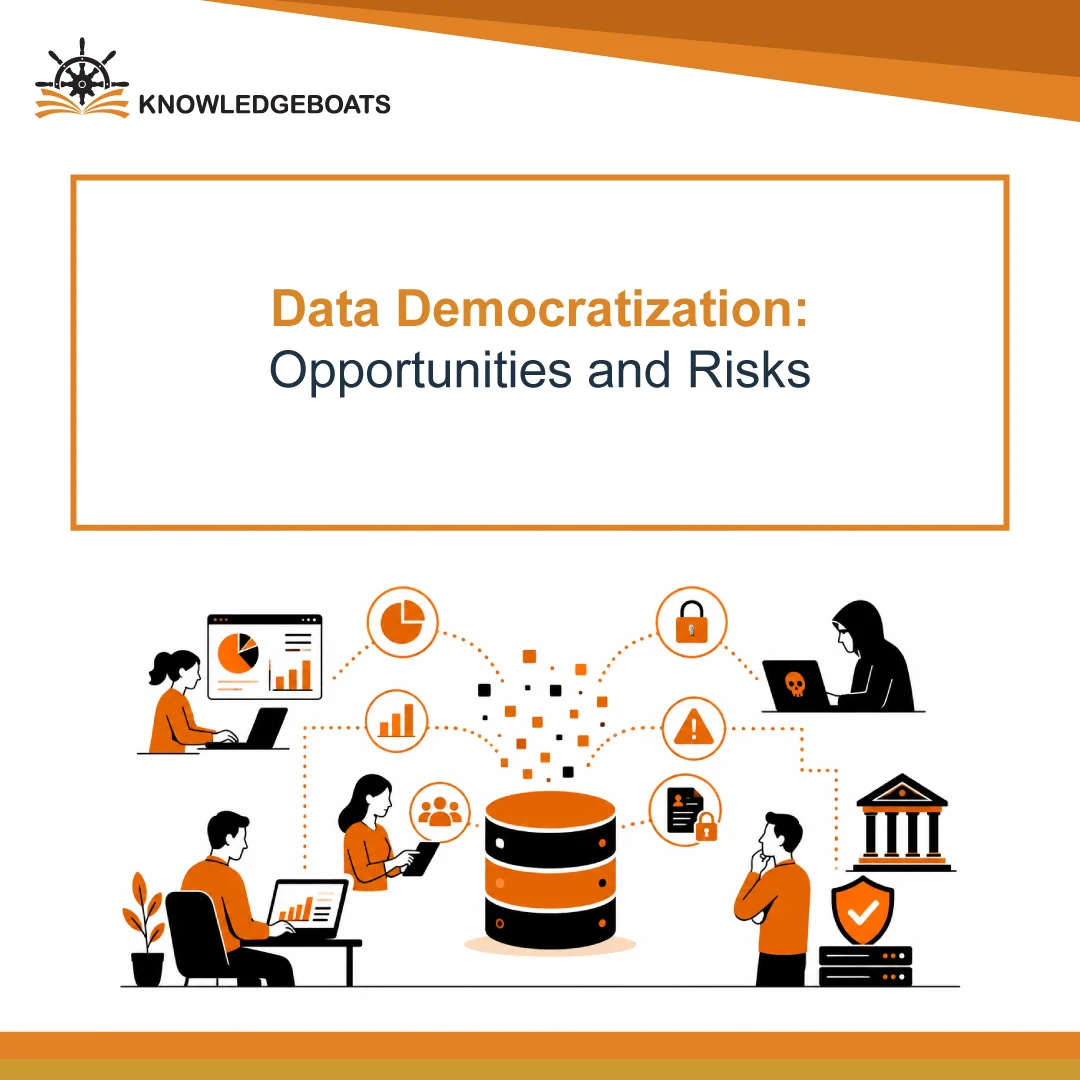
The data democratization strategy offers B2B enterprises access to governed and trusted data whenever required, and its core objective goes beyond providing broader access to enable better decision-making.
Many B2B teams misinterpret data democratization as data access. While access implies the availability and usability of data, democratization brings accountability to its meaningful use.
Google Cloud and Harvard Business Review survey found that 97% of B2B teams believe organization-wide data access is vital for business success, but only 60% can effectively distribute data. Eliminating access controls without building quality infrastructure, governance, and data literacy only increases compliance liability.
While correct democratization improves competitive capability, an incorrect one leads to data breaches, poor decision-making, or a compliance incident. More than the access policy, how organizations enable data democratization creates the difference between the two.
What Is Data Democratization
The data democratization framework is defined as the operational model that makes data accessible to all employees beyond data specialists. Although accurate, the definition can potentially become structurally dangerous if misinterpreted as complete.
Accessibility is often misinterpreted as an outcome, but in reality, it is the precondition. When the democratization framework stalls at access, only the failure mode changes. B2B teams with wide data access but low data literacy rates often make decisions with unequal data confidence.
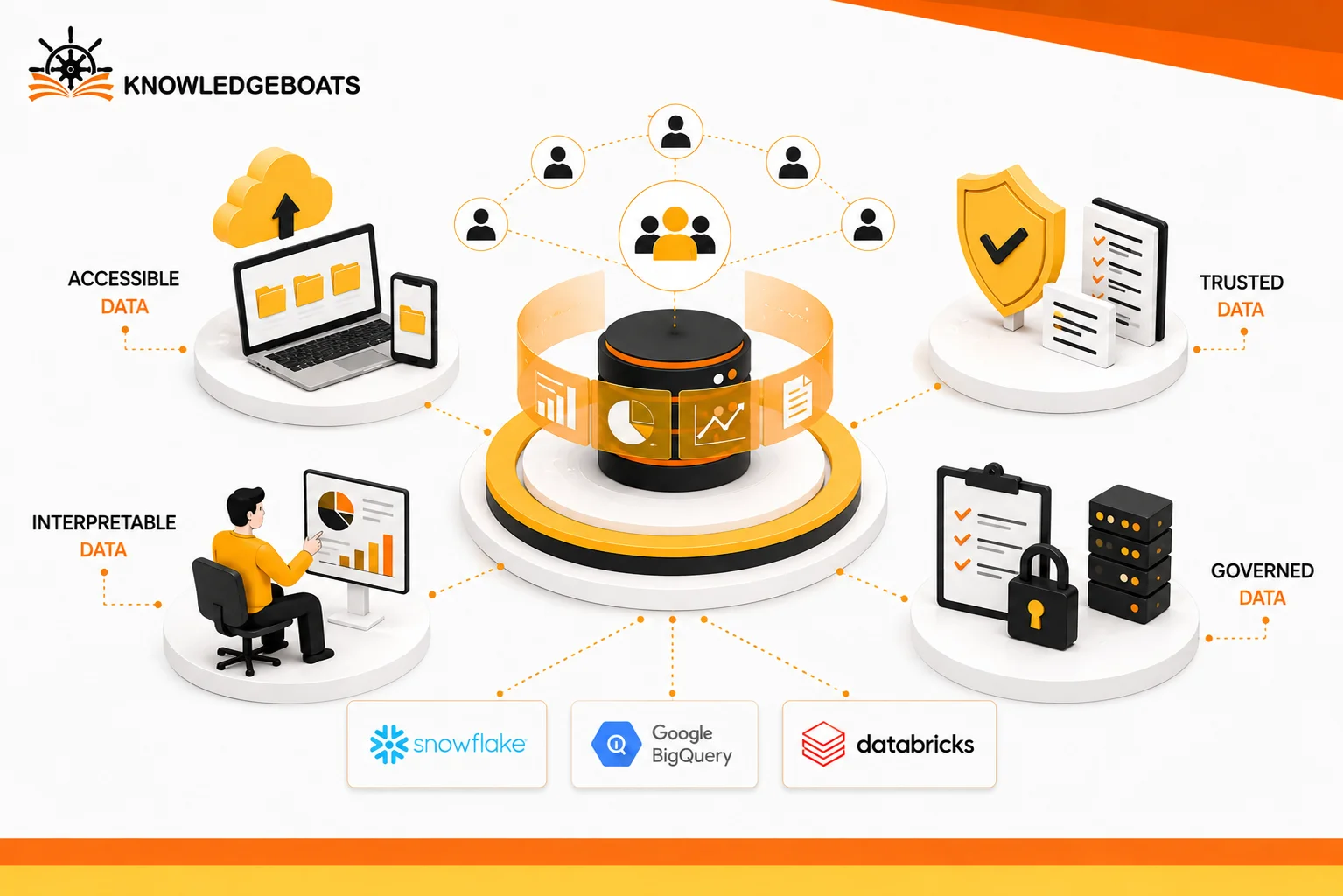
Building a data democratization strategy needs the following coexisting elements:
- Accessible Data: Any authorized user should be able to reach data whenever required.
- Trusted Data: Quality standards must be defined, visible, and enforced.
- Interpretable Data: Users must understand the meaning of data.
- Governed Data: Data must be controlled, auditable, and meet compliance requirements.
When B2B teams meet only one or two of these criteria, they often mistake an incomplete framework for a complete one. The data governance framework without sufficient context rarely produces accurate decisions.
Cloud-based data democratization platforms like Snowflake, Google BigQuery, and Databricks can enforce a governance layer after being configured, and this is where real commercial value is added to the framework. Only trustworthy and accessible data can improve business intelligence.
What Are the Benefits of Data Democratization
Reduced IT bottlenecks, faster reports, and improved dashboard access are obvious data democratization benefits, but they are becoming table stakes. Democratization surfaces anomalies, generates data-based hypotheses, and expands the number of people capable of identifying patterns, which is a more commercially valuable benefit.
As domain context is hard to centralize, enterprise data democratization strategy should never be designed around shifting analytical work away from data teams. Instead, it must enhance the organization’s capability of asking better questions.
Gitnux’s research finds that 72% of companies with a better data governance framework observe 25% faster decision-making. However, speed without accuracy only accelerates errors more confidently instead of producing better decisions.
At the organizational level, AI adoption and democratization are inseparable. Lineage-tracked, clean, well-documented, and governed data accessible to business users and AI models is the prerequisite for AI-ready data democratization.
Ignoring data democratization for machine learning and providing data access only to human analysts often makes AI models perform unreliably and inconsistently. Modern democratization platforms, including Data Cloud, Databricks Lakehouse, and Microsoft Fabric, use a single governed layer to serve both use cases.
What Are the Data Democratization Security Risks
Data democratization and compliance risks broadly fall under the following three categories:
| Risk Category | What It Causes | Governance Control |
|---|---|---|
| Access Risk | Sensitive data reaches users who either don’t need it or cannot handle it responsibly. | Masking, least-privilege access, or classification. |
| Interpretation Risk | Users misinterpret technically accurate data and act on it. | Definitions, stewardship, data literacy, and metadata. |
| Compliance Risk | Data usage violates contractual requirements or regulatory standards. | Purpose-based access, policy enforcement, and audit trails. |
A large number of people confidently acting on misunderstood data is a bigger risk than too many people seeing data. Common data democratization mistakes include emphasizing the access layer, which only addresses the first risk category.
The remaining risks are harder to address because they involve governance, communication, and data literacy, which many democratization models treat as secondary concerns.
Data management frameworks often cause governance design failure when they are built for centralized data ecosystems and extended to distributed environments without rebuilding them. Embedding compliance rules in data itself can be the perfect solution for compliance errors.
How Organizations Execute Balancing Data Democratization and Security
The majority of data democratization challenges are architectural sequencing problems, where enterprises expand access before building data governance. Rather than treating democratization and security as a trade-off, enterprises should design for both from the start.
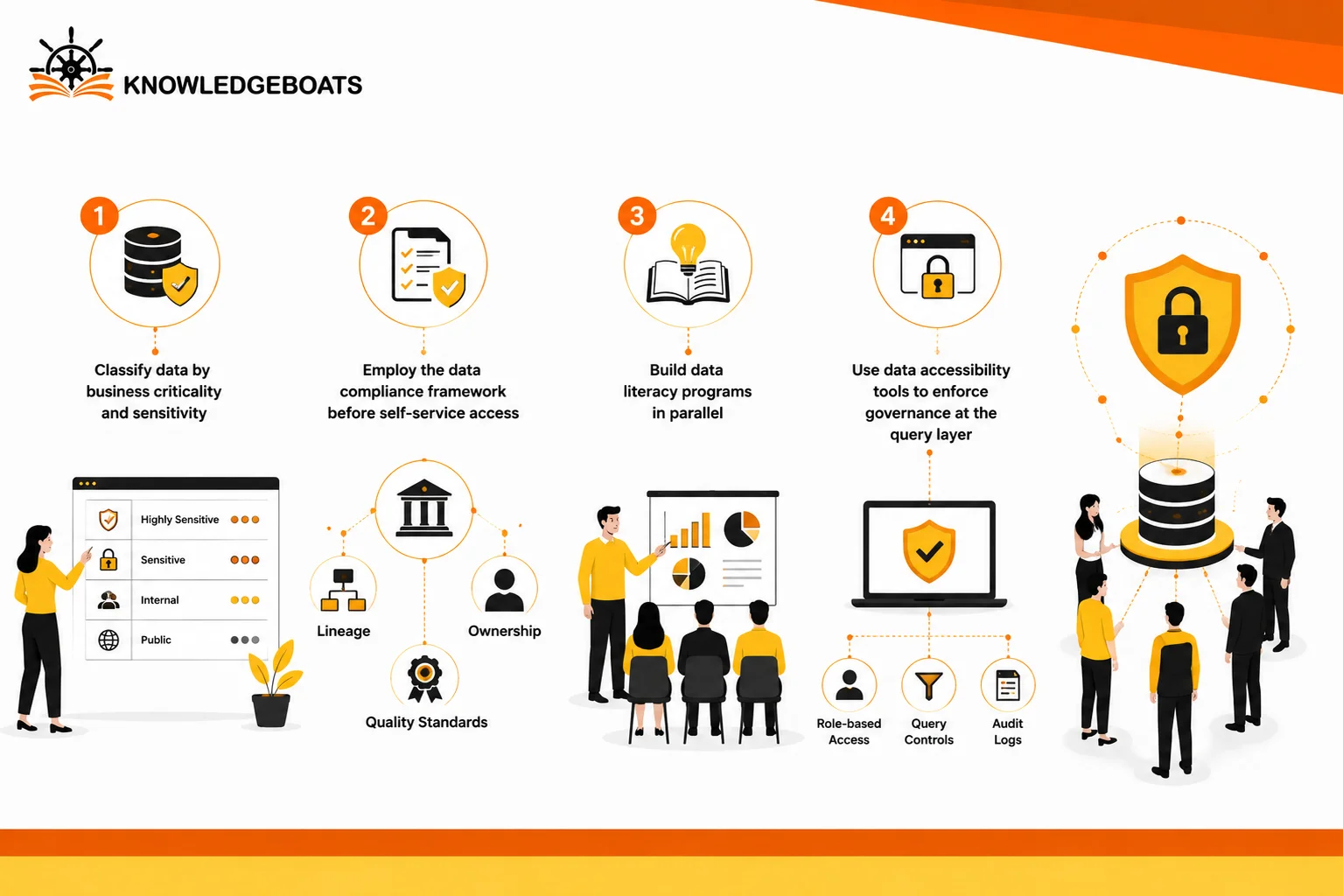
The following are the steps to implement data democratization that can maintain security and produce broad access:
- Classify data by business criticality and sensitivity. All data might not need the same access control, and uniform treatment for all data either results in under-protection or over-restriction.
- Employ the data compliance framework before self-service access. Before activating the access layer, compliance rules, lineage, ownership, and quality standards must be employed.
- Build data literacy programs in parallel with platform deployment.
- Use data accessibility tools. Instead of emphasizing user behavior, these tools must be employed at the query layer to enforce governance.
Number Analytics cited Deloitte’s research stating that effective implementation of modern data management strategies, like advanced data democratization, increases revenue growth by 30% and net profit margins by 45%.
Many democratization frameworks incorrectly present access and security as opposites, while in reality governance reduces the tension between the two.
Final Thoughts: What Is the Ideal Data Democratization Strategy for Enterprises
More than a technology initiative, data democratization is an organizational capability, which needs literacy, quality infrastructure, and governance in place before expansion.
Data democratization for business intelligence becomes a compounding competitive leverage when built accurately. However, it becomes a decision quality problem and compliance liability disguised as a data issue when it is built incorrectly.
Business users and AI models often consume the same data. As a result, the quality of modern data platforms for democratization will determine AI output quality that B2B teams rely on. Companies investing in data management strategy now will face the fewest challenges when the AI audit arrives.
Knowledgeboats can help you find where your current access strategy creates gaps in the governance framework and devise the data quality management framework.
FAQs
1. What is data democratization?
Data democratization is the process that offers authorized employees accessible, trusted, understandable, and governed data to make informed decisions without relying on centralized data specialists.
2. What are the risks of data democratization?
Decisions based on non-contextualized data, poor data interpretation, sensitive-data exposure, regulatory violations, inconsistent metrics, and excessive access are some key risks of data democratization.
3. How do organizations implement data democratization?
The first step is defining ownership, followed by classifying data. The next steps involve employing governance controls, improving data literacy, enabling self-service access, and continuously monitoring quality and compliance.
4. How does self-service analytics support data democratization?
Self-service analytics allows business users to independently find governed data and enables faster analysis to reduce reporting bottlenecks, so that users have sufficient data literacy and contextual understanding.
5. How does AI impact data democratization?
AI models consume enterprise data at scale. However, poor quality, unclear lineage, or excessive access to data amplifies errors. As a result, AI can amplify both data quality and data quality issues, depending on the underlying architecture.