AI-driven customer journey mapping helps B2B teams intervene before disengagement turns into churn by making buyers visible throughout their journey and interaction with the brand in real time.
McKinsey’s research finds that AI-powered customer journey mapping improves customer satisfaction by 15-20% and reduces cost to serve by 20-30%.
Most B2B teams treat retention as a loyalty issue, but in reality, it is a journey visibility problem. Enterprises often blame the cancellation screen for the high churn rate, while they lose buyers a few touchpoints earlier.
B2B teams often realize journey failures late and blame customer attrition on engagement campaigns. Retention issues often originate much earlier than churn.
How AI-Driven Customer Journey Mapping Improves Retention
Many B2B teams miss the structural difference between traditional journey mapping and dynamic customer journey mapping using AI, and treat the latter as only a better version of the former.
Traditional journey maps only explain how buyers move through the funnel, but they are mainly retrospective, aggregating the behavior of average buyers. However, the retention problem arises due to exceptions.
AI customer behavior analysis transforms the journey from observation to intervention by tracking real-time buyer movements to trigger responses upon deviation from the expected engagement patterns.
Its value lies in identifying a real-time point of divergence in a buyer’s journey that deviates them from the renewal pattern. B2B enterprises often find this churn signal only after it becomes a churn event. Identifying buyers that are already at risk is the prerequisite for detecting divergence.
How AI Identifies At Risk Customers in Journey Mapping
At-risk buyers skip features they previously used, log in less, take longer to respond, and eventually reduce their engagement quietly, instead of sending obvious signals. The in-progress churn event is the common pattern across every action.
Without waiting for a threshold, AI based churn prediction models track behavioral trajectory at the individual account level to detect this churn pattern. YouCX finds that AI can help enterprises predict churn 30-90 days before it actually happens.
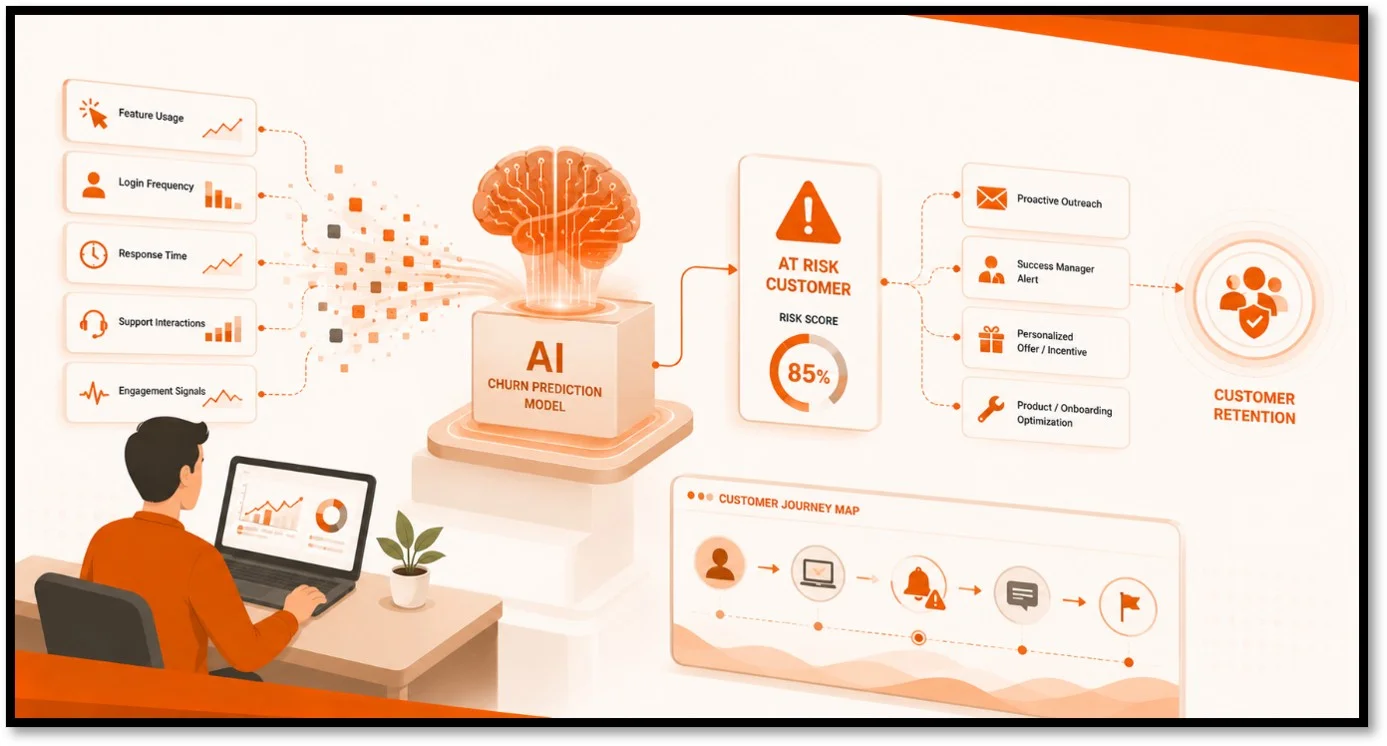
Many organizations employ churn prediction models against CRM data, including NPS scores, support ticket volumes, and contract dates. The data describes relationships that have already eroded. AI driven customer experience mapping, on the other hand, surfaces risks at the behavioral layer several weeks before they appear in CRM.
Instead of waiting for customer complaints, AI proactively predicts and detects buyer deviations. B2B teams that close the retention gap often bypass CRM records to operate behavioral journey models to trigger interventions for recoverable customer relationships.
How to Use AI for Customer Journey Optimization
Enterprises often treat journey optimization as a campaign improvement exercise, where they segment buyers into broad groups to determine the subsequent best action for every segment.
Although this logic works for all segments, it fails at the individual level. The decision turns out to be meaningful for the median customers from a 10,000-buyer group, but fails for customers at the edge.
As a result, buyers that are responsible for attrition are found at the edges, and this is why static customer journeys often produce stagnant retention outcomes. Predictive customer journey mapping pivots analysis from buyer segments to individual customers.
Instead of emphasizing the messages to be sent within the segment, AI prioritizes buyers’ specific needs based on data of their historical activity, which transforms customer experience optimization. Ideal personalization, thus, adapts based on the evolving buyer behavior.
Most teams automate the wrong intervention at scale only to see AI journey optimization programs fail. If the model is trained on the incorrect outcome variables, speed and personalization cannot compensate for it. Enterprises that focus on engagement rather than renewal probability create engaged buyers who never renew.
How AI Improves Customer Experience Across Journey Stages
Many customer experience programs optimize channels rather than journeys, and this is where they fail. The marketing team improves the email journey, product optimizes the in-app experience, and the support team reduces response time. Although every team achieves their KPIs, the attrition rate continues to increase.
This is because customers look at the business as one unit, not as independent functions, and this fragmented experience causes the customer experience to fail to retain buyers. Sword and the Script’s 2024 research found that 54% of B2B buyers would switch over because of poor customer experience.
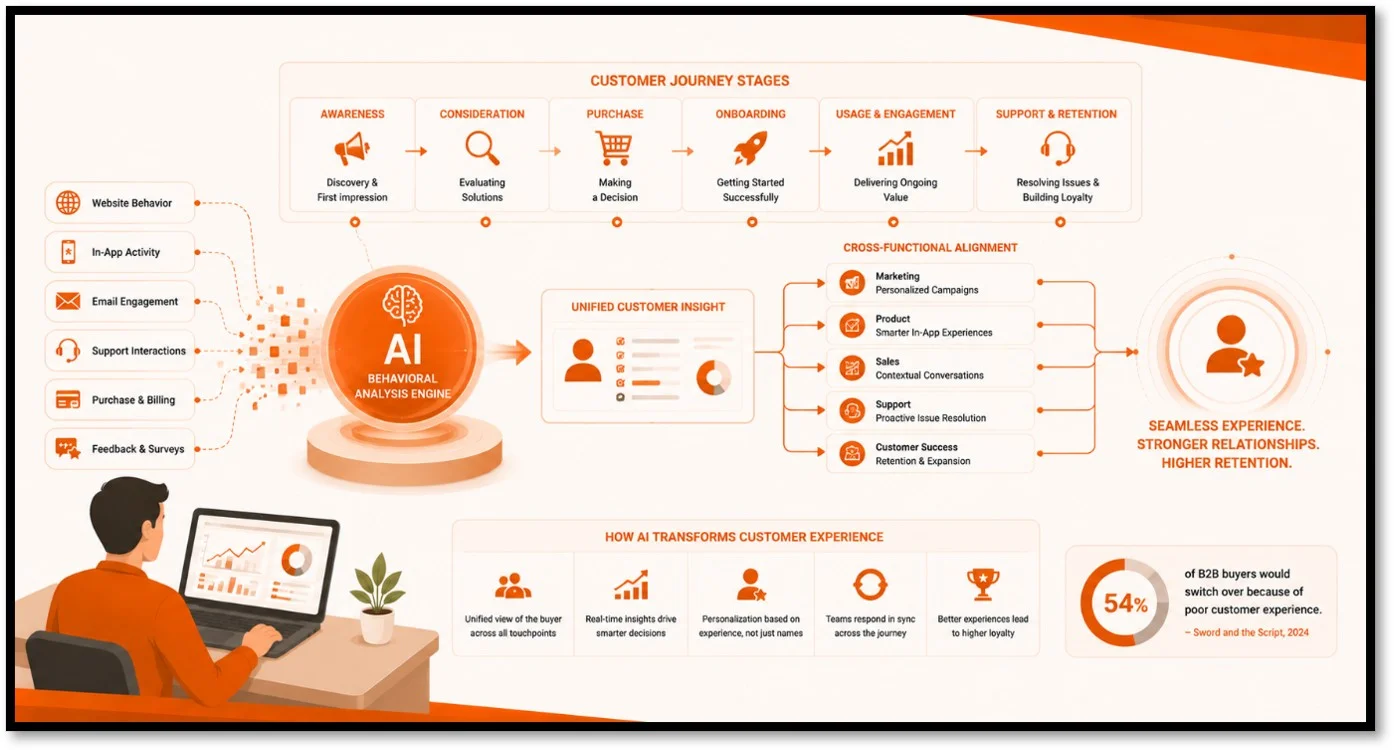
AI customer experience management, a cross-functional infrastructure decision-making model, transforms this dynamic by replacing siloed buyer views with a unified behavioral framework, which every customer-centric team is a part of.
With the help of continuous behavioral analysis, AI builds a shared understanding of what the buyer experiences at every stage, to which every department responds in unison.
The definition of personalization changes with AI in customer journey optimization, shifting from addressing individual buyers by their names to responding to their specific experiences, making each outreach reflect that context.
Final Thoughts: How Reducing Customer Churn Using AI Analytics Will Improve Long-term Retention
AI-driven customer journey mapping for retention helps B2B enterprises understand buyer behavior before customers communicate their dissatisfaction. It tells companies where their buyers are in their journey, helping teams predict what customers will do next, and suggests actions that bolster their relationships.
B2B enterprises that consider journey data as an operational infrastructure will have an edge over teams treating it as a marketing asset. Companies investing in journey orchestration platforms will build a compounding customer intelligence layer with each interaction.
Want to find where customers disengage before churn surfaces? Reach out to Knowledgeboats to devise meaningful customer retention strategies using AI that not only identify early churn signals but also suggest a solution for the problem.
FAQs
1. What are the benefits of AI in customer journey mapping for retention?
AI-driven customer journey mapping not only enables B2B teams to identify early churn signals, but it also allows them to improve engagement. It helps enterprises personalize buyer experience in real-time, bolsters retention through proactive interventions, and increases CLV.
2. What is AI-driven lifecycle marketing for retention, and why does it matter?
Using predictive customer insights, AI-powered lifecycle marketing personalizes interactions at every buyer stage. It also ensures that buyers receive relevant experiences depending on their evolving behavior, which strengthens renewal rates and long-term engagement.
3. How does AI personalization in customer journey mapping improve customer engagement?
AI tracks historical interactions, buyer preferences, and behavioral patterns to personalize messages, onboarding experiences, customer success actions, and product suggestions for every buyer rather than targeting broad segments.
4. How does real-time personalization using journey analytics work?
Real-time journey analytics tracks customer interactions across different channels continuously to instantaneously adjust offers, engagement strategies, support, and communication depending on buyers’ recent activity, current journey stage, and predicted intent.
5. Which AI driven customer engagement strategies improve customer loyalty?
Dynamic customer segmentation, next-best-action recommendations, cross-channel journey orchestration, proactive customer success interventions, personalized lifecycle campaigns, behavioral journey analytics, and predictive churn detection are some key strategies in AI-powered engagement.