Business process automation can replace rule-based, manual tasks with software-driven workflows to improve operational efficiency, and the decision to automate depends on factors such as downstream business impact, rule governance, and execution volume.
Many B2B teams misunderstand business process automation definition, treating it as a technology replacement decision, and they choose platforms before identifying the process to automate and why.
Enterprises lacking a prioritization framework often stall on business process automation strategy, and low-value process automation only delivers faster low-value work. APPS SCALE LAB’s 2026 research finds that 70% of digital transformation initiatives fail to meet their stated goals.
When a company understands how to choose a business process to automate, it can ensure compounding advantage from its first business workflow automation.
What Is Business Process Automation
Executing rule-based and structured tasks, such as data entry, notifications, and routing, using software with minimal human intervention required at each step is called business workflow automation.

Gitnux’s 2026 research finds that 58% of B2B enterprises use RPA to replace manual data entry. However, automating the workflow inside a broken process shifts bottlenecks from one point to another rather than improving the process.
| Dimension | BPA | RPA | Intelligent Automation |
| What It Automates | Rule-based and structured end-to-end business workflows. | Repetitive tasks replicating human keyboard and mouse actions. | Semi-structured complex processes. |
| How It Decides | Conditional rules and predefined logic. | A scripted rulebook linked to UI elements. | NLP and ML models. |
| What Causes It Break | Undocumented exceptions or unstructured process inputs. | Change in UI. | Insufficient training data or poorly defined process logic. |
Intelligent automation can represent a later maturity stage, where rule-based automation is the first step, followed by an AI layer as data confidence develops. Automation should follow process visibility. B2B enterprises starting with clear, rule-governed, and high-friction processes often build successful programs.
What Makes a Business Process Suitable for Automation
Business process automation use cases are strong candidates when workflows have high volume, are repetitive, and rule-based, with no system configured to handle them.
A business process automation framework often emphasizes what a process appears to be on paper. Disqualifying signals, however, surface when the process is mapped in detail, and many B2B enterprises omit this step.
| Criterion | Automation-fit Signal | Disqualifying Signal |
| High-volume | Multiple recurring executions. | Rare activity |
| Error-sensitivity | Manual errors that incur costs. | Errors are inconsequential and rare. |
| Rule-governed | Consistent decision rules. | Contextual judgment-based outcomes. |
| Time-critical | Delays affect outcomes. | Flexible timing, and latency reduction is not commercially visible. |
| Data-standardization | Structured inputs. | Inconsistent inputs. |
High-volume manual work often accumulates without being questioned, creating automation candidates with greater commercial value.
Process mapping before automation can eliminate the post-deployment surprises, such as a process looking rule-based at the summary level and containing judgment steps that the executor did not articulate.
How to Identify Business Processes to Automate
A structured audit mapping the existing execution against defined qualification criteria is how do companies decide what to automate. Rather than choosing the process with the most favorable effort-to-impact ratio, B2B teams often select the one with the strongest executive sponsor, and the decision becomes political.
The effort-vs-impact matrix can eliminate the political dimension and make prioritization conversations more defensible. Asana’s research, cited by Clockify, found that employees spend 62% of their time on recurring tasks.
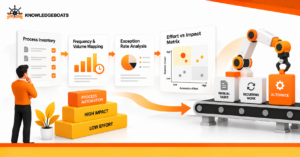
The following can be a practical four-step business process automation guide that can save this wasted time:
- Step 1- Process Inventory: Document all recurring workflows that need manual intervention.
- Step 2- Frequency and Volume Mapping: Track executions per week and time needed per execution to establish a time-cost baseline.
- Step 3- Exception Rate Analysis: Analyze the frequency of deviation for each process, and what triggers this deviation.
- Step 4- Effort-vs-Impact Matrix: Score every candidate on business impact and automation effort, from low to high. Focus on the high-impact, low-effort quadrant for the first process improvement and automation.
A high-volume, low-visibility process can remain hidden for years because it is rarely questioned, and this is what makes a good automation candidate.
How to Create a Business Process Automation Strategy
A sequential plan that defines which processes should be automated, in what order, what governance should be applied, and how the program scales from the initial deployment to the company-wide capability is called a business process automation implementation strategy.
Although B2B teams treat this as a technology roadmap, it is an organizational change program, and governance decisions taken determine its scalability.
| Phase | What to Automate | Success Metric |
| Phase 1: Foundation | One high-volume, low-complexity process. | Before-vs-after error rate and time-per-process reduction. |
| Phase 2: Expansion | 3–5 adjacent processes, where governance and data standards are already established. | FTE hours recovered. |
| Phase 3: Intelligence | AI layered on stable, data-rich workflows. | Process accuracy at scale and exception resolution time. |
B2B enterprises employing AI business automation on cluttered data and unestablished governance end up building an automation foundation on an unsupportive intelligence layer.
Beyond acquiring business process automation tools, automation program ownership should be prioritized. Its absence can make the program fragmented into siloed departmental, disconnected automations.
What Should a Company Automate First
Processes with high execution volume, downstream business impact, and rule-based governance should be automated first. Automating a high-impact process first, producing measurable time recovery, can build the budget case for each following automation.

The correct first process workflow automation might not be universal. It usually depends on where the most rule-governed and friction-driven process resides in an organization. The following comparative table answers where should a company start with automation:
| Process | Why It Qualifies | Platform Examples |
| Employee Onboarding | Time-sensitive, repetitive, and multi-step. | Workato and BambooHR. |
| Report Generation | Recurring and data-driven. | Power BI and Looker. |
| CRM Data Entry and Enrichment | Structured and repetitive. | Salesforce Flow and HubSpot Workflows. |
| Approval Workflows | Clear routing rules. | ServiceNow and Monday.com |
| Invoice Processing | Compliance-critical, rule-based, and high volume. | SAP Concur and Tipalti. |
Final Thoughts: Why Is Business Process Automation Important
Rather than selecting a platform or setting the budget, a scalable business process automation system starts with the right first decision.
Rather than using sophisticated business process automation software, B2B teams can build a compounding advantage by automating the right process first, measuring the result precisely, and using that evidence to justify subsequent automation.
Knowledgeboats helps you understand how to prioritize business process automation and find processes in your existing operations worth automating first.
FAQs
1. What should companies automate first?
Processes with high-volume, measurable costs, rule-based governance, clear outcomes, manageable implementation complexity, and stable inputs should be automated first.
2. Which processes are best suited for automation?
Business processes that have predictable rules, structured data, measurable errors, high transaction volume, limited judgment, and repetitive steps are best suited for automation.
3. How do you prioritize automation opportunities?
Score processes by execution volume, business impact, measurable ROI, exception rate, implementation effort, data readiness, and automation feasibility to prioritize automation opportunities.
4. How is BPA different from RPA?
While BPA automates general business workflows, RPA automates recurring system-level tasks with the help of structured interactions and predefined instructions.
5. How do you calculate automation ROI?
Automation ROI can be calculated by comparing measurable benefits from the automated process with implementation and ongoing operating costs, including labor capacity, error reduction, maintenance, and governance costs.