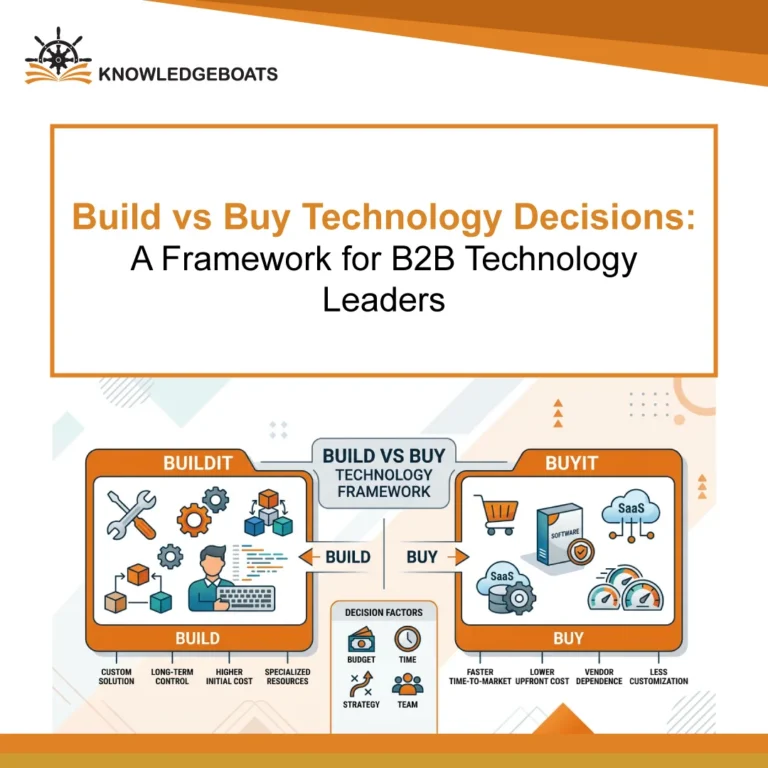
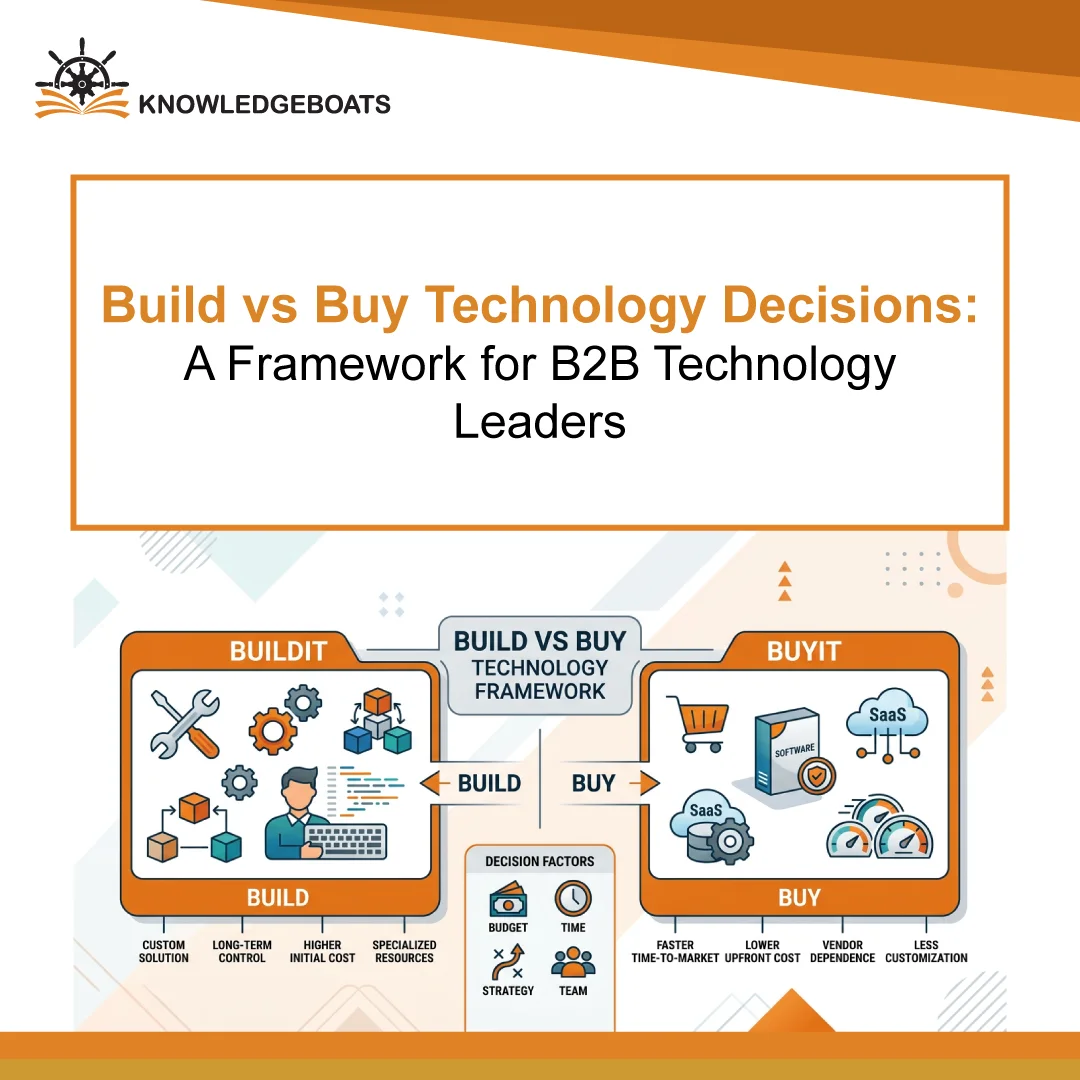
Along with a company’s internal software development capabilities, the right build vs buy technology decision depends on long-term control, total cost, strategic differentiation, risk, and speed. The conventional belief of “build for differentiation, buy for everything else” is incomplete in 2026, though it is useful.
Because procurement is familiar and SaaS is fast, B2B teams buy, but as proprietary software becomes a product, that bias feels incomplete and wrong. Medium’s 2026 research finds that 66% of software development projects fail as they either exceed budget, miss timelines, or fail to deliver what they promised.
A more accurate response to how to choose between custom software and SaaS can be to check whether the capability deserves to be an internally owned asset. Selecting without a build vs buy decision framework can be the most expensive mistake.
How to Make a Build vs Buy Decision
Evaluating competitive differentiation, time to market, total cost of ownership, internal capability, and strategic flexibility systematically can help B2B teams make a build vs buy software decision.
These criteria should be applied before estimating development efforts or comparing vendors. Tiraverse’s 2026 analysis finds that 35% of B2B enterprises are replacing SaaS with custom software.
Assuming a build vs buy approach to be mutually exclusive can create strategic rigidity, because APIs, custom layers, configuration, and extension reside between both. Before making a decision, you can use the following practical criteria framework:
| Parameter | Build Signal | Buy Signal |
|---|---|---|
| Time to Market | Manageable | Immediate launch |
| Internal Capability | Team exists | Capability unavailable |
| Competitive Differentiation | Unique advantage | Commodity capability |
| Strategic Flexibility | Control matters | Ecosystem matters |
| Total Cost of Ownership | Ownership pays | Licensing pays |
Before choosing full custom development, B2B teams should check if the capability can be bought and then differentiated via configuration, which is how to decide whether to build or buy software. More than building or buying, the real decision comes from the capability to be owned.
When Should a Company Build Custom Software
When equivalent commercial alternatives cannot produce the desired outcome, the capability itself is the product, or workflow logic demands customization in any off-the-shelf solution, a B2B team should build custom software.
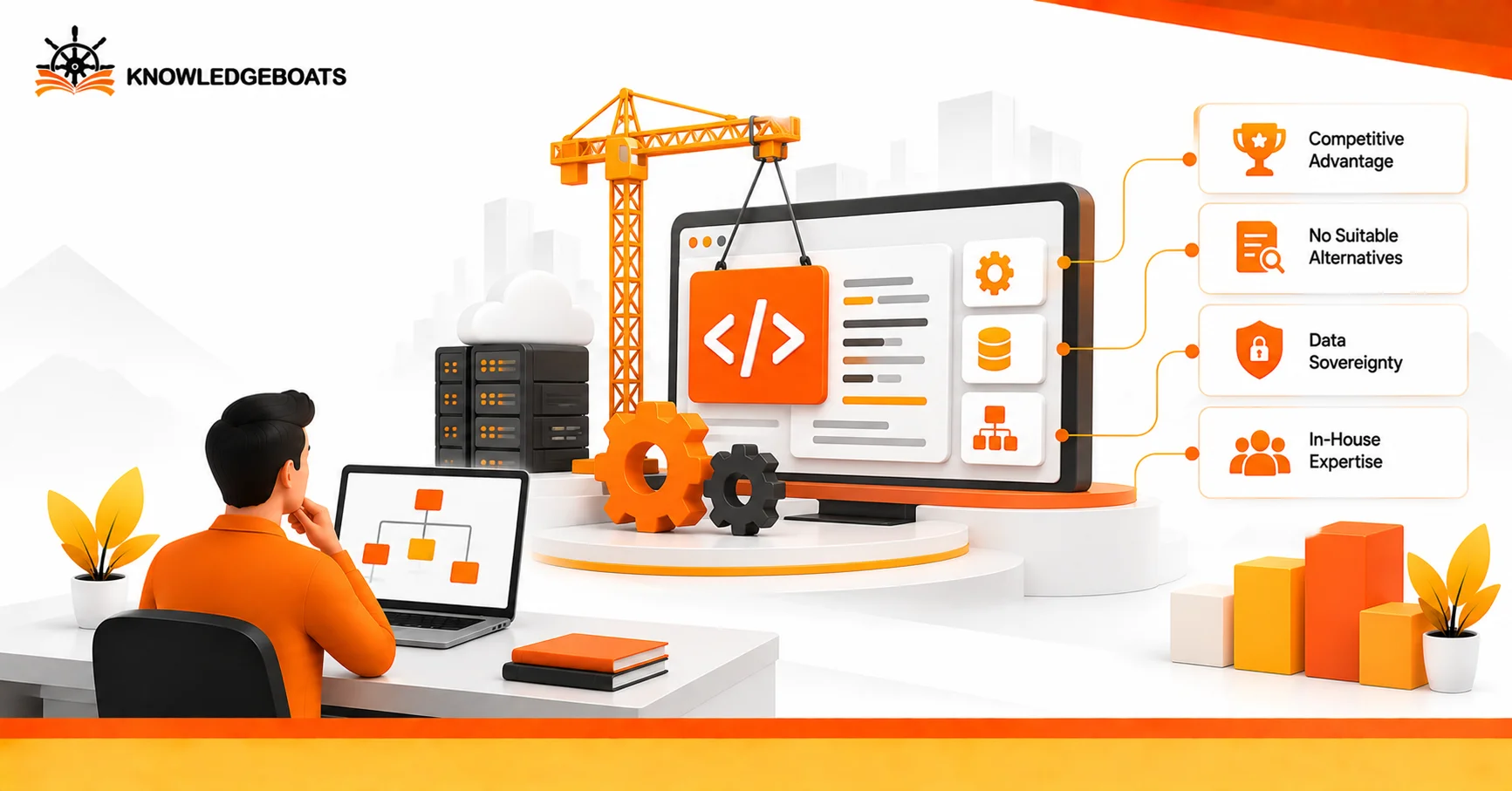
The following practical conditions can define when to build vs buy software decision framework:
- The software is the competitive moat. The company sells the proprietary logic inside the system.
- No commercial alternative is suitable. Adopting a SaaS product requires more development effort than building.
- Data sovereignty is non-negotiable. Third-party data hosting structurally becomes unacceptable due to security, competitive, or regulatory requirements.
- The internal team is capable of maintaining what it builds. Institutional knowledge and engineering capacity can exist for long-term iteration.
Then when is custom software worth building? Only when the enterprise decides to be the long-term owner of the product and is ready to bear maintenance, security, and support costs. Software that becomes a part of a company’s strategic capability can be a strong build case.
When Is SaaS Better Than Custom Software
When the supported process is not a source of differentiation, existing commercial alternatives efficiently solve the problem at scale, and the ownership cost favors licensing over development, it is when a company should choose SaaS.
Many B2B teams do not choose SaaS because they feel they might lose control or have different engineering preferences. However, this does not imply custom development is always better for enterprises.
| Dimension | When SaaS Is Better | When Build Is Better |
|---|---|---|
| Feature development pace | Vendor roadmap | Unique roadmap |
| Vendor support | Specialist support is available | Internal ownership |
| Deployment speed | Rapid launch | Manageable speed |
| Proprietary logic | Standard workflow | Differentiated logic |
| 5-year cost | Predictable usage | Scale transforms economics. |
Enterprise software selection should be a five-year TCO horizon evaluation plan. Many buyers can fund features that one enterprise might not build on its own, which is why SaaS has an edge.
How AI Is Changing Build vs Buy Decisions in 2026
AI can compress custom development costs rather than reducing governance, security, product ownership, or maintenance, changing decisions in the build vs buy enterprise software conversation.
Development speed rarely changes the differentiation calculus, which is why building the software that is expected to be bought might not give optimum results, though B2B teams argue stating that AI reduces cost. Lower development effort rarely removes governance, maintenance, AI operating costs, or product ownership.

The following AI shifts matter for the build vs buy framework:
- AI can reduce build effort. It does not affect ownership. Developers using tools like Cursor and GitHub Copilot can code faster, while post-launch maintenance, governance, and ownership costs do not disappear.
- AI increases the SaaS quality ceiling. Commercial software embeds AI capabilities that need major ML engineering to reproduce internally.
- Proprietary AI produces a new build category. Models trained on proprietary data can create more value than those trained on shared commercial capabilities.
According to Novative’s 2026 analysis, AI-powered development reduced software development cost by 30-50% in the last three years. Buying a foundation to build a differentiated intelligence layer can be a high value-producing answer to the debate in 2026.
Should companies build or buy AI software? The decision depends on whether the proprietary data can produce a defensible edge. While AI is supposed to transform the evaluation criteria, it should not eliminate build vs buy analysis discipline.
Final Thoughts: What Is the Build vs Buy Technology Decision Framework for B2B Technology Leaders
The debate on custom software vs off-the-shelf software starts by asking whether the capability gives rise to competitive differentiation, and operates backward from the answer. Rather than minimizing software cost, allocating technology ownership where it produces measurable business value is the core objective.
How to choose between building and buying software? Build if it offers you a unique edge; buy if a commercial platform meets the demand without compromising the advantage. AI can simultaneously raise SaaS quality and compress build cost, and the differentiation criteria remains decisive.
Knowledgeboats can help you develop a build vs buy framework for enterprises, and find out whether the technology roadmap can be built, reconsidered, or bought based on your existing capabilities.
FAQs
1. When should a company build software instead of buying it?
When software can produce competitive differentiation, proprietary data matters, internal teams can withstand long-term ownership, and commercial alternatives fail, a company should choose to build.
2. When should a company buy software instead of building it?
When a company has to meet standard requirements and operational speed, five-year ownership economics favor licensing, and commercial products can provide adequate functionality, a company should buy software instead of building.
3. How do you calculate build vs buy costs?
Include licensing, maintenance, support, security, opportunity, training, development, upgrades, and infrastructure costs while calculating five-year TCO.
4. How does competitive differentiation affect build vs buy decisions?
When proprietary software can share operational advantage, defensible IP, unique data capabilities, and directly create customer value, competitive differentiation strengthens the build case.
5. What are the risks of building custom software?
Cost overruns and risks around security, governance, maintenance, technical debt, long-term ownership responsibility, and scalability can affect building custom software.