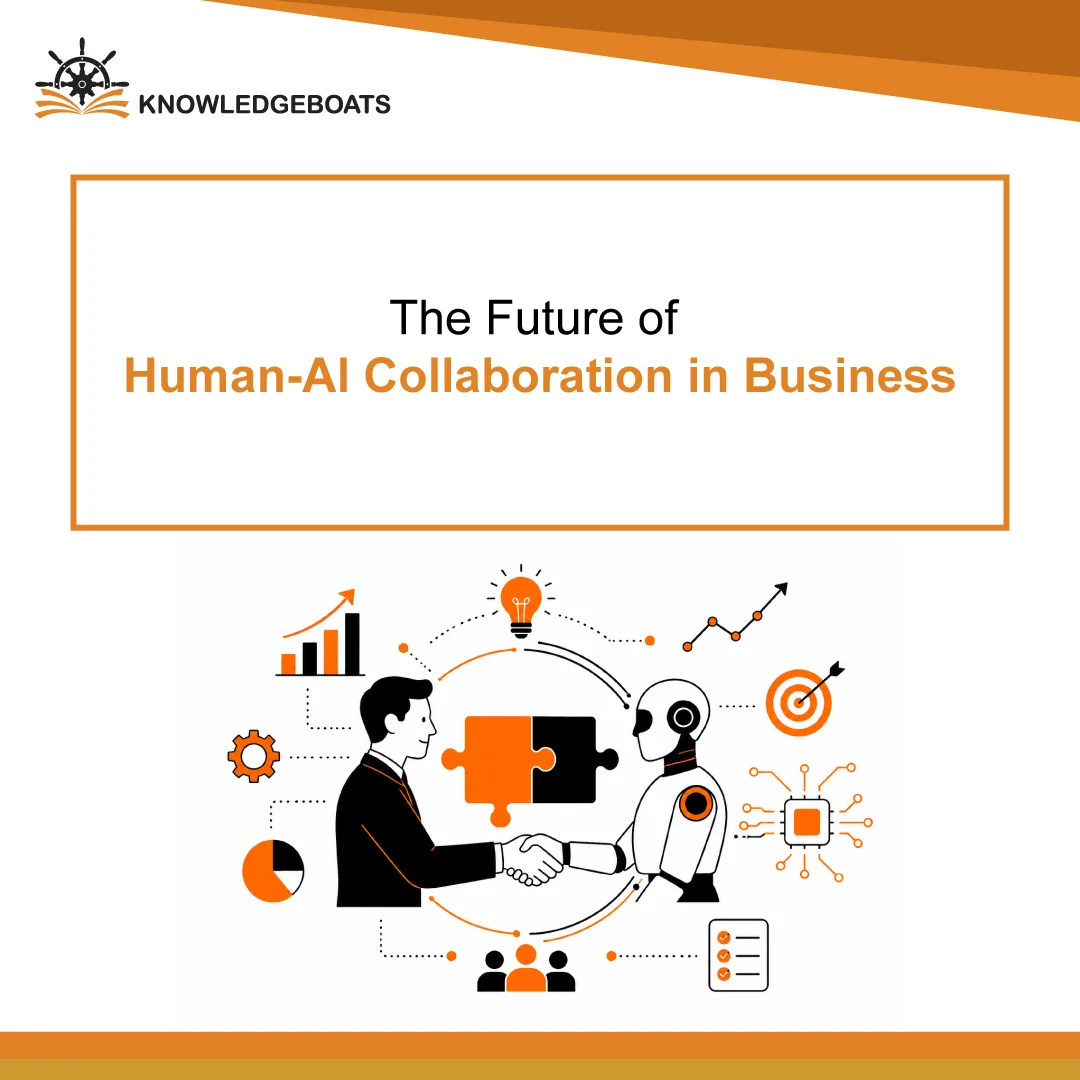
The future of human-AI collaboration will benefit B2B enterprises that can integrate both effectively, with AI handling tasks it performs better while humans can prioritize high-value tasks like contextual reasoning, relationships, and judgment.
Although most B2B teams treat AI as a replacement strategy, its real commercial value lies in augmentation. Companies often automate tasks before redesigning workflows, and this is the core problem.
Azumo’s 2025 report finds that 91% of employees across B2B enterprises say their teams use at least one AI technology. Rather than increasing work volume, AI provides a competitive advantage by performing the correct tasks. AI-powered productivity is often measured based on quality of decisions instead of volume of automated tasks.
What Is Human-AI Collaboration in Business
Human and AI collaboration is often defined as humans using an AI tool, but this is mere augmentation treated as collaboration. When leaders use AI to summarize a legal document, they are augmenting a task rather than collaborating with AI. As humans own all critical decisions, the workflow remains unchanged.
Human-AI partnership works only when B2B enterprises redesign workflows around complementary strengths. While AI takes up tasks it is structurally superior at, humans look after judgment-driven, context-centric, and accountability-oriented tasks.
As augmentation and collaboration logic produce fundamentally different outcomes, the distinction matters the most. While augmentation focuses on completing tasks faster, complementarity segregates tasks based on individual capabilities of AI and humans so that both improve each other’s performance.
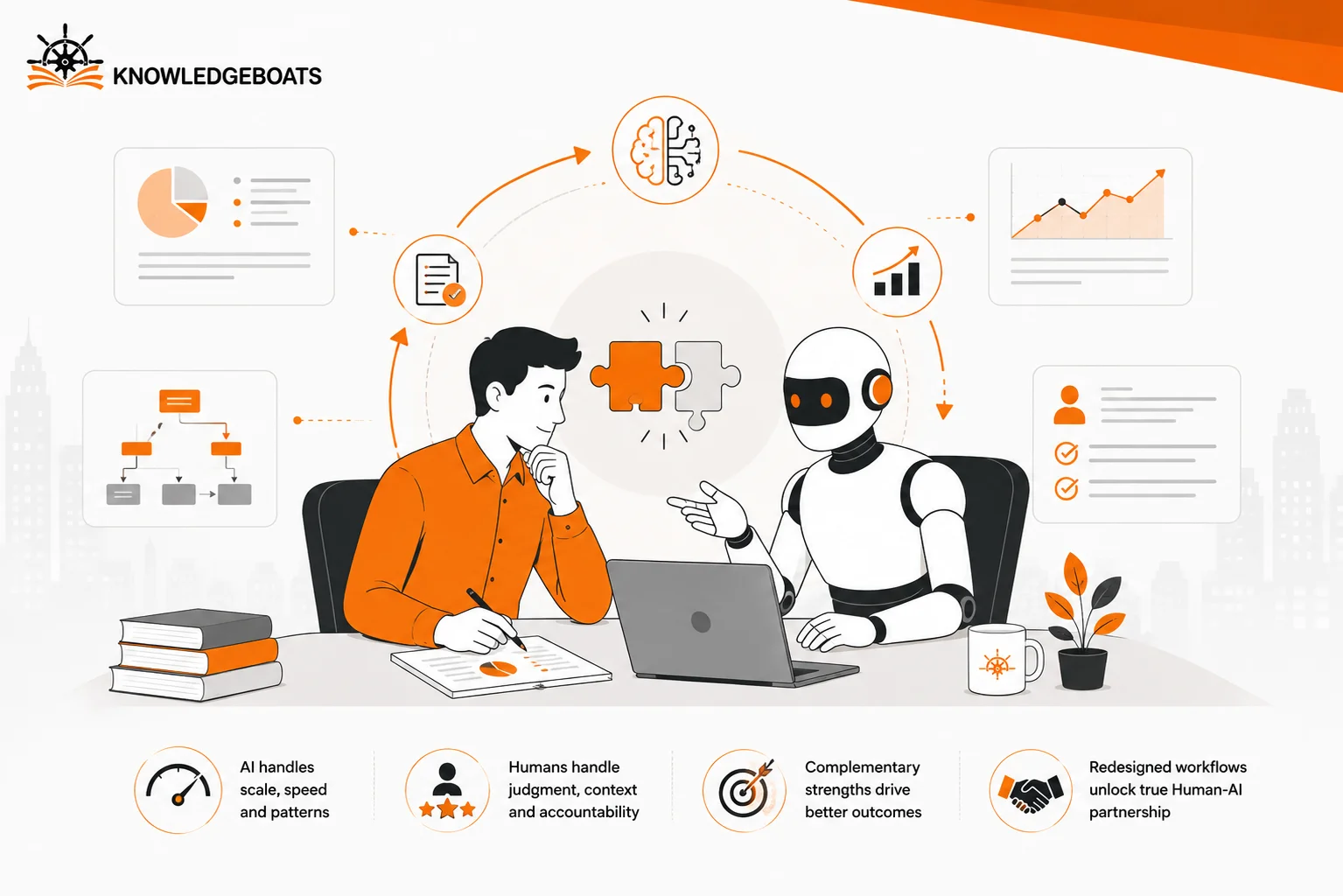
Collaborative intelligence based on complementary logic often outperforms AI-assisted decision making built on augmentation logic. AI copilots built on Large Language Models (LLMs), including platforms like Google Gemini, Salesforce Agentforce, and Microsoft Copilot, become successful when deployed with complementary logic.
Rather than treating AI-human collaboration as technology deployment, B2B enterprises considering it as a workflow design often observe structural performance improvement.
How Human-AI Collaboration in the Workplace Changes Work
The future workplace with AI will explicitly define the boundary between machine and human responsibility, ensuring AI-powered workflows function as the operating model’s permanent layer.
Most AI deployments follow a predictable pattern, starting with buying platforms, followed by training employees, and ending with measuring adoption rates. Although this approach produces high adoption, it hardly generates transformation.
Enterprises that initiate process audits end up with structural workforce optimization. The audit identifies workflows consuming the most human time and the AI agents that can offer end-to-end solutions to reduce that burden.
McKinsey’s research finds that current Gen AI can automate workflows to absorb 60-70% of employees’ time. AI-enabled workforce transformation is often a discontinuous shift, and every subsequent upgrade is triggered when the preceding AI capability matures to own the workflow that required human intervention previously.
B2B teams often have productivity advantages of a digital workplace architecture equipped with governance frameworks and accountability structures designed to absorb these shifts.
What Are the Benefits of Human-AI Collaboration
The discussion on the advantages of human-AI collaboration in business often ends with speed and cost reduction. Although these parameters are significant, they are hardly the differentiators that matter today.
Instead of measuring innovation rate, work capacity, or decision quality, most B2B enterprises and employee productivity programs track the wrong metrics. Executing the wrong decisions rapidly at scale only leads to the incorrect outcome.
Decision quality is the key benefit that compounds, as AI can process information volume beyond human cognitive capacity. An analyst evaluating 50 and 5,000 datapoints makes substantially different quality decisions in both cases. However, AI collaboration makes the latter feasible.
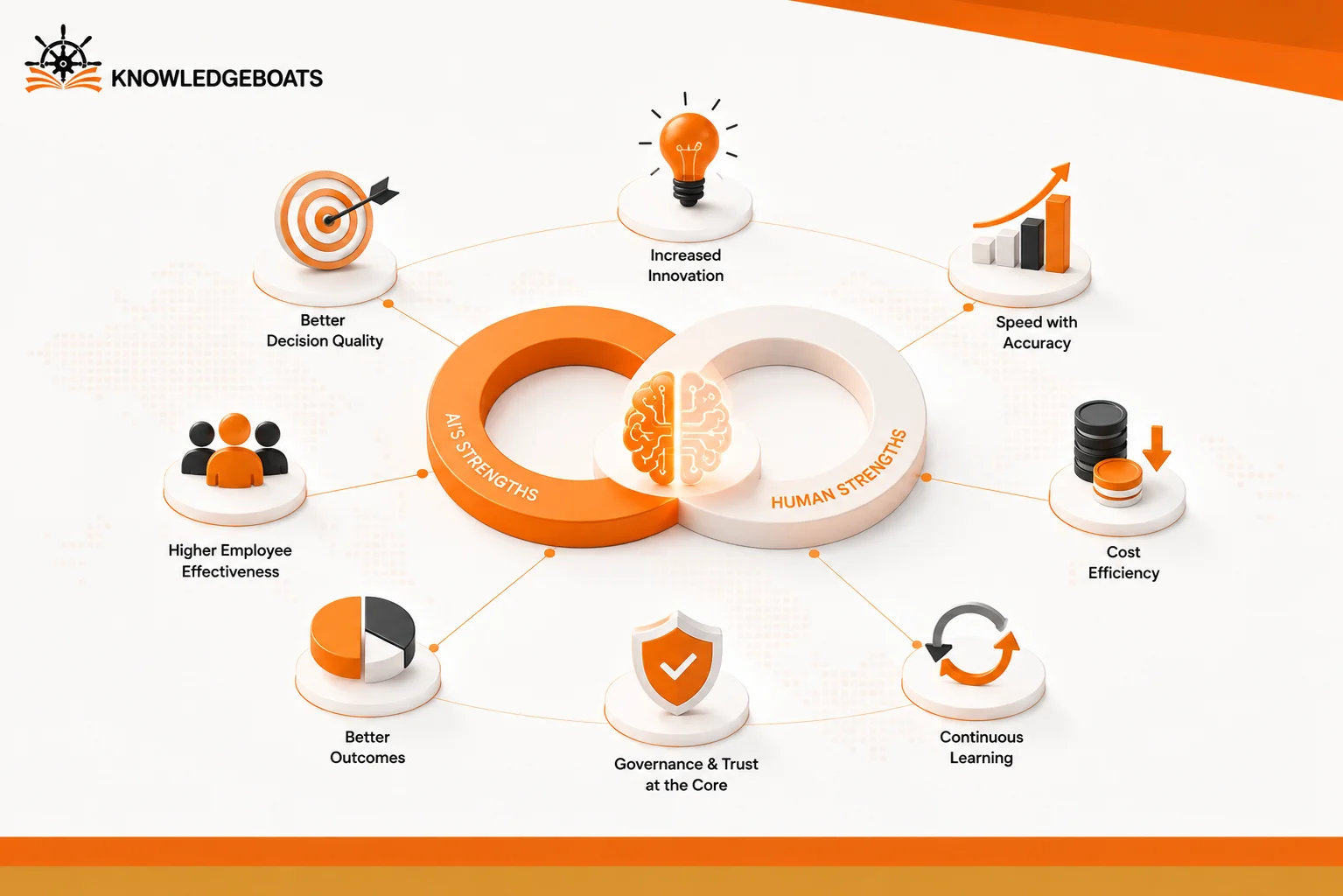
The enterprise AI component often improves over time, but B2B teams employing static models produce a one-time productivity benefit. However, organizations that deploy feedback loop-embedded models often produce compounding benefits.
Platforms like Salesforce Agentforce and Microsoft Copilot learn from every decision cycle, making humans more effective, which subsequently produces better data for the following cycle. However, constructing feedback architecture and AI governance is a mandatory prerequisite.
Which Human-AI Collaboration Strategies Work at Enterprise Scale
AI implementation in enterprises often starts with change management, which helps employees accept AI. However, it can never be sufficient. A more important step is to work on accountability, clarifying the responsibility of personnel when AI-driven decisions go wrong.
B2B teams that ignore the question before deployment often answer reactively, mostly during a client conversation, an incident, or a regulatory review. AI-driven workforce transformation at scale requires the following three architectural decisions:
1. Task Boundary Design
Defining explicit boundaries before deploying AI is the first step. Without this step, AI is not owned anywhere despite getting deployed everywhere. As a result, it produces overlapping responsibility with diffused accountability. Here are the key questions that must be asked before AI automation:
- Which tasks will AI own autonomously?
- Which operations does AI support with human final authority?
- Which actions must remain human-only due to accountability, relationship requirements, and judgment?
2. Governance Integration
Human-centered AI in business is often built on trust. AI decisions that affect humans must remain visible to them. Digital Applied’s 2026 research finds that 56% of B2B teams employ a dedicated agentic AI for governance. However, instead of treating governance integration as a compliance overhead, it should be embedded in the workflow design.
3. Continuous Learning Architecture
Treating employee feedback, including rejection, correction, recommendation, or approval, as structured organizational knowledge is a sign of successful implementation of AI in the workplace.
Summary: How Human and AI Working Together Will Transform the Workplace
The future of human-AI collaboration will stretch beyond a technological inevitability to become an organizational design choice, which will determine if the decision-making becomes more accurate or the company produces a wrong outcome faster.
Well-defined task ownership, proper governance, feedback loops, and accountability structures are important factors that reduce the friction in AI-driven collaboration with humans. B2B teams investing in this infrastructure will build a competitive architecture that competitors can hardly ever replicate.
The transition of AI models from task execution to multi-step autonomous decision-making will make the collaborative model’s quality a key differentiator for enterprise AI ROI.
Want to check if your enterprise is ready to embrace the future of AI in business? Book a 30-minute human-AI collaboration readiness audit with Knowledgeboats, and identify where your current workflow design limits AI productivity.
FAQs
1. How does AI improve workplace collaboration?
Along with automating repetitive work and allowing employees to prioritize strategic, relationship-driven, and creative responsibilities, AI supports decision-making and generates faster insights, improving workplace collaboration.
2. Will AI replace human workers?
Although AI will take over some routine and repetitive tasks, it will hardly entirely replace human expertise. Companies will redesign roles, fostering human-AI collaboration that improves productivity and business outcomes.
3. How can businesses use AI to improve productivity?
AI deploys copilots and agents to allow employees to emphasize high-value decision-making and innovation. It also automates repetitive tasks by redesigning workflows and improves productivity.
4. What are the challenges of human-AI collaboration?
Overreliance on AI without human judgment, employee skill gaps, unclear accountability, limited AI governance, poor workflow design, and data quality issues are some key challenges in human-AI collaborations.
5. How do AI agents work with human teams?
AI agents analyze data, recommend or execute actions, and manage defined tasks, while humans provide oversight, accountability, judgment, and ethical decision-making.