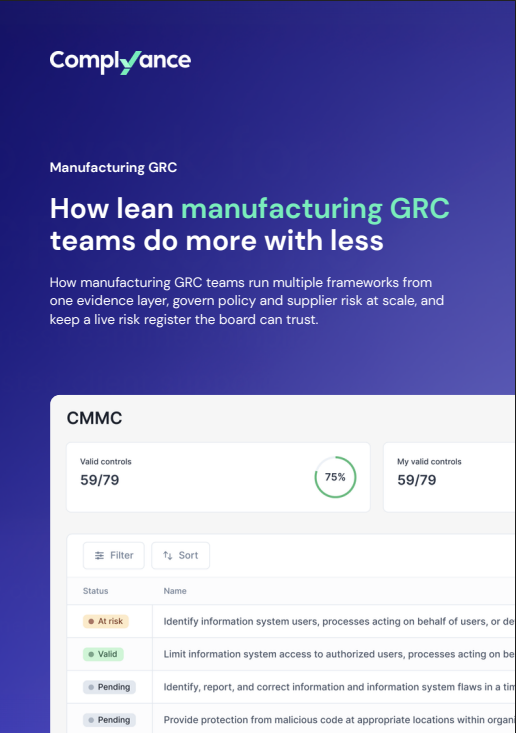
Manufacturing GRC teams are expected to run a lot of programs at once, and to do it with a lean team. Frameworks like NIST CSF, ISO 27001, and CMMC; customer-driven security standards; newly emerging AI governance requirements; and ever-changing state-privacy regulations all land on the same team. Each carries its own requirements, but many of those requirements overlap, and the same controls have to be evidenced across different jurisdictions, at different times, and across different sites. That overlap is what makes the manual model so heavy. The same evidence gets collected separately for each framework, control owners get chased by email for things they’ve already handed over once, and no one has a single view of where compliance actually stands at any given moment. Every new framework, site, and supplier adds to the load, but the team stays the same size. With Complyance, that execution work moves off the team’s plate. Purpose-built AI agents, domain-trained and secure, apply the organization’s own criteria and manufacturing-specific workflows across every framework, so the program runs continuously instead of lurching from one audit to the next. The team sets the criteria and makes the calls; the agents do the collecting, reviewing, chasing, and drafting underneath them. Here’s how that plays out across the program lifecycle: running multiple frameworks from one evidence layer, managing policy as a governed layer of the program, reviewing supplier risk at scale, and bringing every control gap and supplier finding into one live risk register.
