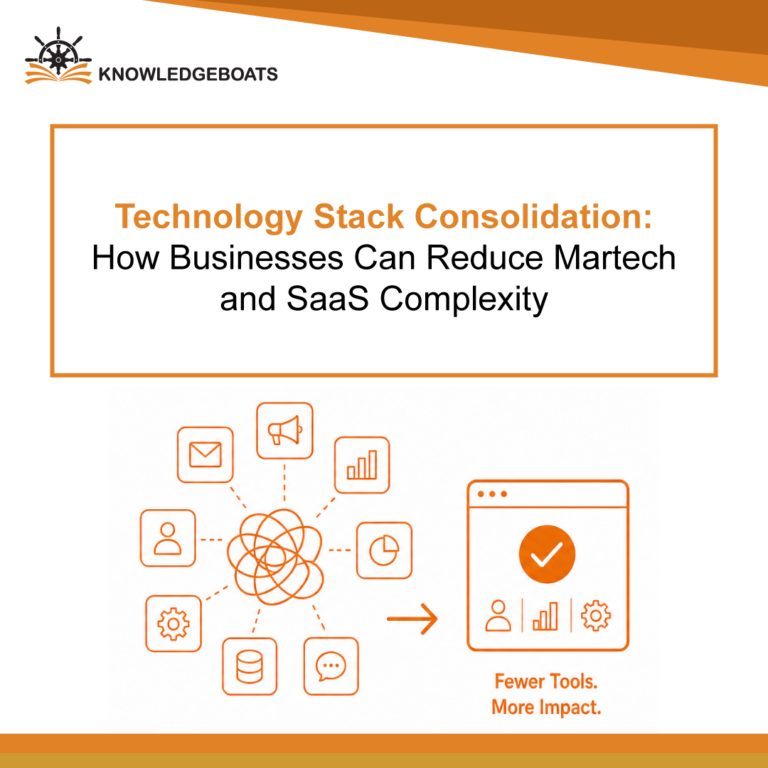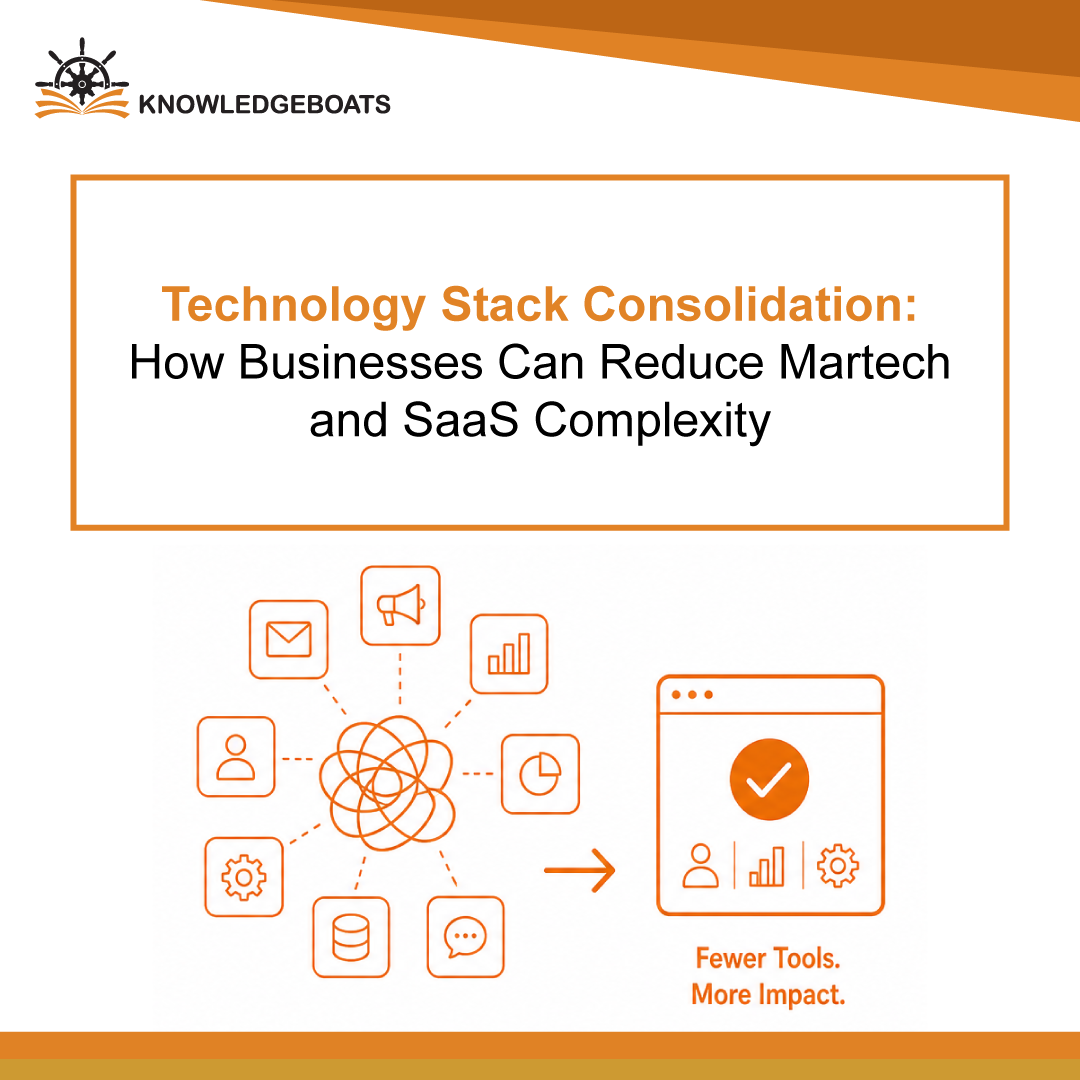
Technology stack consolidation can channelize software investments into platforms producing measurable business outcomes, unify fragmented data, and eliminate redundant tools, reducing operational costs and complexity.
B2B teams buy many applications for different purposes but rarely evaluate them against what they already have. Enterprises often frame technology stack management as a cost reduction program, but the real value comes from data unification.
Disconnected tools result in disconnected data, which eventually produces analytical failures misallocating budgets. According to Productiv’s report, cited by Businesswire, B2B teams use only 45% of SaaS applications regularly.
Rather than a software-count reduction program, data flows and business capabilities are the ideal starting points for SaaS consolidation. The real answer to why consolidate a martech stack lies in identifying the highest-utility stack for specific business models.
What Is Technology Stack Consolidation
The process of concentrating capabilities in integrated platforms, eliminating underutilized applications, and auditing all in-use software is a perfect answer to what is tech stack consolidation. Instead of using one platform to replace multiple tools, workflow dependencies and architecture matter more.
| Terminology | What It Means |
| SaaS Sprawl | What is SaaS sprawl? It is the unmanaged accumulation of unevaluated software in the stack. |
| MarTech Consolidation | It channelizes spend to serve several marketing functions, integrates data flows, and reduces tool count to rationalize the marketing technology stack. |
| Tech Stack Rationalization | It evaluates each tool present in the stack against existing business requirements. |
Enterprise technology stack governance should evaluate whether each new tool adds differentiated capability, overlaps with an existing tool, or creates avoidable integration and ownership costs.
Even smaller technology stacks can become fragmented when data and workflows remain disconnected. Applications purchased without proper integration evaluation can be costlier than combined licensing fees.
Why Should Businesses Consolidate Their Technology Stack
SaaS sprawl often creates compounding costs that, although they appear manageable at the individual level, can collectively make the business underperform. More than subscription costs, operational complexity can be a consolidation opportunity.

Each newly added application can bring security, process, ownership, integration, and data dependencies with it. SaaS sprawl can introduce the following costs:
- Redundancy Cost: B2B teams pay for business technology stack capabilities already present.
- Integration Cost: Data and engineering teams invest time in maintaining connections between tools that were not meant to operate as a single architecture.
- Data Fragmentation Cost: Fragmented marketing tech stacks often produce low confidence in marketing decisions and higher costs. OneIO’s 2026 research found that 54% of B2B enterprises face a barrier of higher consulting and implementation costs.
Martech stack consolidation justified by licensing cost savings might be deprioritized upon the arrival of another budget pressure, while the one defended based on decision quality and analytical capability will sustain.
How to Reduce Technology Stack Complexity
An audit process mapping the existing tool usage against business capability demands, sequencing eliminations to avoid workflow disruptions, evaluating integration quality, and identifying redundancy can reduce enterprise tech stack complexity.
B2B teams often rely on leaders’ instincts rather than data to start consolidation projects, and this methodology can induce downstream capability gaps. Here is how to consolidate a martech stack:
- Step 1- Full Stack Inventory: Maintain a catalogue of each tool with its owner, integration dependencies, primary function, and annual cost.
- Step 2- Capability Overlap Mapping: Identify which tools overlap with other tools across the stack.
- Step 3- Utilization Analysis: Compare the actual usage rate against licensed capacity to identify low-value applications.
- Step 4- Consolidation Sequencing: Prioritize high-overlap, low-usage tools for review, then sequence retirements based on business criticality and integration dependencies.
According to VirtualAssistantVA’s 2026 research, B2B teams use only 54% of licensed software. The ideal technology stack strategy should sequence eliminations against integration dependencies.
Instead of measuring consolidation in terms of applications, it should be tracked using workflow and capability. Enterprise tech stack optimization should identify what can disappear without disrupting business capability.
How AI Is Changing Tech Stack Consolidation in 2026
AI can simultaneously drive SaaS sprawl and help B2B enterprises identify and reduce it. Platforms like Marketo, Salesforce, and HubSpot can embed AI capabilities similar to those that B2B teams add, increasing their redundancy risk and shortening their useful commercial lifecycle.
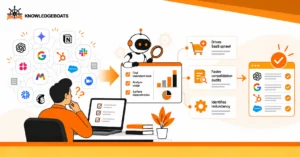
The following two questions define how AI changes consolidation:
- How AI Is Increasing SaaS Sprawl: B2B teams often buy AI analytics, research, productivity, SDR, and writing tools without checking which pre-existing platforms provide similar capabilities.
- How AI Enables Faster Enterprise Technology Stack Consolidation Audits: Compared to manual reviews, AI-driven SaaS consolidation can accelerate redundancy identification, usage analysis, and dependency mapping.
Rather than evaluating them as siloed experiments, AI tools should be analyzed as part of the technology stack optimization ecosystem. Consolidating governance, data access, and AI capabilities is the next step that answers how to consolidate AI tools.
Key Takeaways: What Should Be the Technology Stack Consolidation Strategy for B2B Enterprises
An ideal SaaS stack consolidation strategy starts with a full inventory and utilization audit, then maps capabilities, data flows, and dependencies. Rather than treating consolidation as software cost-cutting, B2B teams should spend deliberately, treat stack governance as an ongoing operational discipline, and eliminate redundancy.
A strategically coherent stack is the core objective behind software stack consolidation. Governance discipline can become more commercially consequential, as AI tools will continue to multiply sprawl risks.
Knowledgeboats can help you find answers to questions like how to reduce SaaS sprawl and how to consolidate fragmented customer data.
FAQs
1. Why should businesses consolidate their technology stack?
When fragmented data, unused licenses, integration dependencies, and redundant tools reduce operational visibility, affect decision quality or technology governance, and increase costs, B2B enterprises should consolidate their technology stack.
2. How do you consolidate a technology stack?
Start with auditing applications. Map capabilities and dependencies in the next step. Identify redundancy after measuring utilization, and lastly, sequence retirements once integrations and workflows are ready.
3. How do you reduce SaaS sprawl?
SaaS sprawl can be reduced through usage analysis, renewal governance, capability mapping, clear requirements to replace current tools, and ownership controls.
4. How do you identify redundant SaaS tools?
Compare each tool’s capabilities, costs, usage levels, data flows, users, business outcomes, and integrations against overlapping applications.
5. What are the benefits of technology stack consolidation?
Reduction in software waste, better governance, improved data visibility, coherent technology architecture, and reduced operational friction are some important benefits of technology stack consolidation.