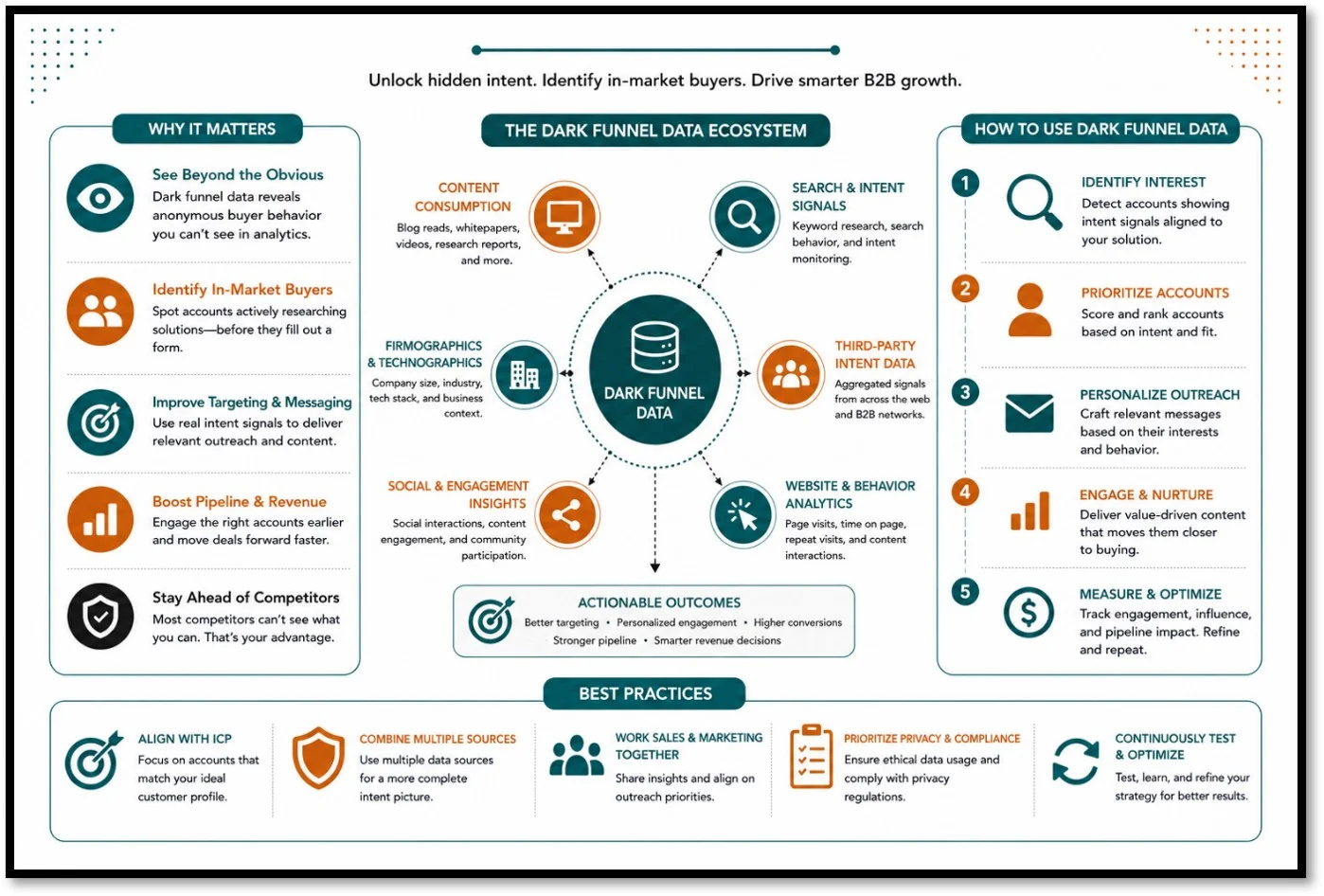
Successful B2B teams that build accurate pipelines track buyers’ activity beyond their own website, even before buyers fill out the form. They are focusing on understanding buyer influence beyond visible channels, and this shift redefines dark funnel B2B marketing.
The majority of B2B buyers’ activity happens outside the trackable CRM, including peer conversations, LinkedIn feeds, and private Slack communities. Based on 6sense’s 2025 findings, B2B buyers complete 70% of their buying journey even before contacting a vendor.
Yet, many B2B teams still optimize for visible attribution, but the core decision-making is completed in this invisible dark funnel, and this is the main problem. The starting point to address this issue is to start the conversation with an understanding of what the dark funnel is and why it expands.
What is the Dark Funnel in B2B Marketing and Why is it Growing
Although the industry often addresses the dark funnel concept as a measurement issue, it actually is an architectural problem. B2B buyers don’t want vendor influence in their decision-making, which is why they shift their research to channels vendors cannot track.
Every time buyers lose their trust in sales-qualified thought leadership, the gated content, or sponsored case studies, the dark funnel in B2B marketing expands further. The dark funnel reflects buyer influence occurring outside attribution systems.
SCI-TECH TODAY states in its 2025 findings that 95% of B2B buyers refer to peer reviews before making any purchase decision. As a result, the peer conversations, more than the vendor’s website, are the starting point of the buyer’s journey.
Attribution systems were designed for clicks rather than influence, which is why the dark funnel is invisible and constantly growing. It is a marketing philosophy failure, not a gap in the data architecture.
Where B2B Buyers Research Before Contacting Vendors
Most B2B teams never think strategically about how deep the dark funnel operates within closed environments. The surface-level answer to where buyers research is Reddit, LinkedIn, or G2. However, the deeper layer generates more consequential and specific interactions.
B2B teams share which vendors they have considered or ruled out on executive Slack communities and Discord. Private LinkedIn DMs often become channels to check peer reviews.
Analyst briefings, Notion, or Confluence are some other platforms where buyers either stress-test vendors against a third-party or carry out a sceptical comparison internally.
Hidden buyer journey signals in B2B marketing are structurally impossible to track as they are outside CRM, and as a result, the strategic response to the issue comes from presence rather than surveillance. However, B2B teams need unique measurement thinking to ensure their presence in the dark funnel.
The Role of Dark Funnel Data in Demand Generation and Revenue Strategy
Demand generation has shifted to influence optimization from attribution, which has become the core role of the B2B dark funnel strategy. Traditional demand generation assumes that buyer journeys move from clicks to forms to qualified leads, which B2B buyers have outgrown.
The dark funnel data challenges this assumption, and the content hardly generates a trackable conversion event. The core objective of the content here is to create memories rather than focusing on immediate conversion.
Although no influence is visible inside the last touch, it shapes the deal. Data in the dark funnel unveils how buying presence forms before any measurable intent. B2B teams that measure direct conversions largely undervalue long-cycle influence channels.
How to Measure Dark Funnel Marketing Impact Without Perfect Attribution
One honest answer to the question of whether the dark funnel attribution problem can be solved is a clear no. Although the issue cannot be completely resolved, a three-layered measurement framework can be built that stops penalizing channels failing to generate last-click attribution and uses proxy signals to approximate influence.
The first layer is self-reported attribution, where every lead is asked how they heard about the vendor. B2B teams that discover podcasts, LinkedIn dark social, and community mentions can increase their pipeline contribution, which CRM would have flagged as direct traffic.
The pipeline velocity by cohort is the second layer. Accounts engaging with the non-gated content before entering the funnel have a better chance of closing faster with higher ACV than leads that enter via gated demand gen.
The last layer is the share-of-voice in peer communities, which measures how often the brand is mentioned, defended, or recommended in communities. More than being about certainty, the dark funnel marketing strategy is about triangulation.
How to Build a Dark Funnel Marketing Strategy for B2B Companies
Many marketing strategies stop at generating content volume on thought leadership, which never generates a dark funnel presence for companies. Distribution architecture is the key distinction, which many B2B teams fail to achieve as they build for reach rather than resonance.
Successful B2B teams that build dark funnel presence often invest in practitioner voices. Internal subject matter experts are more credible than branded content.
Another important practice these teams carry out is to make buyers think about the problem. These B2B companies treat category education as a long-term asset. Buyers who go beyond vendor evaluation share a framework instead of product pages.
Successful B2B teams intentionally create their presence around the edges of the dark funnel to explore hidden marketing touchpoints.
When teams measure pipeline velocity and deal quality rather than monitoring individual click attribution, treating distribution channels in the dark funnel as a strategic investment, they build durable pipeline advantages.
Strongest B2B teams deliberately develop their influence infrastructure and measure their influence through the pipeline quality, not content downloads, and this is how the dark funnel deepens as the journey evolves.
Final Thoughts: Changing Role of Dark Funnel Data in Demand Generation
Dark funnel in B2B is not a visibility gap that can be bridged, but it is a channel that must be earned. Buyers will always keep themselves invisible during the decision-making process to avoid vendor intervention.
AI-generated content has flooded all trackable channels, and the resistance of B2B buyers to vendor influence has increased. This shift will make the dark funnel a primary arena for building B2B shortlists.
Want to understand where your organization currently stands among the channels your buyers trust the most? Book a free 30-minute dark funnel audit with Knowledgeboats, and find out how you can improve your credibility.
FAQs
1. How dark funnel data influences B2B sales?
Dark funnel data shows how buyers build preferences through communities, external research, and peer discussions, even before they enter the measurable sales pipeline.
2. How to track dark funnel activity in B2B?
To monitor dark funnel activity, track proxy indicators, including self-reported attribution, branded search lift, account-level engagement patterns across channels, and direct traffic spikes.
3. What are hidden buyer journey signals in B2B marketing?
Hidden buyer journey signals include analyst conversations, community discussions outside CRM visibility, private referrals, peer recommendations, and anonymous product research.
4. How buyers make decisions in the dark funnel?
B2B buyers privately validate vendors via communities, trusted peers, independent research, and trusted peer discussion before making a decision.
5. What are the best dark funnel analytics tools for B2B marketing?
Self-reported attribution, account-level analytics, community monitoring, and intent tracking are some of the best tools used for dark funnel analytics.