AI assistants in enterprise knowledge management provide an intent-driven infrastructure for B2B teams to address the enterprise knowledge friction. B2B teams that close the productivity gap faster reduce the time between a query and its answer.
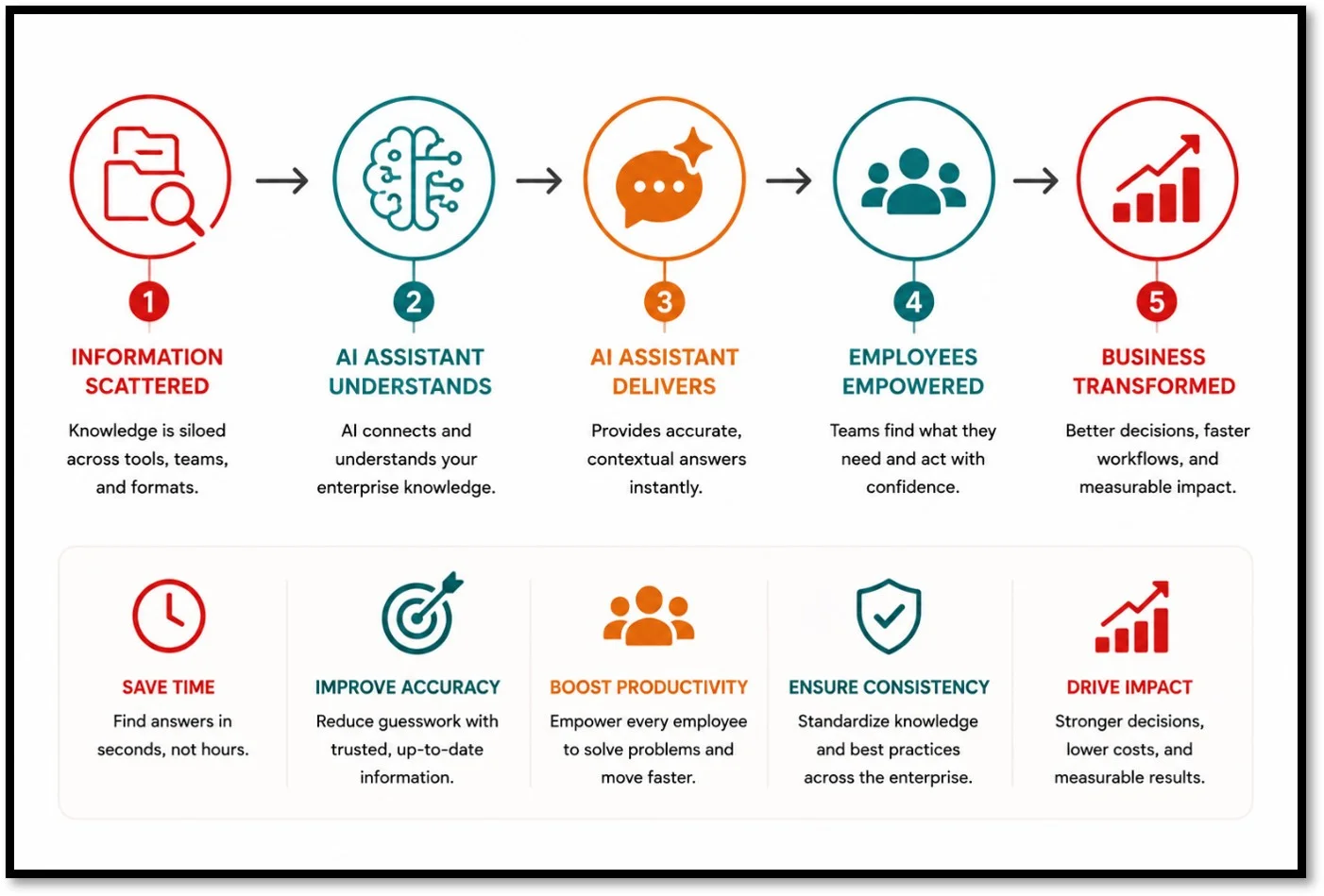
The majority of the enterprise knowledge is technically accessible across Slack archives, SharePoint, and Confluence, but is practically invisible, and this is the real problem. Employees waste their time searching for information rather than using it.
Agility Portal’s research finds that employees waste 20% of their workweek searching for information. Along with accelerating the search, AI-powered assistants architecturally change what the search is capable of.
B2B teams suffer from knowledge abundance, not information scarcity, and AI systems make this abundance navigable.
Why Traditional Enterprise Knowledge Management Fails
The most common belief is that AI solves knowledge management problems, but in reality, the issue runs much deeper. AI, in fact, inherits problems that companies can never actually resolve.
The quality of knowledge architecture determines the AI output quality. Deploying an AI assistant for a poorly structured knowledge base amplifies the issue instead of solving it.
The compounding reasons why traditional systems fail start from the design of knowledge management systems, which were primarily designed around document storage instead of retrieval. The assumption was simple- if employees had documented the information correctly in the first place, they could retrieve it whenever required.
The assumption failed because filling in and finding the information are completely different cognitive tasks. Further, B2B teams never treated knowledge maintenance as a strategic task. As a result, nobody owned documentation, and it kept getting delayed.
Enterprise search had always been keyword-dependent, but institutional knowledge was never properly documented, and it diminished as employees left the company. B2B teams were optimized for documenting information, not operationalizing it.
How AI Assistants Improve Enterprise Knowledge Management
The conventional framing sets AI as a smarter and faster search engine for enterprise content. However, the framing appears accurate at the surface level, and it fails where it matters the most. Instead of measuring retrieval architecture, it constantly measures retrieval speed, which is completely the wrong metric.
AI powered knowledge management structurally changes three things about keyword search:
- AI shifts enterprise search from document retrieval to answer synthesis to address buyers’ exact queries with sources cited for verification. Generative AI in knowledge management reads across multiple documents simultaneously to return a direct response instead of a results page.
- AI knowledge systems surface tacit knowledge and map relationships between people, concepts, decisions, and projects, highlighting the institutional context residing between documents.
- The last shift is toward the organizational context, where AI enterprise search tools are trained on product naming, internal shorthand, and company-specific terminology despite employees using informal language.
AI assistants bridge the gap in fragmented knowledge systems. Lleverage’s research finds that internal support tickets are reduced by 30-50% after AI systems take over. As a result, knowledge becomes a queryable infrastructure, which was previously only accessible via human networks.
What is the Role of AI Assistants in Knowledge Management
Vendor conversations about intelligent knowledge management systems are always focused on AI retrieval capabilities, but none of them prioritize maintenance. It causes knowledge decay, and this is why most enterprise knowledge bases become unreliable after their launch.
Apart from finding the information faster, AI-driven systems accurately identify when the content is decaying or becoming stale. It surfaces knowledge gaps through repeated employee queries by flagging contradictions between updated documents.
The repeated failure of AI to answer a specific query is a gap in the enterprise’s documented knowledge. Knowledge automation in enterprises enables the system to have a feedback loop, turning it into a living system instead of a static repository.
B2B teams that build feedback architecture to update the existing knowledge base will sustain enterprise productivity.
How Does Generative AI Transform Knowledge Management at the Workflow Level
AI knowledge deployment in many B2B companies happens only at the base interface or portal layer, where employees search for information. The traditional architecture looks at knowledge management as a destination, while B2B marketers who extract the most value from it treat it as an embedded layer inside the workflows.
Conversational AI knowledge assistants for employees are integrated directly with CRM platforms, Slack, or Microsoft Teams to change the dynamics of knowledge access. As a result, reps do not need to navigate through the system or access a separate knowledge portal.
This reduced friction changes the usage behavior, and employees do not need to maintain personal knowledge silos or document libraries. According to WifiTalents’ 2026 research, efficient knowledge sharing reduces operational costs by 35%.
The value that AI knowledge management platforms add is that it reduces cognitive load, far beyond finding documents. The transformation that it brings to the system is about the distribution model.
Key Takeaway: The Future of AI Knowledge Management Solutions for Enterprises
AI enterprise knowledge assistants expose the knowledge management problem more precisely and install the infrastructure to systematically address the issue. B2B teams that treat AI deployment as a chance to rebuild the knowledge architecture will develop a value-compounding system every quarter.
Institutional knowledge is becoming tougher to transfer via proximity, along with workforces becoming more distributed. In this scenario, B2B teams that emphasize developing AI knowledge discovery systems will have a structural edge in decision quality, onboarding speed, and execution consistency.
The gap between such B2B marketers and companies operating on fragmented legacy intranets will continue to widen.
KnowledgeBoats can help you find where your organization’s knowledge infrastructure creates friction and how you can improve.
FAQs
1. What are AI knowledge assistants in enterprises?
AI knowledge assistants help employees synthesize, apply enterprise information across multiple systems, and retrieve the information with the help of conversational queries.
2. How do AI assistants improve enterprise knowledge management?
AI assistants provide synthesized answers, cut down retrieval friction, surface institutional knowledge, and connect fragmented systems.
3. What are the benefits of AI powered knowledge management systems?
Reduced cognitive overload, better operational consistency, faster information access, stronger knowledge retention, and improved productivity are some key benefits of AI-powered knowledge management systems.
4. What is AI knowledge management?
The use of artificial intelligence to organize, retrieve, maintain, and operationalize enterprise knowledge with elevated precision is called AI knowledge management.
5. How do AI powered knowledge graphs for enterprises improve knowledge retrieval?
AI knowledge graphs connect documents, people, workflows, and decisions based on their context so that enterprise AI systems retrieve the data more accurately and produce relevant information.