The good old days of B2B security weren’t that good, but they were certainly simpler. You had an office with a firewall. If someone was inside the building, you trusted them, and if they were outside, you didn’t. It was the classic castle and moat strategy.
But today? The castle is empty, the moat has dried up, and your employees are scattered across three time zones, working from kitchen tables and airport lounges.
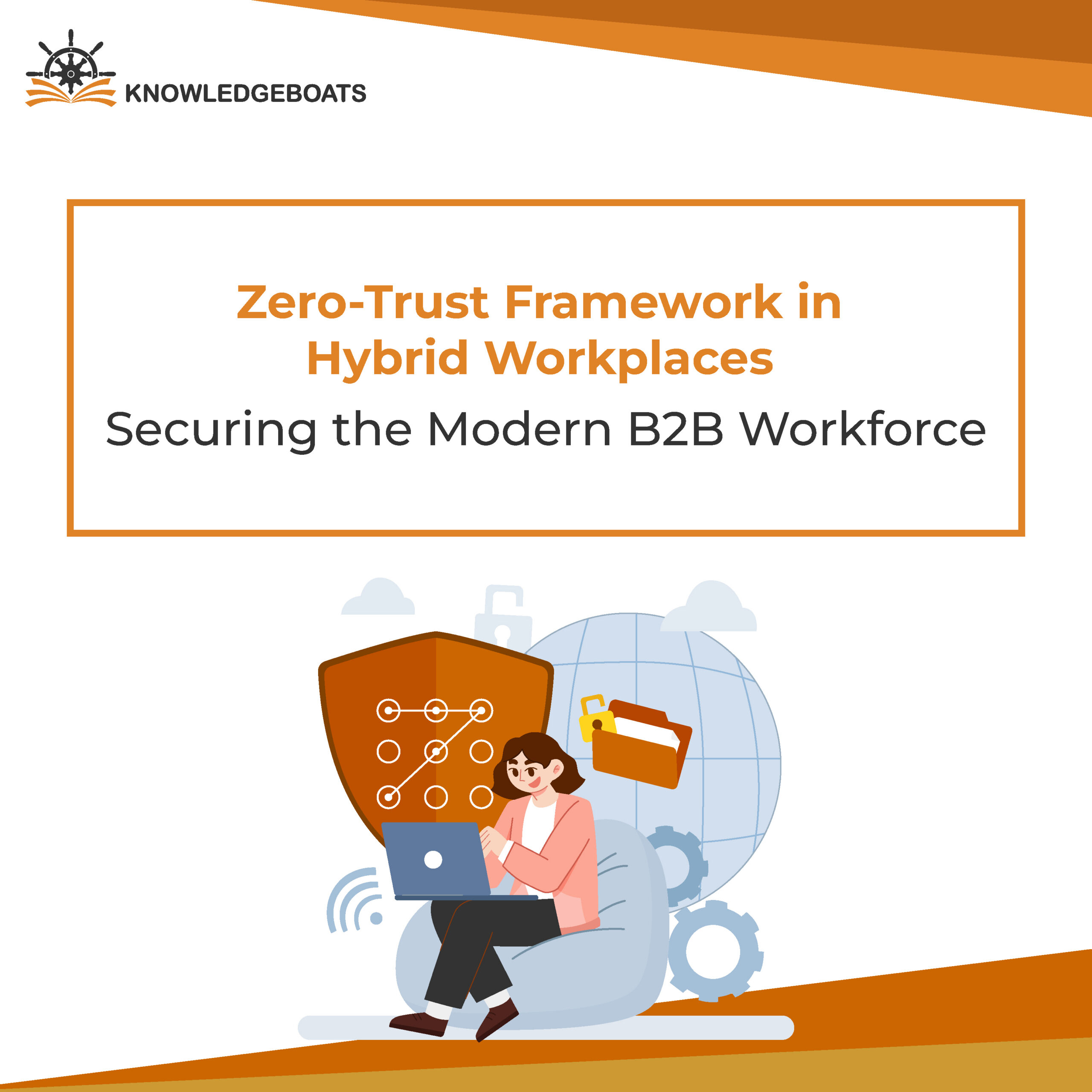
In this chaotic environment, B2B workforce security has become a nightmare for IT directors. Relying on legacy tools like VPNs to patch holes in a crumbling perimeter just doesn’t cut it anymore. This brings us to the only logical path forward, i.e., the Zero-Trust Framework.
If you are trying to figure out how to implement a Zero-Trust framework in a hybrid workplace for B2B organisations, you aren’t alone. Here is a realistic look at how to make it work.
Why “Trust but Verify” is Obsolete
For years, the mantra was “trust but verify.” But in a hybrid workplace security model, implied trust is a vulnerability.
Think about the traditional VPN. It’s essentially a master key. Once a remote worker logs in, they often have visibility into the entire network. If a hacker phishes those credentials, they have the keys to the kingdom. They can move laterally, jumping from a compromised laptop to your most sensitive servers.
This is why enterprise B2B organisations are shifting to Zero-Trust Security. It doesn’t matter if the request comes from the CEO’s iPad or a junior developer’s desktop inside the HQ; no one gets a free pass.
The Three Pillars of a Zero-Trust Architecture
A Zero-Trust Architecture isn’t a single box you buy and plug into a rack. It’s a mindset shift built on three non-negotiable pillars tailored for hybrid workforce security.
1. Verify Explicitly
We need to stop assuming that a correct password means a safe user. We need to look at the whole picture. Is the login coming from a usual location? Is the device properly managed? Is the operating system patched? This is where continuous authentication for hybrid employees comes into play.
2. Least Privilege Access
This is the digital equivalent of need-to-know clearance. If you work in marketing, you don’t need access to the engineering code repository. By strictly limiting access rights, we minimize the blast radius if a breach occurs.
3. Assume Breach
This is the most pessimistic, yet safest, pillar that operates as if an attacker is already inside your network. This mindset drives the need for micro-segmentation in hybrid networks, ensuring that even if one segment falls, the rest of the ship stays watertight.
The Tech Stack
So, what does this look like in the wild? Securing the B2B workforce across office, remote, and mobile with Zero-Trust architecture relies on a few specific technologies.
Identity First Security
In a world without perimeters, identity is the new firewall. Identity First Security ensures that the user is the primary control point. Using robust Multi-Factor Authentication (MFA) and Single Sign-On (SSO) is the baseline here. If you can’t prove who you are, you don’t get in.
Zero-Trust Network Access (ZTNA)
If the VPN is a master key, Zero-Trust Network Access (ZTNA) in B2B environments is a hotel key card. It gets you into your room (the specific app you need) and nowhere else. ZTNA creates a secure, one-to-one connection between the user and the application, keeping the rest of the infrastructure invisible. This is critical when you have third-party vendors or contractors who need access to your systems but shouldn’t see your internal data.
The BYOD Headache
We can’t talk about hybrid work without addressing the elephant in the room: your personal devices. BYOD and Zero-Trust in hybrid workforces have a rocky relationship. Employees love using their own phones, but security teams hate it. A good Zero-Trust policy bridges this gap by checking the health of a device (is it jailbroken? does it have a passcode?) before granting access to corporate data.
Moving from Theory to Practice
Implementing this can feel like trying to change the tires on a moving car. If you are looking for a roadmap, here is a practical approach to how to implement a Zero-Trust framework in a hybrid workplace for B2B organisations.
Phase 1: Know Your Terrain
You can’t protect what you can’t see. Start by identifying your protective surface. Where is your critical data? Is it on-prem? Is it in the cloud? Classify your data based on sensitivity.
Phase 2: Map the Flows
Watch how your employees work. Which apps does Finance use? What APIs does Engineering call? This visibility is essential for designing continuous authentication and least privilege access in hybrid workforces using Zero-Trust. You want to lock things down, but you don’t want to break legitimate workflows.
Phase 3: Build the Architecture
This is where you deploy cloud-native security for hybrid work environments. You’ll move away from on-premise appliances and start using cloud-delivered policies that follow the user, regardless of where they are working.
Phase 4: The Human Element
This is the step most people forget. You have to train your team. Zero-Trust can feel restrictive to employees who are used to open access. Explain why you are doing this.
The Hurdles Along the Way
Let’s be real about the Zero-Trust adoption challenges in hybrid models.
First, there’s legacy infrastructure. Many B2B companies are running older software that wasn’t built for modern authentication. You might need to use ZTNA connectors to wrap these old apps in a security layer.
Second, there is user friction. If your security is too tight, employees will find workarounds. The goal is frictionless security. This helps in overcoming challenges of deploying Zero-Trust in hybrid work models and how to overcome them, by using adaptive policies that only step up security challenges when the risk level changes (like a user logging in from a new country).
A Checklist for Security Leaders
To wrap this up, here are some actionable Zero-Trust security best practices for modern hybrid workforce environments:
- Kill the implicit trust: Stop trusting devices just because they are on the office Wi-Fi.
- Segment everything: Understand the role of micro-segmentation and ZTNA in securing hybrid enterprise networks. If you don’t segment, you are leaving the door open for ransomware to spread.
- Automate offboarding: In high-turnover B2B sectors, ensuring access is revoked the second an employee leaves is critical.
- Focus on the Identity: Invest heavily in IAM (Identity and Access Management). It is the foundation of everything else.
Wrapping Up
The future of work isn’t going back to the way it was. Cloud-native security for hybrid work environments is now the standard.
By adopting a Zero-Trust Framework, you aren’t just buying security tools; you are modernizing your entire business operation. You are enabling your team to work securely from anywhere, protecting client data, and ensuring that when the next cyber threat emerges, your organization is resilient enough to handle it.
Securing the modern B2B workforce is a journey, not a destination. But with the perimeter gone, Zero-Trust is the only map we have left.