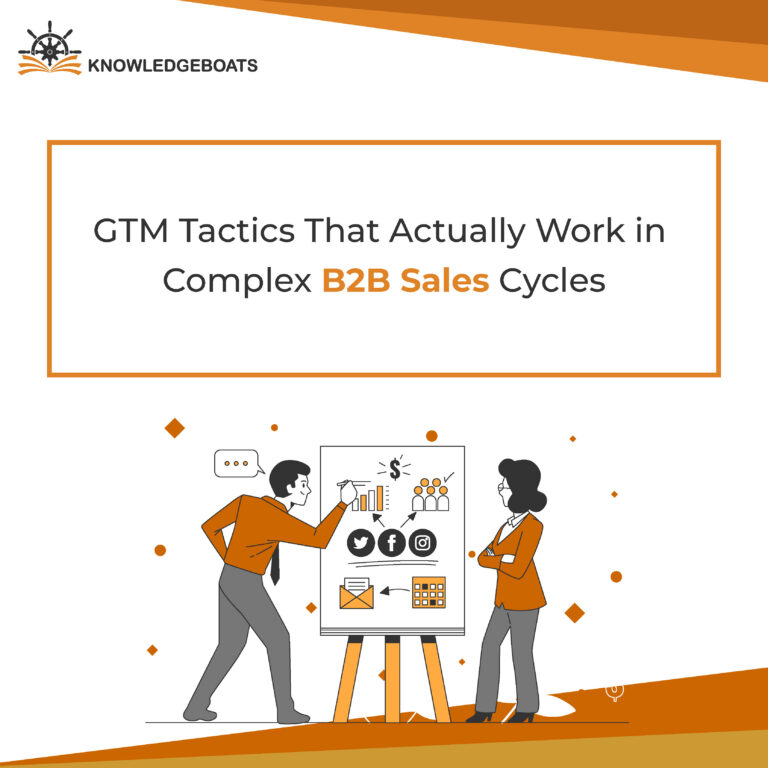
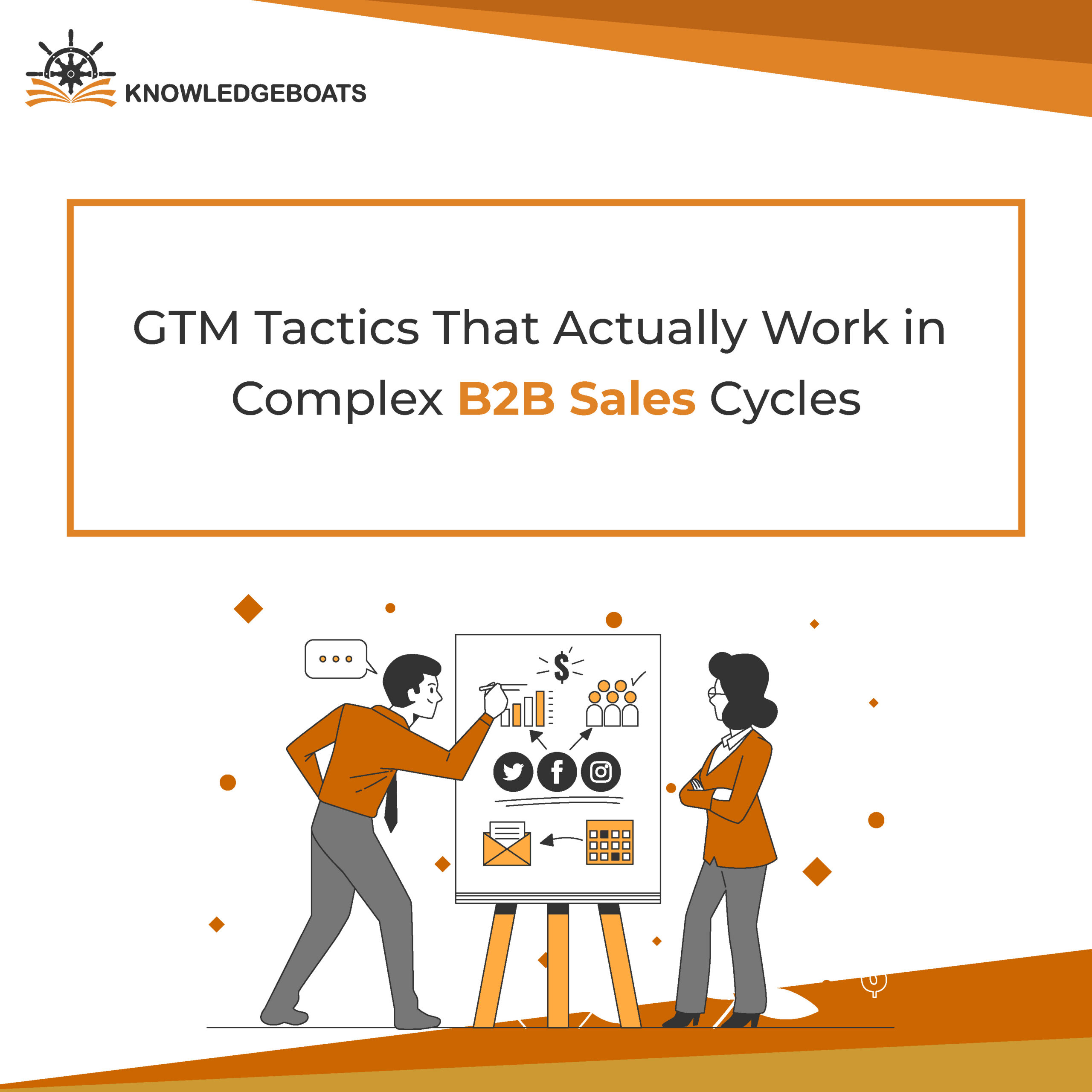
The majority of B2B teams employ GTM strategies to cater to linear sales cycles. These approaches fail because B2B sales cycles have become more complex, nonlinear, and stakeholder-dependent.
As per Forbes’ 2025 analytical report, modern B2B decision-making processes include 6 to 10 stakeholders. Due to the increased complexity, GTM planning and execution must be treated differently.
Due to the involvement of multiple stakeholders from operations, finance, leadership, or IT departments in the decision-making process, deals can extend up to 18 months. Their competing goals can induce friction in the process.
Conventional GTM approaches cater to simple and linear sales cycles, a single buyer, and rapid decisions. It is the time to redesign GTM strategies to cater to these complexities.
Building a Go-to-Market (GTM) Strategy for Complex Sales
Account-based GTM as the Foundation
It addresses high-value accounts rather than catering to a broader reach. Instead of adhering to the one-size-fits-all approach, tailor the GTM execution as per the target account.
Personalized GTM outreach supersedes volume in the modern B2B sales cycles. The account-based go-to-market approach allows you to deliver tailored messages to different stakeholders based on their role.
This approach helps you build a stronger revenue pipeline. According to GTM 80/20’s report, B2B companies using ABM strategies deliver 200% higher marketing-generated revenues compared to those who rely on traditional approaches. When built on accurate account selection, GTM delivers the best results in elongated B2B sales cycles.
Multi-Stakeholder Buyer Journey Mapping
The perspective of every decision-maker is important in the modern B2B domain. For instance, the finance department looks for ROI, engineers emphasize technical integrations, whereas the operations team cares for the effective implementation.
Here, generic messaging fails. Personalized GTM outreach supersedes. Every stakeholder’s concerns can be addressed through effective GTM approaches. The buyer journey feeds the data to the execution of the strategy at all touchpoints.
Without assuming a single buyer in the process, B2B teams should align their messaging across all stakeholders. The multi-stakeholder engagement needs role-driven messaging with seamless coordination throughout the sales cycles.
Aligning Sales and Marketing in GTM Execution
Perfectly aligned marketing and sales produce seamless sales-led go-to-market execution. Marketing produces the correct content, intelligence, and timing. Both teams align through the RevOps GTM strategy. Account selection, messaging, follow-ups, metrics, etc., are key alignment factors.
GTM implementation will fail if it does not align properly. Aligned teams accelerate pipelines.
Sales and marketing teams should work collaboratively and act as unified revenue engines. This increases the decision velocity, along with the win-rate. Further, the strategy enhances enterprise capability, shifting from departmental initiative.
Devising Multi-channel GTM Campaigns With Synchronized Messaging
Simultaneous utilization of display, direct outreach, LinkedIn, and email has become a new normal in the modern B2B domain. The main objective is to offer consistent messaging across all channels.
You need to state the core value proposition clearly. Adapt your presentation approach as per the channel. Coordinate timing. Ensure that decision-makers can see reinforcing messages. This approach keeps your brand visible throughout the buying cycle.
When execution spans across multiple channels, pipeline acceleration strategies become more effective.
Lead Nurturing Workflows for Elongated Cycles
Conventional email drip campaigns are insufficient for complex B2B cycles. Lead nurturing for a longer duration is mandatory.
According to Bloom’s 2025 article, B2B companies that master lead nurturing produce 50% more sales-ready prospects at 33% lesser cost. The behavioral intent is used for nurturing prospects. The marketing and sales teams devise nurturing tracks collaboratively.
The subsequent sequence is automatically triggered when buyers engage with the content. Without manual intervention and overwhelming leads, the engagement is maintained across the sales cycles. Sales enablement techniques ensure timely follow-ups.
Step-by-step GTM framework for B2B SaaS
- Define target accounts. With the help of ICP & buyer personas, spot high-value accounts. Emphasize precision targeting over a broad outreach.
- Develop account plans. For all stakeholders, their priorities, and contact points, devise a tailored engagement sequence and messaging.
- Align sales and marketing execution. The marketing team orchestrates different campaigns, while sales directly engages stakeholders. With the help of inbound & outbound GTM tactics, coordinate between these teams and execute the plan.
- Monitor and optimize the progress. GTM Analytics will help you govern the development of your approach. Based on the feedback you receive, adapt and tweak your strategy.
KPIs to track in a complex GTM strategy
Vanity metrics like clicks and impressions have become outdated. Pipeline-centric metrics, including engagement rate, content downloads, or revenue contribution, have gained importance.
Ask the following questions to check whether the strategy is working for you:
- Are sales cycles shortening? If your strategy is capable of reducing the sales cycle, GTM tactics are effective.
- Has the pipeline velocity increased? Effective tactics will push leads through the pipeline uniformly without creating bottlenecks.
- Is the GTM execution cost-efficient? With better execution of the GTM strategy, the customer acquisition cost reduces.
- Has your conversion rate increased? You will observe a win rate increase if your strategy is implemented successfully.
Wrap Up: GTM Execution Tactics Working in the B2B Domain
B2B buyers do not undergo simple interactions across their journey. Traditional tactics fail due to their inability to handle complex sales cycles. Account-based GTM, disciplined performance measurements, aligned execution, and multi-stakeholder engagement increase the velocity of complex deals.
Moving ahead in 2026, the competition will belong to those who execute GTM strategies effectively. B2B marketers who refine the B2B GTM playbook will outperform their competitors who do not drift away from outdated tactics.
At KnowledgeBoats, we can help you execute your GTM strategy better, assist you in recognizing modern approaches, and devise tactics that work for you. Book a 30-minute free assessment to evaluate your current strategy.
FAQs
1. Which are the GTM tactics that work for multi-stakeholder B2B buying?
Multi-stakeholder journey mapping, account-based GTM, and synchronized multi-channel campaigns are the best strategies working for B2B buying. Personalized GTM outreach across all channels also supports the multi-stakeholder purchasing process.
2. How to shorten complex B2B sales cycles with GTM?
To shorten sales cycles, B2B marketers must align marketing and sales teams. They should focus on intent-based lead nurturing workflows and account-based targeting.
3. What is the best GTM strategy for enterprise sales teams?
Aligned sales-marketing execution, account-based GTM with precise targeting, stakeholder-specific engagement, and precise targeting followed by timely optimization will be the best strategy for B2B teams.
4. What are the KPIs to track in a complex GTM strategy to measure success?
Vanity metrics like clicks and impressions have become obsolete. Check if your sales cycles are shortening, pipeline velocity is increasing, customer acquisition cost is decreasing, and win rates are rising. Monitor pipeline-focused metrics like engagement rate, content downloads, and revenue contribution.
5. How to align RevOps with GTM goals?
Sales and marketing teams need to share account selection criteria, messaging frameworks, follow-up prospects, and measure unified revenue metrics. The marketing team devises campaigns, and the sales team engages buyers. Their coordination increases decision velocity, improves win rates, and shifts GTM from a departmental initiative to an enterprise-wide growth capability.