For decades, the manufacturing sector operated under a binary constraint: you could optimize efficiency, or you could optimize sustainability, but rarely without significant trade-offs. That paradigm is obsolete.
In the current industrial landscape, Environmental, Social, and Governance (ESG) criteria are central to operational strategy and capital allocation. For Lead Generation Managers and operational leaders, the narrative has shifted. Along with products, the market also demands sustainable manufacturing operations with a transparent carbon footprint.
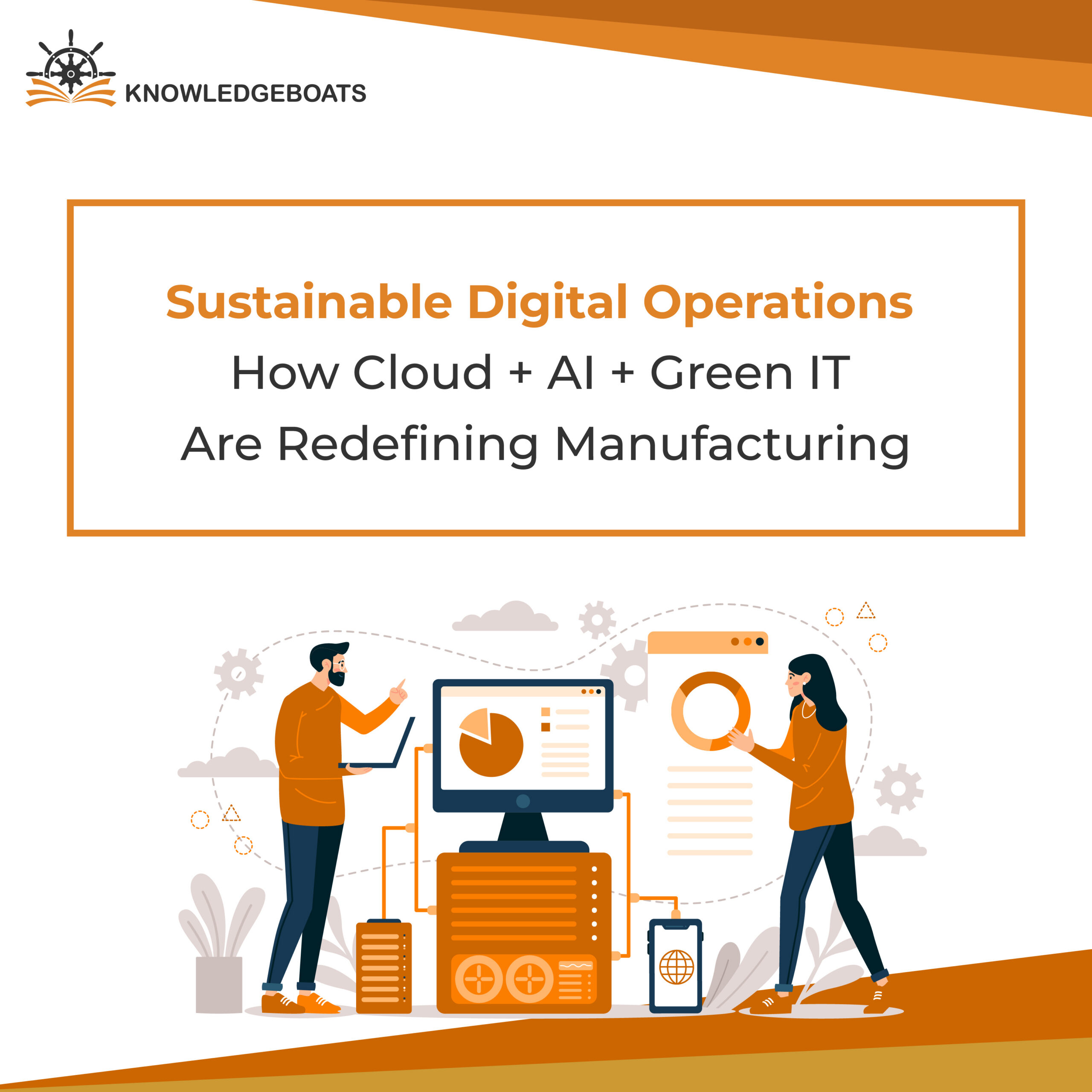
The convergence of Cloud manufacturing, Artificial Intelligence (AI), and Green IT creates a new operational baseline. We are moving beyond simple digitization toward sustainable digital operations, a framework where technology speeds up production and decarbonizes it.
The Foundation: Green Cloud Infrastructure
Legacy on-premise data centers are notoriously inefficient, often characterized by low utilization rates and high cooling costs. The shift toward Green IT begins with the migration to hyperscale cloud environments.
Major cloud providers have achieved power usage effectiveness (PUE) ratios that individual manufacturers simply cannot replicate on-site. By transitioning to green cloud infrastructure, manufacturers inherit the sustainability profiles of these providers, many of whom are already operating on carbon-neutral or net-zero trajectories.
However, cloud manufacturing outsources energy consumption and enables the centralization of data required to measure scope 1, 2, and 3 emissions. Without the elasticity of the cloud, processing the petabytes of data generated by a modern facility is cost-prohibitive. The cloud acts as the scalable backbone, allowing Cloud-based manufacturing execution systems (MES) to orchestrate production with energy efficiency as a core KPI.
The Brain: AI-Driven Resource Efficiency
If the cloud provides the infrastructure, AI in manufacturing provides the intelligence required to reduce waste. Traditional automation follows set rules where AI identifies patterns that human operators miss.
AI-driven resource efficiency works by analyzing historical and real-time data to optimize yield. In a typical production line, scrap and rework are major contributors to carbon emissions, the energy was spent to create a product that cannot be sold. Predictive analytics in manufacturing mitigates this by identifying potential quality deviations before they occur.
Consider energy consumption. AI algorithms can dynamically adjust machinery power usage based on production schedules and energy grid pricing. This goes beyond simple start/stop automation and does micro-adjustments in real-time. How cloud and AI are driving sustainable manufacturing operations is evident in these granular optimizations by reducing the energy load of HVAC systems, compressors, and conveyors by fractionally adjusting performance without impacting throughput.
The Simulation: Digital Twins and Process Optimization
One of the most capital and carbon-intensive aspects of manufacturing is the “trial and error” phase of product introduction or line reconfiguration. The digital twin for sustainable manufacturing eliminates physical waste by moving these trials into a virtual environment.
By creating a high-fidelity virtual replica of physical assets, engineers can run thousands of scenarios to test efficiency. They can answer complex questions: If we alter the chemical mixture, does it lower the thermal requirement? If we change the line speed, does it reduce energy spikes?
This is smart manufacturing sustainability in practice. By validating processes digitally, manufacturers avoid the energy and material costs associated with physical prototyping. Furthermore, once the line is operational, the digital twin remains active, comparing theoretical optimal performance against real-time data in manufacturing operations to flag inefficiencies immediately.
The Edge: IoT and Real-Time Energy Optimization
While the cloud handles heavy analytical lifting, Edge computing for manufacturing sustainability handles the immediate, latency-sensitive decisions. Sending every byte of data to the cloud is inefficient and consumes unnecessary bandwidth and energy.
IoT and energy optimisation in manufacturing rely on edge devices to process data locally. Sensors on the shop floor monitor variables like temperature, vibration, and pressure. Edge computing allows the system to react in milliseconds. For example, if a motor shows signs of strain (increasing energy draw), the edge device can trigger an immediate maintenance ticket or adjust the load.
This capability is crucial for smart factory carbon reduction. It prevents the “drift” often seen in machinery where calibration slowly degrades, leading to higher energy consumption per unit produced over time. Digital twin and IoT-enabled energy optimisation ensure that the physical asset mirrors its ideal digital state as closely as possible.
Breaking Silos: IT/OT Convergence
To achieve true sustainable digital operations, the historical wall between Information Technology (IT) and Operational Technology (OT) must be dismantled. IT/OT convergence in manufacturing is the prerequisite for a unified view of sustainability.
Data silos are the enemy of ESG goals. If energy data sits in a facility management system while production data sits in an MES, calculating the carbon intensity per unit is a manual, error-prone process. Implementing green cloud infrastructure in manufacturing for ESG compliance requires these systems to speak the same language.
When IT and OT converge, manufacturers can implement a circular economy in manufacturing operations. They can track raw materials from sourcing through production to end-of-life recycling. This level of traceability, enabled by blockchain or a centralized cloud database, is increasingly required by downstream B2B buyers who must report on their own supply chain emissions.
Wrapping up: The Strategic Path to Net-Zero
For the modern Lead Generation Manager or Operations Director, sustainability is a powerful differentiator. Buyers are actively seeking partners who can contribute to their net-zero targets.
Optimising manufacturing operations for net-zero targets using cloud and AI is a current competitive advantage. The strategy involves:
- Migrating workloads to carbon-aware cloud regions.
- Deploying sensors to capture sustainability metrics in manufacturing.
- Utilizing AI to translate that data into waste-reduction actions.
Green IT strategies for cloud-based smart factories and Industry 4.0 are about doing more with less i.e. less energy, fewer materials, and less waste.
The integration of Cloud + AI for manufacturing is redefining what it means to be efficient. It transforms sustainability from a cost center into a value driver. By leveraging AI and real-time data in manufacturing to achieve sustainability goals, organizations position themselves as strategic partners in the global effort toward decarbonization.
The industrial sector is at an inflection point. The tools for sustainable digital operations are available. The challenge now is execution, scaling these technologies to ensure that every revolution of the drill and every byte of data contributes to a cleaner, more profitable future.