Successful B2B teams track the right kind of data rather than relying on volumes. For many B2B companies, a prospect downloading a whitepaper is the same as a lead who spends days researching pricing pages across multiple competitors.
While one is just an engagement, the other is a buying motion, which most teams fail to distinguish. B2B teams fail because they interpret the same data differently.
This is where the majority of pipelines break down. The buyer intent data vs behavioral data comparison answers different questions, and confusing them results in forecasts built on incorrect evidence.
According to Rocket Reach’s 2026 findings, B2B companies annually lose more than $5 million due to poor data quality, which includes misinterpretation of the data stream. Before addressing the issue, one must know what each signal actually measures to decide on which signal to act on.
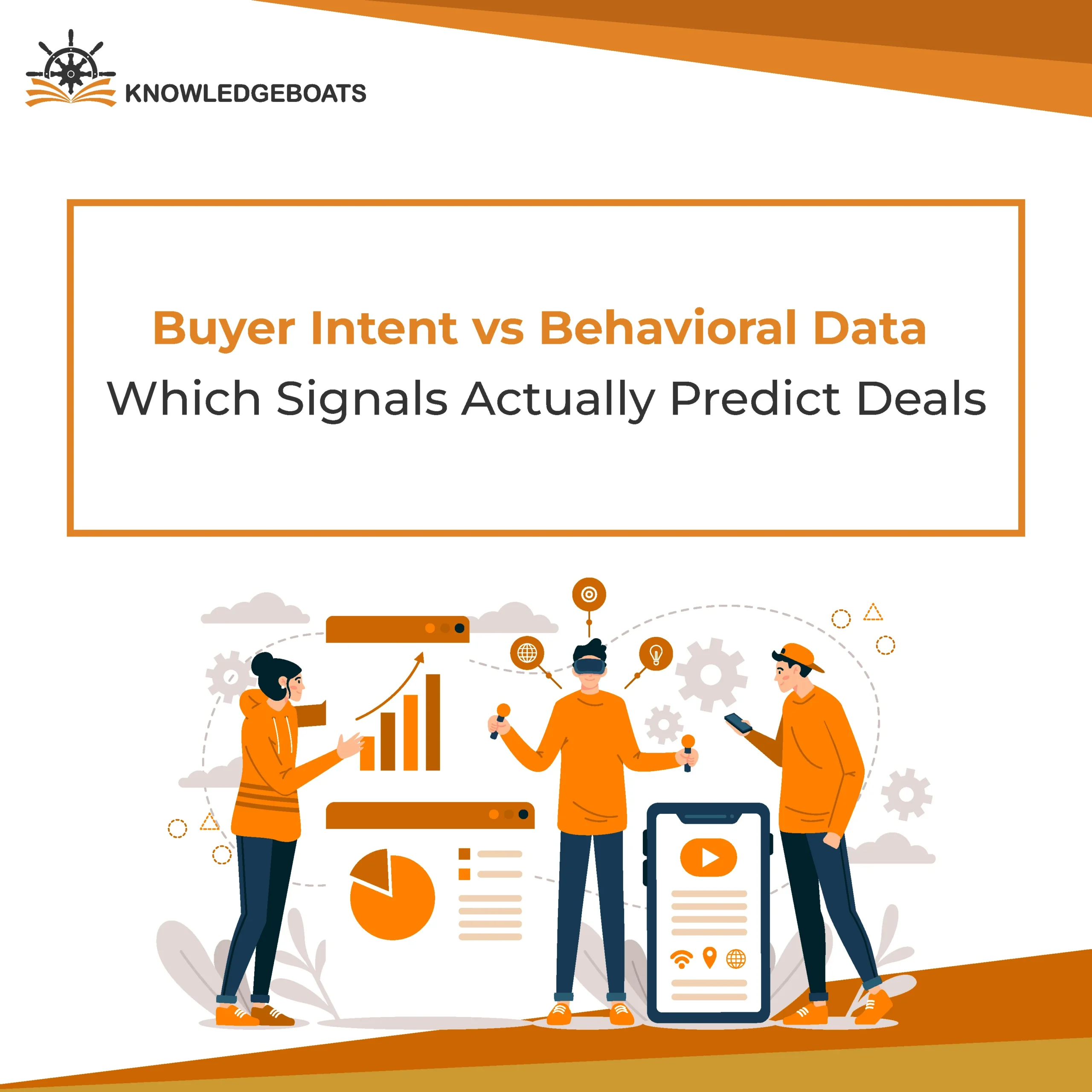
Buyer Intent vs Behavioral Data in B2B Marketing
The B2B industry has incorrectly marked the distinction between buyer intent and behavioral data as technical, but in reality, it is more contextual in how signals are interpreted.
Behavioral data in B2B marketing records buyers’ activity, including the session time, downloads, and page visits. Although it is an accurate, useful, and trackable activity log, it does not predict the intent behind buyers’ activities.
Intent data, on the other hand, infers the purpose behind buyers’ activity patterns and checks whether this activity matches the account research behavior.
Behavioral data without context generates traffic, and this is why it changes how the pipeline is read. According to Land Base’s 2025 analysis, the campaign efficiency increases by 2.5x when intent-based advertising is used.
While intent predicts, behavior validates, and teams optimizing only on first-party behavioral data emphasize engagement over buying motion.
Which Signals Predict B2B Deals, and Which Ones Do Not
Predictive-looking signals and triggers that are actually predictive are not always the same. In the majority of cases, forward motion signals like content downloads, repeat site visits, and high open rates only suggest curiosity rather than commitment.
Despite the absence of a real buying movement, surface-level activities produce the illusion of progress.
Predictive buying signals are cross-channel, implying that signals surface across owned media and third-party media channels simultaneously.
These signals are committee-level, where multiple stakeholders from the same account simultaneously show the same activity. Lastly, they are temporally compressed, implying that signals spike within a defined window. A signal’s predictive value is in its relationship with other signals across the buying committee and time.
How to Identify Real Buying Intent Signals Without Mistaking Engagement for Purchase Readiness
Many B2B teams try to solve intent signal issues by replacing the scoring model, but the ideal fix to the problem is a better signal hierarchy. It determines which data type has more predictive weight, and based on that, it segregates awareness from evaluation.
This is where first-party vs third-party intent data analysis gives a complete view of the account. Instead of treating them as competing sources, signal hierarchy treats first-party and third-party intent data streams as complementary layers.
First-party data emerging from product usage, site visits, and email engagement determines whether the account is aware and engaged with the category. On the other hand, third-party intent data, including review site activity, competitor research, and category comparison pages, predicts if the account is actively evaluating vendors.
The simultaneous spike in both layers within the same compressed window implies that the account is showing early buying signals and must be routed to a senior rep.
When the signal hierarchy clearly differentiates the research activity from the purchase intent, followed by a strong routing logic supporting the distinction, behavioral analytics transforms into an intent-driven marketing strategy.
Which Marketing Signals Indicate Buying Intent, and How Should Sales Teams Actually Respond
After identifying the correct signals, acting on them within the right window is the core revenue problem, where many B2B teams struggle. Regardless of the signal’s accuracy, a delayed response loses its value quickly.
Intent signals for sales teams are delivered as alerts, notifying the account’s activity to reps, and are queued alongside several other tasks. By the time this activity surfaces, the buying committee moves to a competitor who responds faster.
B2B teams succeed when they have pre-built response playbooks mapped for each signal type. The speed of response separates a high-performing team from an average-looking company.
According to LeadAngel’s 2025 analysis, B2B teams responding within an hour make leads 7 times more likely to convert. Upon firing a committee-level intent cluster, the escalation must be automatic with a personalized outreach sequence.
When customer behavior analytics for sales is connected with a defined action protocol, it generates revenue. Apart from the signal itself, the response timing provides a concrete edge to B2B teams.
Final Thoughts: How Buyer Intent Data vs. Behavioral Data Governs B2B Marketing
The intent data vs behavioral data marketing debate is about what every signal is qualified to tell you. While the behavioral data describes the account engagement, buyer intent data indicates whether the account is in motion toward making a purchase decision.
Pipeline forecasts produce incorrect answers due to blind spots when one signal type replaces the other. Identifying in-market buyers and entering the conversion at the correct moment will help B2B teams gain a competitive advantage.
B2B teams building signal hierarchies, along with the response infrastructure, will compress their sales cycles amidst the elongating buying cycles and anonymous B2B interactions.
Want to predict which signals in your pipeline predict deals? Contact KnowledgeBoats and book a 30-minute free signal audit consultation to identify which signals produce noise and build the missing signal hierarchy.
FAQs
1. What is behavioral data vs intent data for sales teams?
While behavioral data monitors engagement actions, intent data recognizes different patterns that highlight active buying research and consideration.
2. How to monitor behavioral signals that predict revenue in B2B marketing?
Firstly, track key patterns, including depth, frequency, and repeat visits. Secondly, integrate them with intent signals to identify which accounts move toward the conversion stage.
3. What are the top buyer intent signals in B2B sales?
Some key buyer intent signals include repeated high-intent engagement across channels, multi-source research spikes, pricing page visits, and competitor comparisons.
4. How to identify intent signals that predict sales opportunities?
Identify cross-channel activity, where multiple stakeholders engage, and look for compressed research timelines within a single account.
5. What are the early buying signals in B2B marketing?
Rising engagement intensity across multiple touchpoints, competitor exploration, and increased category research are some early buying signals that B2B teams must not miss.